


Australia’s feral camel population numbers around 300,000, far fewer than the 1mn generally cited, a new study showed yesterday after a four-year cull removed 160,000.
Wild camels have roamed the arid outback since first introduced to the vast country as pack animals to help early settlers in the 19th century.
But populations mushroomed, leading to devastating over-grazing, fouling of water supplies, loss of native wildlife and damage to traditional Aboriginal lands.
The Australian Feral Camel Management Project was established in 2009 to study their impact and reduce numbers. It was the first Australian project to manage a pest on such a scale, and in a report yesterday it stressed the need to keep numbers down through a nationally co-ordinated response.
“There is now a real opportunity to maintain the low feral camel densities that have been achieved in the Simpson Desert and Pilbara regions,” said Jan Ferguson, managing director of Ninti One, a non-profit organisation which runs the project.
“However surveys indicate more work is required to reduce densities to the long-term goal of less than 0.1 animals per square kilometre – and this will require a concerted commercial use effort in conjunction with aerial and ground culling.
“This is in many ways a remarkable achievement,” she added of getting numbers down to 300,000 by aerial culling over an area of 3mn sq km.
“Feral camels may be the first widely established major pest animal in Australia that we have been able reduce to, and maintain at, acceptably low densities.”
The study focused on camel impacts on the land as well as Aboriginal cultural sites, farm infrastructure such as fences and water points, and human safety, with camels frequently wandering onto roads and airstrips and into remote communities.
It found that reducing the density of feral camels lessened the impact on key environmental assets, which in turn improved their condition with flow-on cultural and economic benefits to Aboriginal people, the pastoral industry, and the commercial camel industry.
“We have also gained a great deal of scientific knowledge about feral camel population dynamics, behaviour and their impacts on the landscape, wildlife, grazing industry and Aboriginal culture,” said Ferguson.
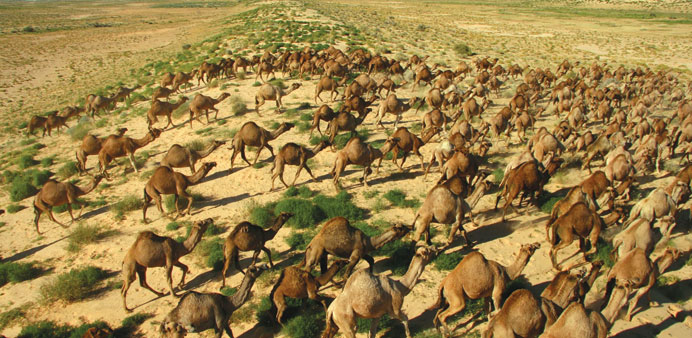
This Ninti One handout photo taken in 2010 and received yesterday shows a large mob of camels in the Simpson Desert in Central Australia. Australia’s