


Reuters/Cairo
Hundreds of Egyptians gathered in Cairo’s Tahrir Square yesterday to commemorate the deaths of protesters killed two years ago and call for reforms, with many in the crowd calling for the power of the security forces to be curbed.
Supporters of army chief General Abdel Fatah al-Sisi, who promised stability and free elections when he overthrew elected Islamist president Mohamed Mursi in July, also showed up at Tahrir but were chased away by activists.
The army and the police have been lionised in the press and public since the fall of Mursi and his Muslim Brotherhood backers. Many Egyptians believe Sisi would become president if he runs for office.
But the protesters who gathered in Tahrir said the goals of the popular uprising which toppled autocrat Hosni Mubarak in 2011 had not been met and accused the security forces of acting mostly with impunity in the intervening two years.
“Down with the military regime,” the protesters chanted. “We want to protect our country from oppression.”
They criticised the bloody crushing of a pro-Mursi protest camp at Rabaa al-Adawiya in Cairo in August.
At one point, security forces fired teargas to try to disperse the crowd, but they were unsuccessful and finally melted away, apparently hoping to avoid clashes on a sensitive anniversary.
“I am not for the Brotherhood. But I sympathise with them because of what happened at Rabaa. It was a horrible massacre. There was more freedom under Mursi,” said Salma, a high school student who joined the demonstrations.
“The interior ministry is stronger than it was before,” she said, referring to the ministry which oversees the police.
The overthrow of Mubarak raised hopes among Egyptians that they would enjoy more political freedoms after three decades of iron-fisted rule.
But Egypt has stumbled through its transition. During his troubled year in office, Mursi alienated many Egyptians who accused him of trying to give himself sweeping powers and mismanaging the economy.
At the same time, the army takeover has raised questions about Egypt’s commitment to democracy.
“We have a president in name but we know Sisi is really in charge. We want freedom and democracy and the military don’t know those things,” said university student Marina Samir, 19.
Security forces have killed hundreds of Muslim Brotherhood members since Mursi was toppled, drawing condemnation from human rights groups. Thousands have been arrested, including top leaders. The group has been outlawed.
Hadiga al-Hanawy, among about 1,000 demonstrators moving through central Cairo towards the Tahrir area late yesterday, said: “We do not want Sisi as president. He is a strong defence minister and he should remain in that position. We want a civilian leader.”
Critics of the government say it is returning Egypt to the repression of the Mubarak era, which it denies.
The protesters yesterday were commemorating the events of November 2011, when demonstrations against the military council ruling the country at the time turned into running street battles in which police used live ammunition, killing 42.
A banner featured people the protesters felt had “betrayed” the revolution - Mubarak loyalists, the military council which led Egypt for 16 months after his fall and the Muslim Brotherhood.
Some activists wrote on social media about their desire to overthrow what they call the new “military junta”, a reference to the interim government installed by the army after Mursi’s removal.
On nearby Mohamed Mahmoud Street, the scene of the 2011 clashes, a wall that street artists used to express revolutionary ideas was covered in coats of paint resembling the pattern of military fatigues.
On Facebook, artists explained that the wall “got a new coat of paint last night. Like the military trying to hide the truth, all the graffiti is now hidden under pink camouflage.”
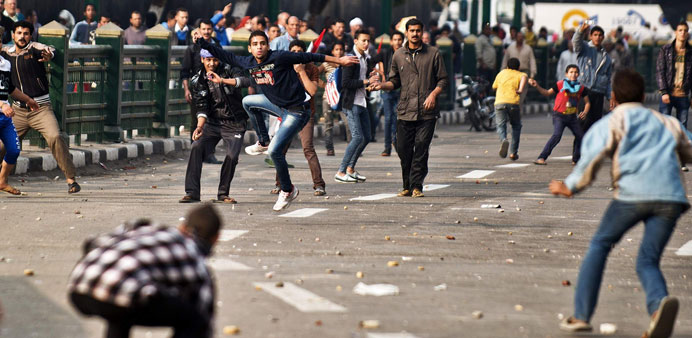
Protesters and supporters of the military regime (background) throw stones at each other during clashes yesterday in Cairo.