


Doha Bank has opened its first representative office in Sharjah, following regulatory approval from the UAE Central Bank.
The Qatari bank already has full-scale branches in Dubai and Abu Dhabi.
Doha Bank Chief Executive Officer Dr R Seethraman said: “The UAE is one of the biggest collective trade destinations in the region through Abu Dhabi, Dubai and Sharjah. Because of a consistently improving global financial marketplace, customers and corporate clients are seeking more support from financial partners to enable them to participate in local economic development. For us, this means developing more tailored solutions for SMEs, providing intelligent analysis and research, and reassessing our banking models to cater to the needs of customers.
“The trends in Sharjah are slightly different from the rest of the UAE and even without as much hydrocarbon-based trade, the emirate has remained sustainable, led by a business friendly approach to commercial licensing which has built a very strong import and re-export platform, particularly in the industrial sector and including trade with other Emirates. The promotion of tourism and steady growth in tourist numbers has also been a strong economic
factor.”
Sharjah’s economic policy makes it attractive for industrial and commercial companies. In the last few years, the emirate has seen extremely positive results. Today, with a lion’s share - of 48% of the UAE’s total industrial revenue, Sharjah ranks first among the seven emirates in this sector.
Sharjah is also seen as a cost-effective option, with official data suggesting industrial investment costs 35% lower than in other emirates. Port Khalid, Hamriyah Port and Port Khor Fakkan have contributed significantly to the growth of
Sharjah’s economy.
The two free zones, Hamriyah Free Zone Authority and Sharjah Airport International Free Zone have bolstered investment and trade by offering company’s incentives.”
Giving insights on current trends in northern emirates, Seethraman: “Northern emirates witness significant economic development in recent times. Fujairah became strategically more important to the UAE in 2012 when the emirate opened an oil pipeline. Major project developments in Fujairah include expansion of the port, bunkering facilities and an airport, and development of the arid coastline. Marine, oil and gas and gold business are areas which can be looked for trade finance business in Fujairah. Dubai’s non-oil trade rose 16% percent from a year earlier in the first half of 2013. Fujairah can benefit by serving some of that business.
“Ras Al-Khaimah supports trade activities with very strong logistical infrastructure. Tourism has grown very quickly over the last few years in Ras Al-Khaimah. Companies can take advantage of UAE’s and Ras Al-Khaimah’s position on the new Silk Road. Tourism and trade are the areas of focus by the Umm al quwain government in recent years. Ajman Free Zone is well placed to serve the eastern and western markets. Ajman’s proximity to Sharjah and Dubai provides easy accessibility to the international airports
and ports.”
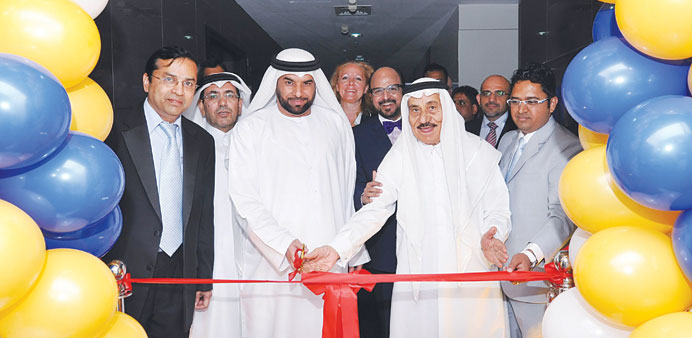
Doha Bank vice-chairman Ahmed Abdul Rahman Yousuf Obaidan Fakhroo, second right, and Seetharaman among other dignitaries during the opening of the ban