


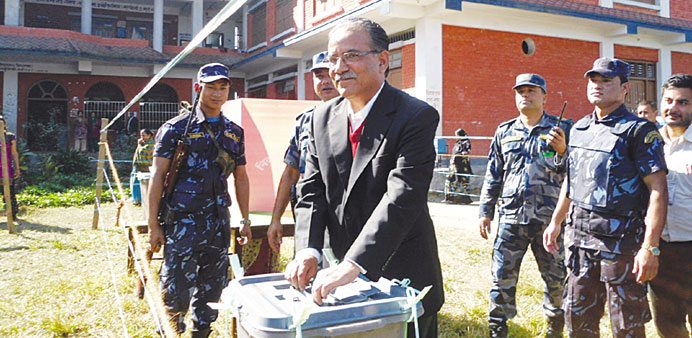
Nepal’s Maoist party chairman Pushpa Kamal Dahal Prachanda casting his vote in the southern district of Chitwan yesterday.
Millions of Nepalis defied low expectations and threats of violence to vote yesterday in elections seen as crucial in stabilising the country and breaking its political deadlock seven years after a civil war ended.
A bombing in the capital Kathmandu early yesterday injured three children, but the explosion and a campaign of intimidation by a hardline Maoist splinter group did not prevent turnout reaching at least 65%.
At this level it would be higher than the 63.29% turnout recorded during the country’s first post-war elections in 2008, when it voted for a constituent assembly tasked with writing a new constitution.
Since then, five prime ministers have served brief terms, the country had no leader for long periods, and the 601-member assembly collapsed in May 2012 after failing to complete the peace process.
“My vote is for the future of youngsters and the new generations,” 101-year-old voter Lal Bahadur Rai said in a phone interview from a polling station in northeasternSankhuwasabha district.
Many analysts had judged the national mood to be downbeat as threats of violence and intimidation added to years of political infighting and drift.
Hopes of political unity to complete the peace process were dashed when a 33-party alliance, led by the splinter Communist Party of Nepal-Maoist (CPN-M), announced that it would boycott polls and intimidate voters.
In recent days, protesters have torched vehicles and hurled explosives at traffic, leading to more than 340 arrests and one death.
In Kathmandu, a crude bomb explosion planted in a middle-class residential neighbourhood was the only major violent incident amid a security crackdown which saw 50,000 soldiers and 140,000 police deployed.
“I was passing by when I saw three children lying on the ground, crying for help,” 28-year-old eyewitness Saroj Maharjan said at the scene.
“One of the children, whose face was covered in blood, fainted in my arms as I carried him to a nearby hospital,” he added.
The Maoist party, led by P Kamal Dahal Prachanda, swept the first constituent assembly polls in 2008, two years after signing a peace deal.
Prachanda, the former rebel leader whose lavish lifestyle has alienated many core supporters, voted in the southern district of Chitwan in the morning wearing a shirt and Western-style black suit.
Organising the election has been a logistical headache in a country home to eight of the world’s 14 highest mountains, requiring helicopters, horses and porters to deliver ballot boxes to remote areas.
“Some of the voters have trekked for five hours to reach here. They include elderly as well as young first-time voters,” Gitachari Acharya, an official at the nearest polling station to Mount Everest, said.
Nepal’s political deadlock in the last five years has had a severe impact on the economy, with annual GDP growth tumbling from 6.1% in 2008 to 4.6% last year, World Bank figures show.
With 39% of the country aged between 16 and 40, according to government data, jobs are a major issue for young first-time voters like Urmila Maharjan.
The 22-year-old Kathmandu-based student said she hoped “the new assembly will address issues like unemployment”.
Voters at one central Kathmandu polling station applauded and chanted, “victory to Nepal” as election officials packed up ballot boxes.
More than 100 parties, including three major ones — the Unified Marxist-Leninist, the Nepali Congress and the Maoists — are fielding candidates for the constituent assembly, which will also serve as a parliament.
The Maoist splinter group had said the vote could not be held under the interim administration headed by the chief justice of the Supreme Court and wanted polls to be postponed until a cross-party government was put in place.
Woman gives birth at polling centre
A woman gave birth to a healthy baby at a polling centre in Nepal yesterday as the country voted to elect its second Constituent Assembly, a media report said.
The woman, Hira Bista, a resident of Achcham district, delivered the baby soon after casting her vote at the Babla VDC-6 polling centre, Nepalnews.com reported.
Hira Bista had come to cast her vote lying on a stretcher at 8am. Soon after balloting, she experienced labour pains and gave birth.