


AFP/Tripoli
Libya’s deputy intelligence chief was abducted yesterday in Tripoli, a security official said, as the capital observed a three-day strike after deadly unrest triggered fears of civil war.
The violence was the deadliest in the city since the 2011 uprising and erupted on Friday when demonstrators took to the streets to protest against an unruly militia of ex-rebels who helped to topple dictator Muammar Gaddafi.
At least 43 people were killed and more than 450 wounded in violence that raged overnight and into Saturday, the health ministry said.
Tripoli city council late Saturday announced a three-day strike across the private and public sector to mourn the dead, also urging citizens to exercise “calm and restraint”.
But people exasperated by the government’s failure to rein in militias set fires and put up barricades on major roads, blocking them to traffic amid calls for civil disobedience.
As reports emerged that deputy intelligence chief Mustafa Nuh had been kidnapped, dozens of protesters broke into the General National Congress (GNC), Libya’s parliament and top political authority.
“We demand brave decisions from the Congress to put an end to the presence of militias in the capital,” one demonstrator said.
A security official said that Nuh was abducted yesterday by unknown individuals shortly after returning to Tripoli from a visit abroad.
A source at the intelligence services said Nuh had “disappeared”, but did not elaborate.
In October, gunmen briefly abducted Prime Minister Ali Zeidan in the capital, and a few days later a security official claimed responsibility for the operation and said he was “proud” of it.
Libya’s embattled government has struggled to rein in former rebel brigades that helped end Gaddafi’s 40-year dictatorship but have since grown into increasingly menacing militias.
Analysts have warned of further unrest unless the militias are disarmed.
Hanan Salah, a researcher with the US-based Human Rights Watch, said the latest clashes “showcase the extent of the reckless acts of unaccountable militias these past two years, and the government’s lack of ability to control them”.
“The priority for the authorities now is to get a grip on these renegade groups, disarm and demobilise them and hold them accountable for crimes committed,” Salah said.
“Otherwise there is a real risk for an escalation in violence.”
The brigade at the heart of the latest violence saw some of the heaviest fighting during the uprising against Gaddafi, when Misrata, a coastal city 200km east of Tripoli, was besieged by regime forces.
On Friday, demonstrators marched on the group’s Tripoli headquarters to demand that they leave and return to Misrata when shots were fired from inside the base.
Several protesters were killed and rival militias then swept in, with gunfire and explosions echoing across the city.
The fighting came a week after clashes between militias in Tripoli killed two people.
Premier Zeidan called for calm after the latest round of fighting and said “the coming hours and days will be decisive for the history of Libya”.
His government has struggled to convince militias to disarm or join the national security forces, as many of the groups are more loyal to their commanders, towns or tribes than to Tripoli.
Tension remained high in Tripoli where banks and most schools, universities and shops were closed except for some grocers and cafes.
“Unfortunately, many schools are closed today,” education ministry spokesman Samir Jarnez told AFP.
Nato-backed rebels overthrew and killed Gaddafi in 2011 and since then have banded into militias and carved their own fiefdoms in a country awash with weapons looted from the slain dictator’s arsenal.
The United States, whose ambassador was killed in an attack on the American consulate in Benghazi last year, has condemned the Tripoli violence and urged restraint.
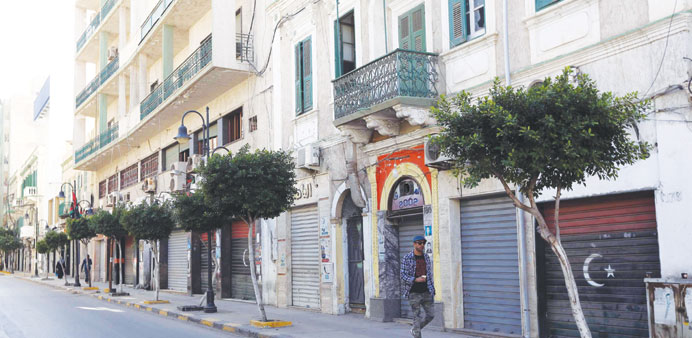
A man walks past closed shops in Tripoli yesterday.