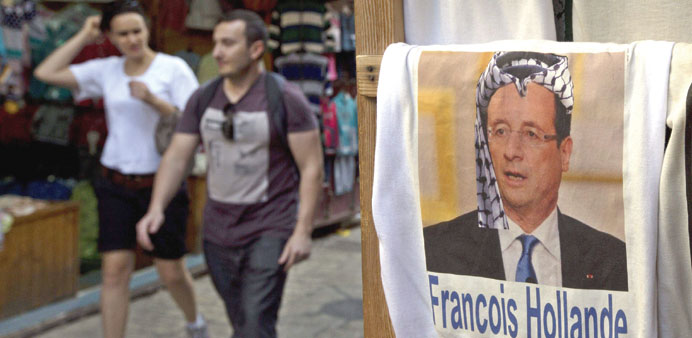
People walk past a souvenir shop in Jerusalem’s Old City displaying a T-shirt picturing French President Francois Hollande wearing the traditional Arab keffiyeh head scarf yesterday.
AFP/Jerusalem
French President Francois Hollande is set for a red carpet welcome when he visits Israel and the Palestinian territories this weekend amid renewed efforts by the West to curb Iran’s contested nuclear programme.
Israeli Prime Minister Benjamin Netanyahu has said he is “impatient” to meet Hollande, who arrives today in the midst of negotiations to resolve the impasse over the nuclear issue.
“The French president is a close friend of the state of Israel and I look forward to hosting him... at a time when the major powers, including France, are discussing ways to halt the Iranian nuclear programme,” Netanyahu said.
In an interview with Le Figaro newspaper published on Saturday Netanyahu added: “We hope France will not yield”.
“For us, the United States remains an important ally, the most important ally. But our relationship with France is also very special,” he said.
“On the Iran issue, our countries have defended common stances for years, regardless of the party in power, and we are maintaining this vital partnership with President Hollande,” he said.
“We welcome his coherent and resolute stance on the Iranian issue.”
Israel and world powers suspect the Islamic Republic’s programme of uranium enrichment to be a covert drive to acquire a nuclear weapons capability, an allegation vehemently denied by Tehran.
French Foreign Minister Laurent Fabius, a major participant at gruelling talks on finding a deal to the Iranian nuclear impasse which ended in deadlock last weekend, is accompanying Hollande.
Western diplomatic sources say the two sides were close to a deal in Geneva but Iran backed off because it was unhappy with some of the wording in the text.
Some reports say this was due to reservations expressed by France which were subsequently adopted by other powers. The talks will resume in Geneva next week.
The P5+1 negotiating with Tehran is made up of the five permanent members of the UN Security Council—Britain, China, France, Russia and the United States—plus Germany.
Hollande’s office said although France’s “tactical approach” on Iran was different from Israel’s bellicose stance, both wanted an end to Tehran’s nuclear military drive.
A highly placed French source said that Paris’s objective was “not to please this country or that but based on a clear principle, civilian nuclear energy, yes; atomic bomb, no”.
Apart from Iran, the other main issues during the trip are the stalled Middle East peace process and stronger trade ties with Israel.
Hollande, whose delegation includes business leaders including the heads of firms such as Alstom, Arianespace and Vinci, wants to boost the level of bilateral trade, which stood at 2.3bn euros ($3bn) in 2011.
“Israel is a rich country and at the cutting edge of innovation but our trade is mediocre,” said a French official.