


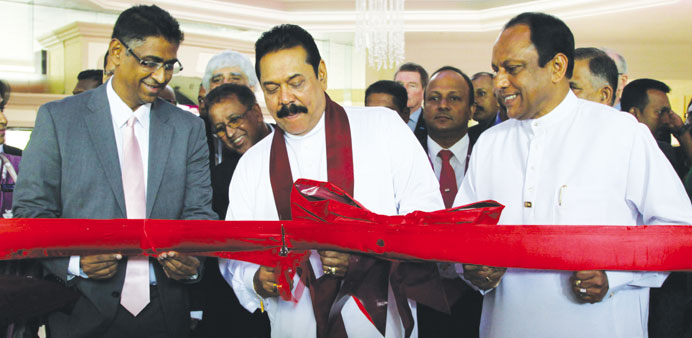
Sri Lankan President Mahinda Rajapakse, centre, flanked by Minister of Investment Promotion Lakshman Yapa Abeywardena, right, and Deputy Minister of Investment Promotion Faizer Musthapha cutting the ribbon to declare open a Board of Investments stall at the Commonwealth Business Forum held at Hotel Cinnamon Grand in Colombo yesterday.
Allegations that ethnic minority Tamils in Sri Lanka are being subjected to abuses four years after the army won a civil war against separatist rebels have put pressure on the government as it prepares to host a Commonwealth summit.
Canadian Prime Minister Stephen Harper said weeks ago he was skipping the meeting because of concern about deterioration in human rights and his Indian counterpart, Manmohan Singh, has also pulled out.
British Prime Minister David Cameron says he will ask “serious questions” and demand an investigation into allegations of war crimes.
The Commonwealth Heads of Government Meeting (CHOGM) opens in Colombo on Friday.
Separatist rebels from the minority Tamil community battled government forces for 26 years, beginning in 1983, until they were finally crushed in a big army offensive in 2009.
A UN panel concluded that thousands of civilians, most of them Tamils, died in the final offensive. It concluded that atrocities were committed by both sides, but that most of the victims were killed by army shelling.
The government says Sri Lanka is on the path to reconciliation, helped by fast economic growth.
But complaints of rights abuses, such as those recently aired in a forum organised by Human Rights Watch, have raised concern about the peace.
Two ethnic Tamils, speaking from Britain where they are seeking asylum, told reporters last month they had been detained by security forces, repeatedly raped and beaten in what rights groups say is a pattern of intimidation.
One of them said he was stopped on the street and pushed into a van last year. During five days in detention, a group of men beat him with a plastic pipe and repeatedly inserted a metal rod into his rectum, he said.
“I had no choice, I couldn’t stand the torture so I admitted to the allegation I was in the LTTE,” the man said, referring to the now disbanded Liberation Tigers of Tamil Elam (LTTE) rebels.
A 30-year-old woman said in the conference call she was pushed into a van last August and raped in detention for 19 days by different men.
“While in detention I could hear other women screaming in other rooms,” she said. Both said they were released after friends and relatives paid a ransom.
Human Rights Watch investigator Charu Lata Hogg said evidence of rape had been detected by doctors, but rarely included in asylum applications because of stigma. She said she had documented 75 cases.
Sri Lankan President Mahinda Rajapakse’s government dismisses such accusations which it says amount to a campaign by rebel sympathisers to tarnish its image and detract from the November 15-17 Commonwealth meeting.
The 53-member Commonwealth, made up mostly of former British colonies, holds a head of government meeting every two years. It has little decision-making power, but has some influence in mediating disputes between members.
“Sri Lanka has zero tolerance on torture,” said military spokesman Ruwan Wanigasooriya.
“If they were really victims, they should have gone to a police station and made a complaint,” he said of those who complained of abuse, adding that 15 cases of torture were before courts.
The government also rejects the findings of the UN panel of heavy civilian casualties at the end of the war, as well as two resolutions by the UN Human Rights Commission calling on authorities to investigate alleged war crimes.
Former war zones still have a heavy military presence that leads to abuse, said M A Sumanthiran, a human rights lawyer and member of parliament for the Tamil National Alliance (TNA) opposition party, the former political proxy of the defeated rebels.
He said this week that public opinion in Sri Lanka, with ethnic Sinhalese making up the majority of the population, was hostile to rehabilitated fighters. Rape victims tended to come forward only if they left the country.
“It is widespread, that’s not to say there is a policy, but there is at least tolerance of such things happening,” he said.
After visiting the north last week, Australian Greens Senator Lee Rhiannon alleged that soldiers there used Tamil women as “comfort women”, a World War II reference to women in occupied areas forced into prostitution by the Japanese army.
The TNA swept the region’s first post-war election in September, showing that the cause of autonomy remains strong, though violence is seen as unlikely to resume.
Tamils in Jaffna protest land grab
Ethnic Tamils staged a rare protest in northern Sri Lanka yesterday against the military’s refusal to hand back land after the war, as Colombo prepared to host this week’s Commonwealth summit.
Several hundred Tamils demonstrated in the former northern war zone of Jaffna, 400km (250 miles) north of Colombo, even though organisers received telephone death threats beforehand against the move, a local Tamil politician said.
Sugirthan Somasundaram said the heads of two slaughtered cows were also thrown into his home and that of another organiser on Sunday, along with a written warning not to go ahead with the protest.
The Tamils are demanding the military dismantle its “high security zone” in Jaffna which would allow them to return to their homes inside the specially designated area.
The Tamils held a peaceful protest on the edge of the zone, which they said had become unnecessary since the end of the conflict four years ago with the defeat of Tamil separatist rebels.
“We still have 30,000 people who are not in their original homes because the military is occupying their lands,” Somasundaram told by telephone. “We want our land back.”
Protests, especially by minority Tamils, are rare in Sri Lanka under President Mahinda Rajapakse’s government.
Somasundaram said the Tamils would continue the protest throughout the Commonwealth Heads of Government Meeting (CHOGM) starting on Friday. The leaders of Canada and India have boycotted the summit over Colombo’s human rights record.
British Prime Minister David Cameron has said he will attend CHOGM but pledged to push for an international investigation into allegations of war crimes by troops against civilians during the war that ended in 2009.
Cameron is due to tour the Jaffna peninsula during CHOGM, which would make him the first foreign head of state to visit the capital of the war-battered north since Sri Lanka was granted independence from Britain in 1948.
Suresh Premachandran, a Tamil lawmaker from Jaffna, said Cameron’s scheduled visit could send a strong message to the government to end alleged rights abuses against Tamils, who are a minority in the Sinhalese-majority island.
The international community including neighbouring India has pressed Sri Lankan authorities to demilitarise the Jaffna peninsula, but Colombo has refused to pull out troops.
Security forces have maintained they need to secure strategic bases in the area and say they are occupying the minimum amount of land needed to maintain security.