


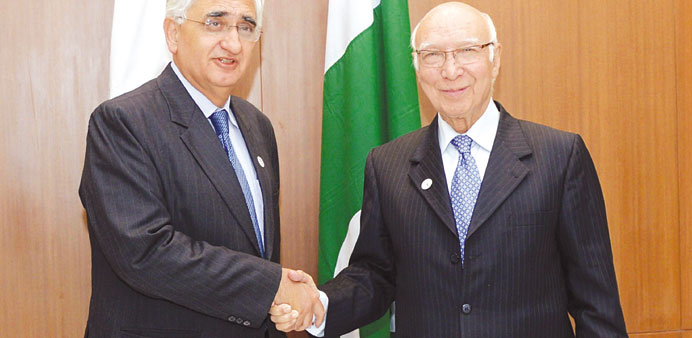
External Affairs Minister Salman Khurshid shakes hands with Sartaj Aziz during a meeting in Gurgaon yesterday.
Taking a stern view of “unfortunately counterproductive” moves by Pakistan, including its officials meeting Kashmiri separatists, India yesterday said if Islamabad was serious about holding a meaningful dialogue it would have to respect “India’s sentiments, point of view and sensitivities.”
Addressing a press conference here on the sidelines of the Asia-Europe Meeting (ASEM), External Affairs Minister Salman Khurshid also said that India had “done a great deal” to build public opinion in favour of dialogue with Pakistan.
He was referring to the meeting between Prime Minister Manmohan Singh and Pakistan Prime Minister Nawaz Sharif in New York on September 29. India had decided to go ahead with the dialogue despite an outcry at home over the killing of five Indian soldiers on August 6 on the Line of Control by Pakistani soldiers.
Khurshid held a half-hour-long bilateral meeting with Pakistan Prime Minister Nawaz Sharif’s Adviser on Foreign Affairs and National Security Sartaj Aziz. Aziz later also met National Security Adviser Shivshankar Menon.
During the meeting, Khurshid raised the issue of Aziz meeting separatist Hurriyat leaders, including Jammu and Kashmir Liberation Front chief Yasin Malik, and leaders of both moderate and hardline factions - Mirwaiz Umar Farooq and Syed Ali Shah Geelani. The three had been invited by the Pakistan High Commission to meet Aziz on Sunday.
Khurshid said the dialogue with Pakistan is “not a dialogue that happens in isolation, this is a dialogue that is contextual and needs public support, and we think we have done a great deal to help the Pakistan government get the public support that it needs to be able to have a fair and transparent dialogue with India.”
He said the meetings with Hurriyat leaders were “not encouraging” moves and are “counterproductive.”
“I think for a meaningful dialogue to take place conducive conditions have to be created, and it will have to be done by both sides, it cannot be only on one side.”
“Some of these events have been somewhat counterproductive unfortunately,” Khurshid added.
During the Khurshid-Aziz meeting, both sides agreed to push for a meeting of their Directors General of Military Operations (DGMOs) at an early date, external affairs ministry spokesman Syed Akbaruddin told reporters later.
The meeting took off from the last bilateral engagement between the two sides - the September 29 meeting in New York between Singh and Sharif “and the agreement on the precondition for movement forward - of peace and tranquillity on the Line of Control,” the spokesman said.
At the New York meeting, both sides had agreed that the DGMOs should meet to ensure peace and tranquility on the border. But there has been no meeting so far. In fact, India saw a sharp spike in violations of the 2003 ceasefire following the New York meeting and also a marked increase in infiltration attempts.
“Both sides said that it is important that the DGMOs should meet… the DGMOs are in touch and we hope they will take the process forward,” Akbaruddin said.
“Our understanding is that the 2003 ceasefire should hold. Peace and tranquility on the LoC is one of the most important CBMs, both for India and for Pakistan, and if that holds and the DGMOs concur with that, we will proceed further on that,” Akbaruddin said.
Khurshid and Aziz also discussed the trial in the 26/11 Mumbai attacks case. India has provided to the Pakistan judicial commission all the evidence that was required of the involvement of Pakistani elements in the carnage, including transcripts.
“This was acknowledged by the Pakistanis and now they are proceeding with the trial,” said Akbaruddin.
The main opposition Bharatiya Janata Party (BJP) had strongly protested against Aziz’s meeting with the Hurriyat leaders and criticised the government for allowing it to take place.
According to the Pakistan High Commission, the meeting with Khurshid was “held in a cordial atmosphere. Both sides reviewed bilateral relations in a constructive and forward looking manner.”