


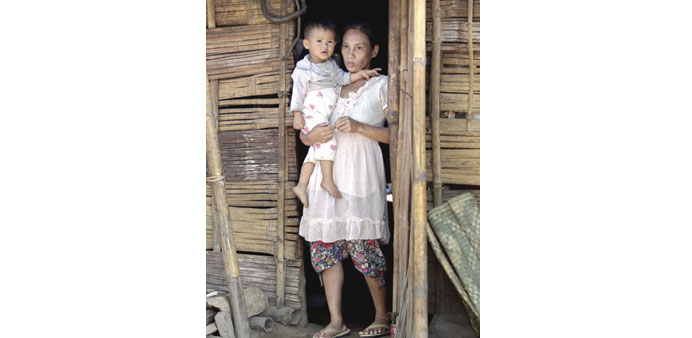
A photo made available yesterday shows a Kachin woman holding her child as she stands at the entrance of the Je Yang Camp in Laiza, Kachin State.
DPA/Je Yang Camp, Myanmar
A 17-year-old Kachin girl was locked in a room for three weeks while a Chinese couple tried to sell her as a “temporary wife” to the highest bidder.
“I cried all the time, but they just told me I had to marry the man they chose for me and that I would never go back home again,” said Seng Pan, recently returned to Je Yang refugee camp from her ordeal across the border in Yunnan, China.
“Some men offered 20,000 Chinese yuan ($3,200) to 30,000 yuan for me, but the couple wanted to get at least 50,000 yuan,” she said.
Seng Pan was lucky her captors were so greedy. One day when the couple left the house she managed to break out of her room and call authorities at Je Yang to inform them of her plight.
Camp officials alerted Chinese police. “The police sent an undercover agent to pretend he wanted to buy me, and then arrested the couple for human trafficking,” she said. “They sent me back to the camp.”
Since June 2011, when fighting broke out between the Myanmar military and the rebel Kachin Independence Army (KIA), an estimated 140,000 civilians in the northern state have been displaced and forced to live in refugee camps, many of them situated along the Chinese border.
Many women in the camps have been forced to seek work in China to support their families, making them vulnerable to abuses.
“Human trafficking is common in the Kachin state, especially in refugee camps near the border,” said Khon Ja, a woman leader from the non-governmental Kachin Peace Network.
After a 17-year ceasefire with the government fell apart more than two years ago, the Kachin state has been divided into areas under state control and those under the control of the ethnic rebels.
According to government figures, there are nearly 43,000 displaced people living in 106 camps under state control, and more than 80,000 living in KIA-controlled camps.
Rebel spokesman Colonel La Nan claimed there are now more than 100,000 displaced civilians in the camps under their control.
The military reportedly launched artillery attacks last month on Mansi village in Bamaw township.
“That recent attack brought an additional 20,000 refugees into KIA areas,” Khon Ja said.
Rebel-controlled camps have less access to international aid, food and medical supplies than government-controlled camps, a source of constant complaints from the UN and relief workers.
Food shortages and combat have forced many Kachin women into the sex trade in China, some voluntarily.
“You can’t blame them,” Khon Ja said. “If you were them, how would you choose? Die in conflicts or stay in China as temporary wife?”
Others are tricked into marrying Chinese men against their will.
“Since the fighting resumed in 2011, more than 200 such cases have been reported in refugee camps,” said Zau Raw, spokesman for the Kachin Refugee Relief and Recovery group.
The real number is thought to be much higher.
“Nobody knows exactly how many such cases there have been because the situation in the camps was very chaotic in the early days of the fighting,” he said.
Rebel groups in the state have been fighting for autonomy for the past five decades, except for a ceasefire period between 1994-2011.
During that lull in fighting, the Kachin state fell victim to massive deforestation and exploitation of the region’s fabled jade mines by the military government and Chinese companies, turning the Kachin population against the ceasefire.
There are hopes that the KIA and other ethnic minority insurgencies will soon sign a nationwide ceasefire with the government, after negotiations kicked off earlier this month.
The ceasefire process would need to include political talks on allowing some form of autonomy in the Kachin state and other traditional territories of the main ethnic minority groups.
A ceasefire would allow the thousands of Kachin refugees to return to their homes.
“We all want to go back home,” said Seng Pan. “We pray every day for the chance to return to our homes.”