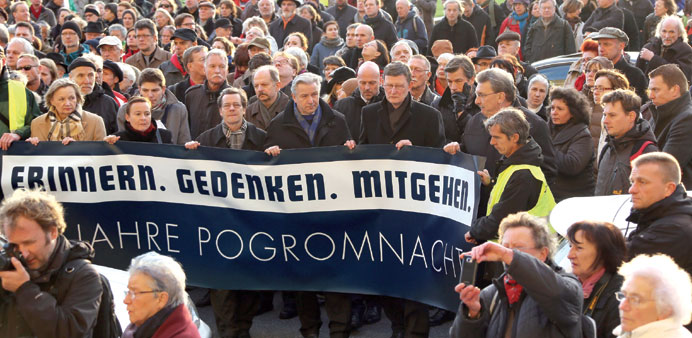
People march behind a banner reading ‘Remembering. Commemoration. March along. 75 years Pogrom Night’ during a silent march through Berlin.
By Georgina Prodhan, Reuters/Vienna
Lilly Drukker was 11 years old when two uniformed Nazis barged into her family’s Vienna apartment in November 1938 to take her father away to the Dachau concentration camp.
It was the day after “Kristallnacht”, a state-sponsored spree of looting and destruction of Jewish property across Germany and Austria that marked a turning point in Nazi policy as Adolf Hitler unleashed the general population against the Jews.
“The two Nazis looked us over and after a while – this was November 10th, it was cold out – they told my father to get his hat and coat and said: ‘You’re coming with us’,” Drukker told Reuters on a visit to Vienna from her home in Philadelphia.
“We saw from the window how they got out of the building and pushed my father into the back seat of the car that was parked in front and drove away,” she said. “We didn’t know where they took him or what was happening. There were rumours.”
Scores of Jews were killed in the Kristallnacht (Night of Broken Glass), and thousands of Jewish businesses and synagogues were ransacked as law-enforcement organs looked on, signalling the start of the Holocaust.
The 75th anniversary of the infamous pogrom is being marked with ceremonies in Berlin, Vienna and elsewhere this weekend.
Events such as the coming to light last weekend of a huge hidden trove of Nazi-looted art show that many questions and claims for restitution arising from the Holocaust and World War II remain unresolved.
But the nature of remembrance is changing as governments absorb the work once done by activists, and the focus switches from bringing the perpetrators to justice to educating a generation growing up as the events fade from living memory.
“Time goes by, it’s clear. It’s not like it was a few years ago. You have to consider that the survivors are dying out,” said Beate Klarsfeld, a driving force in hunting down and bringing to justice war criminals including Klaus Barbie.
Klarsfeld, 78, now spends much of her time on educational work, and was invited to Vienna to speak at the opening of a Holocaust exhibition aimed at school classes.
The opening was presided over by a government minister and attended by dignitaries including the head of Austria’s Jewish community. But the exhibit itself was buried in the cellar of a Jewish theatre in the Leopoldstadt district outside the city centre.
“I think it’s important, but it’s a shame it’s in the basement,” said Ari Rath, who fled Vienna as a boy in 1938 and spent many years as editor of the Jerusalem Post in Israel before becoming an Austrian citizen again in 2007.
The situation underlines the ambivalent attitudes to remembrance of Nazi atrocities, especially in Austria, which largely welcomed Hitler’s annexation in 1938 but spent decades after the war considering itself the dictator’s first victim.
While governments carry out their tasks of remembrance in a dutiful and sometimes heartfelt way, Jewish groups warn against complacency among the general population, citing resurgent anti-Semitism in Europe and concerns about Islamophobia.
In a report published on Friday by the European Union Agency for Fundamental Rights (FRA), over half of 5,847 Jews surveyed in eight EU countries said they had heard or seen someone claim that the Holocaust was a myth or had been exaggerated (see sidebar).
New York Rabbi Marc Schneier, himself the descendant of Viennese Jews, has spent years working to build bridges with the Muslim community and he urged solidarity with other minorities during a visit to Vienna this week.
“Had there been these alliances 75 years ago, it would have been a very, very different story,” he told Reuters ahead of a Kristallnacht remembrance event at the Austrian parliament. “It’s about fighting for the other.”
Drukker’s father, Josef Geringer, a violinist with the Vienna Philharmonic until he was pushed out in early 1938, was released from Dachau thanks to the intervention of an influential non-Jewish friend from the orchestra.
Drukker escaped to London on a British children’s transport and eventually joined her parents in the US.
Anti-Semitism on rise in Europe: survey
Anti-Semitism has worsened in Europe in the past few years with abuse increasingly widespread on the Internet, a survey by the European Fundamental Rights Agency (FRA) showed.
The study found that 66% of European Jews considered anti-Semitism “a fairly big or very big” problem in their country.
A total of 76% said it had worsened in the past five years, with abuse especially prevalent on the Internet, where social media and file-sharing websites allowed anti-Semitism to travel around even faster than before.
“I feel that since going on Facebook, I have experienced more anti-Semitic comments in a few years than I ever have done throughout my whole life,” one British respondent was quoted as saying. “This is very dispiriting.”
FRA’s report was based on an online survey in eight EU countries – Belgium, Britain, France, Germany, Hungary, Italy, Latvia and Sweden – which are home to 90% of the bloc’s Jewish population.
Of these, France, Belgium and Hungary reported the highest rates of anti-Semitism in the media and political life, as well vandalism and open hostility in the street.
Hungary, especially, has come under fire in the past year over repeated anti-Semitic incidents.
“Anti-semitism is a disturbing example of how prejudice can persist through the centuries, and it has no place in our society today,” FRA director Morten Kjaerum said in the report.
“It is particularly distressing to see that the Internet, which should be a tool for communication and dialogue, is being used as an instrument of anti-Semitic harassment,” he added.
According to FRA’s study, 21% of people said they had experienced verbal or physical abuse in the last year for being Jewish.
Close to half meanwhile feared public insults or harassment in the next 12 months, with as many as 23% saying they avoided Jewish sites or celebrations as they might not be safe there.
“We are asked to disperse quickly at the exit of the synagogues, community centres ... a special security service is required, which is, to my knowledge, not necessary at the exit of the churches or chaplaincies ... nor for temples and mosques,” one Frenchwoman was quoted in the survey.
Such constraints on day-to-day living and a feeling of insecurity had pushed almost a third of respondents to consider emigrating, FRA found.
In total, some 5,850 people who identified themselves as Jewish responded to the survey between September and October 2012.