


|
The opposition Bangladesh Nationalist Party (BNP) yesterday announced another 84-hour nationwide strike, starting today, after police arrested BNP leaders, triggering violent protests across the country. |
The aim of the strike is to force the ruling Awami League to hold elections, due by January at the latest, under a non-partisan caretaker government.
Prime Minister Sheikh Hasina has repeatedly refused. Instead, she has offered the formation of an all-party government to see through the elections with her staying in charge.
The deadlock, nothing new in Bangladesh, has led to the deaths of at least 18 people during several violent protests and shutdowns.
The mounting tension is a fresh threat to Bangladesh’s $22bn garment export industry, the economic lifeblood of the impoverished country of 160mn, which has already been rocked by a string of deadly
factory accidents this year.
“To protest the arrests of our senior leaders, we were forced to extend the shutdown by another 12 hours to 84 hours,” said Ruhul Kabir Rizvi, joint
secretary general of the BNP.
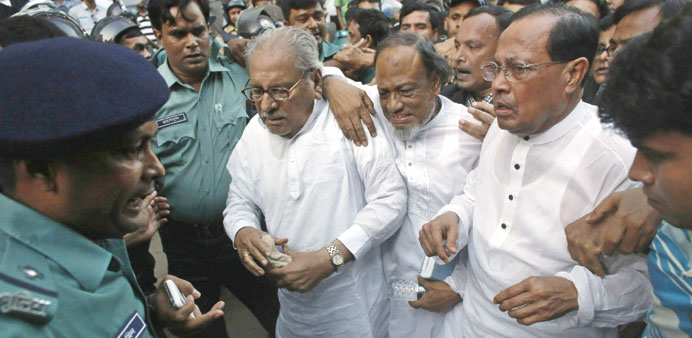
Police early yesterday arrested at least five senior leaders of the BNP including opposition leader Begum Khaleda Zia’s adviser and a special assistant. Police also raided the homes of other leaders.
The arrested include Moudud Ahmed, M K Anwar and Rafiqul Islam, who are members of the standing committee of the BNP in connection with anti-
government protests last week.
BNP chairperson Khaleda Zia’s adviser Abdul Awal Mintoo, her special assistant Shamsur Rahman Shimul Biswas and Anwar Hossain Tipu, a leader of BNP’s student wing, were also arrested during a surprise crackdown on the opposition which continued yesterday.
“They were arrested on specific allegations as they were instigating attacks on people and their properties,” said Shamsul Haqu Tuku, junior minister for home affairs.
Foreign minister Dipu Moni told reporters the government “was forced to arrest” the BNP leaders after they “instigated” violence by calling the new strike.
After the arrests, pro-BNP activists went on the rampage, torching vehicles and blocking the Dhaka-Chittagong highway.
The BNP has branded the current government “illegal”, and says that under the law a neutral caretaker government must be set up before the elections.
Hasina has scrapped the caretaker system and instead proposed an all-party interim government led by herself to oversee the polls.
Bangladesh has also been hit by a wave of violent demonstrations over war crimes convictions dating back to the war of independence from Pakistan in 1971, with more than 100 people killed in protests and
counter-protests this year.
Earlier, the alliance, which includes the key Bangladesh Jamaat-e-Islami party, observed a 60-hour countrywide strike from October 27.
Since June 2011, when parliament abolished the non-party caretaker government system after an apex court verdict declared the 15-year-old constitutional provision illegal, the BNP-led alliance has been holding mass protests demanding the reinstatement of the
provision.
Bangladesh has been ruled alternately by Hasina and Zia since 1991, apart from when a military-backed government ran the country between 2007 and 2008.