


Guardian News and Media
|
|
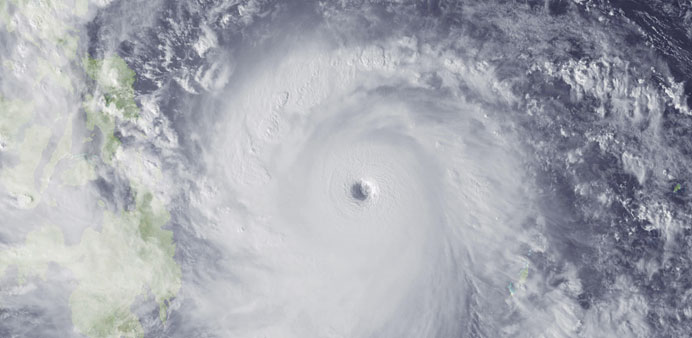
Super-typhoon Haiyan - thought to be the strongest recorded storm ever to hit land - barrelled through the Philippines yesterday with winds up to 315 kilometres an hour and waves as high as 5m.
The category 5 storm, which made landfall at dawn yesterday on Samar island in the central Philippines, blew westward in a devastating streak across a number of islands, including Leyte, Cebu, Bohol and Negros, where it brought down power lines, knocked out communications, caused landslides and left streets flooded.
Hundreds of thousands of people were evacuated and thousands more fled their homes as Haiyan tore apart buildings and left whole provinces without power or communications. Experts predicted “catastrophic damage” as a result of the super-typhoon, whose speeds at landfall of 315km an hour and gusts of up to 380km an hour were faster than the previous strongest tropical cyclone, Hurricane Camille, which was recorded in the US at 305km an hour in 1969.
Official reports indicated that three people had been killed after being struck by power lines, another by lightning and possibly one more by a falling tree.
But the final toll is expected to climb much higher as so many affected areas were cut off, said Mathias Eick, of the European Commission’s humanitarian aid department (Echo) in Manila.
“In our previous experience with similar storms, because the Philippines are comprised of many islands and many isolated communities, often the statistics show a very low human toll (at first) but then within 24 or 48 hours the numbers just take off,” he added.
“We’re talking about a storm where two-thirds of the whole area of the Philippines was directly affected - not entirely by the eye of the storm but by a very large area - and with many isolated communities on smaller islands or living in mountainous areas, it takes some time for the authorities, Red Cross and volunteers to collate the information.”
About 12 airports were closed - including those in the tourist islands of Palawan and Boracay - and schools and offices shut, with roughly 1mn people in shelters scattered around 29 provinces.
Haiyan - the Philippines’ 25th typhoon this year - has put an estimated 12mn people at risk and last night was still pummelling the country, with the eye of the storm 32km west of Coron, Palawan, according to local media.
“There aren’t too many buildings constructed that can withstand that kind of wind,” said meteorologist Jeff Masters. “There are very few storms that have stayed at category 5 strength for so long.”
The 600km-wide storm, which is called Yolanda in the Philippines, cut power to entire provinces, ripped iron roofs off buildings and threw trees across roads. Certain areas, such as Tacloban City and Cadiz, were particularly badly hit.
“We’ve been hearing from my colleagues in (the city of) Tacloban that they’ve seen galvanised iron sheets flying just like kites,” Mai Zamora, of the charity World Vision, told the BBC. “It’s actually all around the roads now. The roads are flooded in Tacloban.”
Camera-phone videos uploaded to YouTube and Twitter showed streets reduced to rivers full of debris, trees uprooted and huge waves crashing against slums located along riverways.
The damage to infrastructure, agriculture and livestock, electricity, water supplies, shipping routes and harbours all across the Philippines could be huge, said Eick. The World Food Programme expects that at least 2.5mn people will require food assistance. Page 16