


By Pratap John
|
|
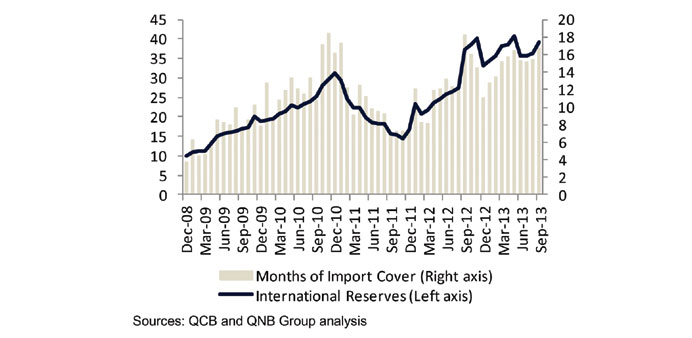
Driven by high hydrocarbon prices, Qatar’s international reserves have edged higher, totalling $39.3bn in September, up 16% on 2012, a new study has shown.
The country’s international reserves stood at $33.1bn in December 2012, which shows $6.2bn flowing into Qatar’s forex kitty in the first nine months of this year.
According to a QNB report “the import cover stood at 16.7 months as a result of this. This is well above the IMF recommended level of three months for pegged exchange rates.”
Qatar’s international reserves have been steadily rising over the years as foreign exchange receipts from exports grew. The pullback in reserves in 2011 was largely due to capital outflows for the purchase of foreign assets.
“We forecast international reserves to increase gradually until 2014” QNB said.
It said strong fiscal and economic fundamentals have reduced Qatar Credit Default Swap (CDS) spreads to historic lows in October.
Qatar CDS spreads are amongst the “lowest regionally” as they are supported by the country’s “robust economic growth and resource-driven wealth as well as its strong fiscal and external positions.”
The report indicated that four major Asian countries, Japan, South Korea, India and China, remained among the top export destinations for Qatar.
Combined, they accounted for exports worth $77.5bn in 2012, driven mainly by liquefied natural gas contracts.
Japan remained Qatar’s top destination with $32.6bn last year. South Korea accounted for about $23.2bn, India QR14.7bn and China $7bn.
The European Economic Community (EEC) accounted for most of Qatari imports and accounted for $7.4bn in 2012.
Qatar’s oil production averaged 717,,000 barrels per day in September, which shows a decline of 2.4% y-o-y, believed to be because of Opec quota restrictions.
The Qatari crude averaged $111.7 per barrel in September, which shows a decline of 1% y-o-y.
The report shows Qatar’s population grew by 15.2% year-on-year in October 2013 to reach 2.02m. Population growth in recent months has been driven up by the large ramp up in infrastructure spending in preparation of FIFA World Cup 2022, which Qatar is hosting.
According to QNB the latest population figures are in line with its full-year forecast of 10.9% population growth in 2013.
“The larger population will lead to higher economic growth by boosting aggregate domestic consumption and investment in housing and services,” QNB said.
But, the report said the further pickup in population growth will drive consumer demand and push inflation to 3.8% in 2014.
“There is an upside risk for inflation if the rollout of major infrastructure projects run into capacity constraints,” QNB said.
In September, inflation fell for the fifth consecutive month to 2.7% year-on-year, the report said.