


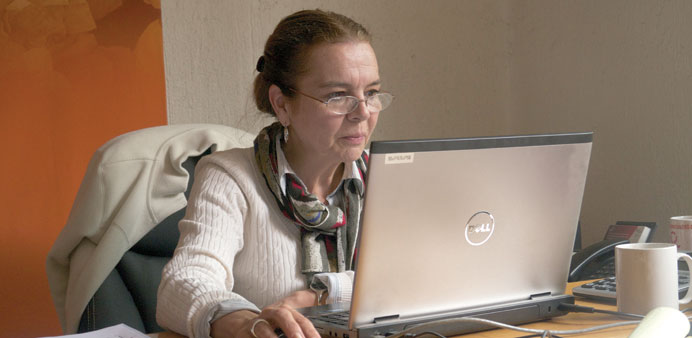
Leticia Prado, director of the Vacation Colonies in Mexico. Prado says the charity is facing economic difficulties as the crisis has undermined donations. But she is confident that by using creative methods to raise funds, such as offering leadership courses to companies in exchange for sponsorship, Vacation Colonies can continue its work. Photograph: Jaime Tello
By Angela Moscarella
Rodrigo Perez Oronoz has two lives. His normal existence as a 23-year-old university student in Mexico City, and his other life: the one he dedicates to impoverished children selected to go on week-long holidays throughout the year at two large houses donated for that purpose in the Mexican countryside.
Perez has been part of the ‘Vacation Colonies’ since he was six. His parents sent him to a paid summer camp for privileged children.
That camp is a source of income the charity uses to raise money to fund its real work: pulling poor children out of their bleak city surroundings in Mexico and taking them away for a week of outdoor fun and entertainment while nourishing their self-esteem.
He went back every summer until he was 13 and made many friends. The camps, held in two country houses, Santa Teresa and Don Cres, located two hours’ drive from the city, made a profound impression on Perez. Later, at age 16, Perez overcame his self-doubts and agreed to take a course to become a camp leader.
“It is only on the course that you really come to understand why you are there. It is impressive what you can achieve in a week with underprivileged children,” he told in an interview.
Perez’s fate became inextricably tied to that of dozens of kids from slums in Mexico City and other working-class districts that he and another 300 volunteers aged 17-25 help each year.
“The idea of the camps is that they teach you things, provide you with certain tools that you can easily employ yourself afterwards. I can still sing the songs I learned when I went to camp as a child,” he said.
Not everyone is cut out to be a camp leader, Perez explained. “You really have to have a great love for children,” he said.
Leaders must meet multiple times to prepare. They make costumes and plan entertainment, physical activities, handicrafts, games and theatre for practically every minute of the day. Each camp leader is assigned about 10 kids for the week.
In a year, Vacations Colonies organises 14 camps for children aged 7 to 11 that take place in the spring, summer and winter school holidays. The Santa Teresa facility houses 130 children and Don Cres 70.
“We take urban children and put them in contact with nature. We pull them out of their environment, where they live surrounded by cement, and have them play games,” said Leticia Prado, 57, the director of Vacation Colonies.
Prado became involved with Vacation Colonies because she had sent her daughters to the privileged kids camp. Their experience was so enriching that the girls eventually themselves became camp leaders.
A privileged child pays 5,350 pesos (about $410) for a week-long stay. The money funds another three poor children whose stays cost about 1,300 pesos ($100).
Eventually Prado was drawn in to her current position at the helm of the charity organisation. She is one of only five paid employees in a small office in Mexico City. There are another five salaried staff members in the countryside.
The Vacation Colonies were created in the 19th century during the Industrial Revolution by Swiss pastor Hermann Walter Bion. He believed that taking city children for a month to the Swiss Alps to breathe fresh air and learn survival habits would do wonders for their health. It did and the concept caught on. European governments currently sponsor such programmes.
In Mexico, where it remains outside the government sphere, the Colonies arrived in 1965 under the aegis of the Catholic Church. Eventually the church stepped aside and the group became a civic association in 1979 and a private charity in 1985.
The Vacation Colonies reach out to schools, community centres and church groups in disadvantaged neighbourhoods.
A week may seem like a short time, but it can transform the lives of disadvantaged children, said Judith Anguiano, 40, in charge of fundraising. Some children are thrilled simply by the shower they take each day or that there are more meals after breakfast.
“What, we get to eat again!” they exclaim. The kids are put in teams and an important early aspect is to invent a story they play-act together. They do this with hand puppets, figures made from bottles or cardboard masks, using recyclable materials. “At home, these children often don’t even have the right to express themselves... At the colony, they are shown that decisions they themselves take, do matter,” said Prado.
“We change their mental switch,” she added. “We show them love. The environment is filled with love. There is not a moment when the guides are not with them,” Prado said.
Anguiano said the children, “Go home with a new outlook on life, with tools they can apply at home, in their relationships with their families... (They have learned) that life with others can be loving, without shouting, without blows.”
Vacation Colonies, like other charities in Mexico, is struggling to keep afloat. The economic crisis has reduced donations.
But the group is working hard, with its 11 volunteer board members, to find alternate ways to raise funds such as providing personnel leadership courses to firms in exchange for sponsorship.
Perez told of how, when he sits down with his kids to create a story, there is always a child who wants to tell a drug-trafficking story, about how the “bad guys show up and we shoot them all.”
So he says he nudges the children in another direction, to lift them out of their stark reality filled with violence, drugs and sex. “Why don’t we tell a story about animals, and a princess? And we don’t have to hit the princess, she can take care of us, be nice to us.”
And that is what Perez likes the most about the Vacation Colonies, and the reason he returns each year without fail.
“Because I too can step out of my own reality, pull myself out of my usual existence. I am still me, but I can turn into somebody else, become a very different person, somebody magical.” – DPA