


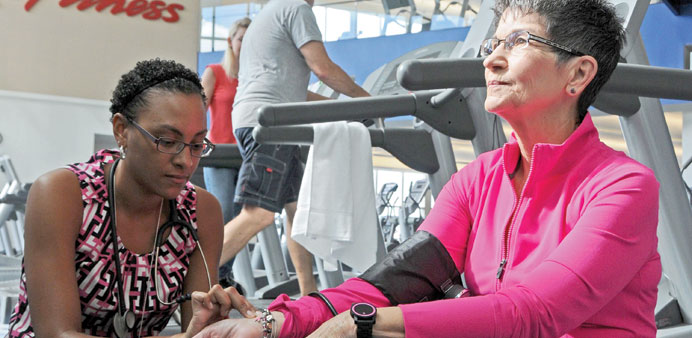
Stacy Cutrono, left, exercise physiologist, takes the pulse of Judith Cornille, who just completed her exercise workout, during their U Survive & Thrive programme, at the University of Miami’s Wellness Center.
By Ana Veciana-Suarez
Judith Cornille survived breast cancer. The lumpectomy. The radiation. The utter shock. But even as she recovered from treatment, her mind was on the future: Now what? “Everyone was telling me to get on with my life, but I was still reeling emotionally,” recalled Cornille. “This wasn’t what I had planned.”
Cornille, 65, was lucky. She enrolled in the new Breast Cancer Survivorship Clinic at the University of Miami’s Sylvester Comprehensive Cancer Center, a three-month-old programme that supplements routine care provided by a breast oncologist with a multidisciplinary approach to managing the long-term effects of cancer and the side effects of treatment.
The programme offers nutritional counselling, physical rehab and fitness training, psychiatric counselling and integrated medicine, including acupuncture, yoga and tai chi. “It’s like a GPS after treatment,” Cornille said. “It helps me to know what I should expect and what I can do to feel better. It does a lot for the psyche.”
The Breast Cancer Survivorship Clinic is part of a growing movement within the US healthcare system to help survivors adjust to their new life, post cancer. As more of them lead longer, healthier lives, hospitals are reorganising their services by offering a one-stop shop that gathers together various disciplines.
“We’re moving toward a collaborative model,” said Dr Beatriz Currier, who heads up the psychiatric part of the clinic. “We are all tackling the symptom from our different expertise and a major asset is that everything is centralised.”
For years, breast cancer patients were released with little guidance on how to deal with post-treatment issues, everything from depression to weight gain, to sleep problems and sexual dysfunction. But that is changing as more patients of all cancers survive.
There are almost 14mn cancer survivors in the United States and that number is projected to increase by 31%, to almost 18mn, by 2022, according to the National Cancer Institute. The medical community has realised such encouraging numbers demand follow-up guidelines to ease the lives — and the worries — of these former patients.
That’s why the influential Institute of Medicine issued a report in 2005 recommending that all patients, after completing treatment, receive a survivorship care plan (SCP), a blueprint that helps a survivor steer her way through the maze that is post-treatment life.
A care plan includes both a record of care the patient has received and a follow-up plan about psychosocial effects of treatment, prevention of new cancers and surveillance of recurrent cancers, among other things.
The American College of Surgeons considers these survivorship plans such an important part of post-treatment cancer care that in 2011 its Commission on Cancer announced that it would require all of its accredited facilities — where about 70% of new cancer patients are treated — to provide these plans to all patients by 2015.
Because breast cancer survivors comprise the largest percentage of survivors, 22%, it was a natural step for local hospitals to begin implementing SCPs with them. “They have a spectrum of issues but they are also more open, more motivated to deal with them,” Currier said.
At the Sylvester clinic, the initial visit includes a two-hour screening to determine the issues a patient is facing. If, for example, she suffers from fatigue, she might see the psychiatrist, exercise physiologist or nutritionist, perhaps even an integrated medicine specialist for acupuncture or yoga. All these disciplines can offer help.
The Breast Cancer Survivorship Clinic sees about five new patients a week. It is now open only to Sylvester patients, but Currier says it might one day open to other breast cancer patients who have been treated in other cities and institutions.
Cornille’s first appointment was with the exercise physiologist. Eager to get her life back on track, she had tried the gym on her own, but her efforts were short-lived “I was on the elliptical for five minutes and my legs were like jelly,” she recalled.
So she registered with the U Survive & Thrive programme at the survivorship clinic, where exercise physiologist Stacy Cutrono tailored an exercise routine and followed her through 16 supervised sessions.
Cornille said she was “very encouraged” to see her endurance and strength improve on every visit to the gym. “It starts as hand-holding than it takes off,” Cutrono said. “They take what I teach them and they go from there.”
Heidi Rowland, a 57-year-old breast cancer survivor, has seen both Cutrono and the nutritionist for follow-up care. In a couple of months she will visit Currier for a cognitive assessment. These appointments are in addition to her follow-ups with the breast oncologist.
“To have to see several physicians who don’t talk to each other and are in different places would be very stressful,” she said. “It would be daunting, so it’s great to have everyone gathered in one place and everyone talking to each other.”
Other local hospitals have launched survivorship care plans for their breast cancer patients. Advanced Medical Specialties oncologist Dr Grace Wang, who chairs the Commission on Cancer (COC) committee for Baptist Health, has worked on the survivorship plan template the hospital gives to survivors for more than a year.
To those guidelines she plans to add a list of available community resources, as well as a financial component because cancer “can cause financial distress to so many of our patients.”
Wang sees SCPs as a vital part of “a team effort” to reduce the recurrence of cancer and offer support to survivors so they can comply with post-treatment care.
“You’re educating and keeping them on task about what they should be doing,” she said.
At the Memorial Center Institute in Broward, psychiatrist Patrick Reynolds, who heads a multidisciplinary oncology support system, has been supervising the rollout of the SCPs for breast cancer patients. Like other centers, Memorial plans to add other cancer survivors in the future.
“In the past people fell through the cracks,” he said. “The pieces were there, but the care tended to be fragmented. What we’re doing now is formalising the process so survivors don’t get lost in the follow-up.” — The Miami Herald/MCT
* Stacy Cutrono, left, exercise physiologist, takes the pulse of Judith Cornille, who just completed her exercise workout, during their U Survive & Thrive programme, at the University of Miami’s Wellness Center.
The two sides of screening debate
Mammography works: It can detect cancer. On that point, at least, most experts agree. For the past two decades, however, doctors and researchers have been debating the details of the popular screening, including the best age to start and whether the risks of false alarms outweigh the benefits of catching cancer in its early stages.
Mammograms, or X-rays of the breast, are the best way to spot cancer early, when it’s easier to treat and before it’s big enough to be felt or cause symptoms. For women between the ages of 50 and 74, there’s general agreement that mammograms are a valuable screening tool. The American Cancer Society recommends yearly mammograms, and the US Preventive Services Task Force recommends mammograms every two years.
But for women in their 40s, it’s not so clear cut. Mammograms may identify cancers that could turn lethal. But they can also flag disease that would never have been a problem, triggering a cascade of potentially unnecessary treatment and anxiety.
False positives are no less of a problem for women older than 50. But there is a comparatively smaller risk of breast cancer in the 40s versus for those 50 and older, said Dr Robert Smith, a cancer epidemiologist and senior director of cancer control for the American Cancer Society.
Most organisations, including the American Cancer Society and the National Cancer Institute, recommend screenings begin at age 40. But in 2009 the US Preventive Services Task Force, a government-backed panel of preventive-medicine experts, shook up the cancer world when it recommended the procedure every two years, starting at age 50.
Women between 40 and 49 can benefit from screening, but they should make an individual decision in conjunction with their doctor, the task force said.
Some research showed the new advice didn’t change breast screening rates: In 2010, women in their 40s continued to show up for their mammograms. About 70% of women older than 40 reported having a recent mammogram. But should they?
Below, two experts explain the rationale behind the differing screening guidelines. Their responses have been edited.
Dr Robert Smith, a cancer epidemiologist and senior director of cancer control for the American Cancer Society:
Regular mammograms starting at age 40 are a smart move.
Regular mammograms can be thought of as a form of insurance, said Smith, an adjunct professor of epidemiology at Emory University.
“It takes time and is a bit of a nuisance, but it protects you against high enough odds — but still unlikely — that something catastrophic will happen,” he said.
The average woman’s risk of breast cancer was 1 in 12 in 1980; today it is 1 in 8. Breast cancer risk rises with age. “Most of that risk is going to occur after 65; the odds of developing it as a 40-something is less than 2%, about 1 in 60 women during the decade, Smith said.
But if it does happen, it’s more likely to be treated if detected by a mammogram before symptoms develop, Smith said. Smith agrees the high rate of false positives needs to be reduced, though they can’t be completely eliminated. Research shows “that anxiety (related to a diagnosis) is short-lived and doesn’t affect whether you come back for a mammogram or not,” he said.
“Women tell us they understand that false positives are a fact of life and have a much higher priority on finding it early than avoiding downsides of having to go through the experience.”
Michael LeFevre, co-vice chair of the US Preventive Services Task Force and a professor and vice chair in family and community medicine at the University of Missouri: Mammograms are important for some in their 40s; it’s up to each woman to decide.
The emotional, physical and financial toll related to false positives needs to be considered, LeFevre said. For women who have a suspicious mammogram, “there’s lingering anxiety that hangs out there,” LeFevre said. “We don’t think it’s enough to discourage a mammogram, but women who don’t want the pain or anxiety might wait until age 50 to start screening,” he said. “Another woman, who can live with false positives and unnecessary biopsies, might want to maximise her chances. Then she can start screening at age 40.”
In statistical terms, if 1,000 women, starting at age 40, are followed until death, 30 will die of breast cancer if no screening is done, LeFevre said. If they are screened every other year between age 50 and 75, the number of deaths falls from 30 to 23, dropping the death rate from 3% to 2.3%. If screening begins at 40 instead of 50, the number of deaths can be lowered by one — to 22 from 23 per 1,000. But it also results in 5,000 additional mammograms and 500 false positives. That means 1 of 2 women screened in their 40s get called back due to something on their mammogram that requires further attention. Thirty-three of those get biopsies, and one death will be averted, he said.
“The balance is favoured toward mammography but only a small amount,” LeFevre said. “We judged that to be a small benefit relative to the harms.
“One of most common risk factors for women in their 40s is family history. They might decide starting earlier rather than later because there is greater benefit. Women with no risk factors might say ‘it’s not worth it to me.’ But they should be able to make that decision rather than be told what to do.” — By Julie Deardorff/Chicago Tribune/MCT
The two sides of screening debate
Mammography works: It can detect cancer. On that point, at least, most experts agree. For the past two decades, however, doctors and researchers have been debating the details of the popular screening, including the best age to start and whether the risks of false alarms outweigh the benefits of catching cancer in its early stages.
Mammograms, or X-rays of the breast, are the best way to spot cancer early, when it’s easier to treat and before it’s big enough to be felt or cause symptoms. For women between the ages of 50 and 74, there’s general agreement that mammograms are a valuable screening tool. The American Cancer Society recommends yearly mammograms, and the US Preventive Services Task Force recommends mammograms every two years.
But for women in their 40s, it’s not so clear cut. Mammograms may identify cancers that could turn lethal. But they can also flag disease that would never have been a problem, triggering a cascade of potentially unnecessary treatment and anxiety.
False positives are no less of a problem for women older than 50. But there is a comparatively smaller risk of breast cancer in the 40s versus for those 50 and older, said Dr Robert Smith, a cancer epidemiologist and senior director of cancer control for the American Cancer Society.
Most organisations, including the American Cancer Society and the National Cancer Institute, recommend screenings begin at age 40. But in 2009 the US Preventive Services Task Force, a government-backed panel of preventive-medicine experts, shook up the cancer world when it recommended the procedure every two years, starting at age 50.
Women between 40 and 49 can benefit from screening, but they should make an individual decision in conjunction with their doctor, the task force said.
Some research showed the new advice didn’t change breast screening rates: In 2010, women in their 40s continued to show up for their mammograms. About 70% of women older than 40 reported having a recent mammogram. But should they?
Below, two experts explain the rationale behind the differing screening guidelines. Their responses have been edited.
Dr Robert Smith, a cancer epidemiologist and senior director of cancer control for the American Cancer Society:
Regular mammograms starting at age 40 are a smart move.
Regular mammograms can be thought of as a form of insurance, said Smith, an adjunct professor of epidemiology at Emory University.
“It takes time and is a bit of a nuisance, but it protects you against high enough odds — but still unlikely — that something catastrophic will happen,” he said.
The average woman’s risk of breast cancer was 1 in 12 in 1980; today it is 1 in 8. Breast cancer risk rises with age. “Most of that risk is going to occur after 65; the odds of developing it as a 40-something is less than 2%, about 1 in 60 women during the decade, Smith said.
But if it does happen, it’s more likely to be treated if detected by a mammogram before symptoms develop, Smith said. Smith agrees the high rate of false positives needs to be reduced, though they can’t be completely eliminated. Research shows “that anxiety (related to a diagnosis) is short-lived and doesn’t affect whether you come back for a mammogram or not,” he said.
“Women tell us they understand that false positives are a fact of life and have a much higher priority on finding it early than avoiding downsides of having to go through the experience.”
Michael LeFevre, co-vice chair of the US Preventive Services Task Force and a professor and vice chair in family and community medicine at the University of Missouri: Mammograms are important for some in their 40s; it’s up to each woman to decide.
The emotional, physical and financial toll related to false positives needs to be considered, LeFevre said. For women who have a suspicious mammogram, “there’s lingering anxiety that hangs out there,” LeFevre said. “We don’t think it’s enough to discourage a mammogram, but women who don’t want the pain or anxiety might wait until age 50 to start screening,” he said. “Another woman, who can live with false positives and unnecessary biopsies, might want to maximise her chances. Then she can start screening at age 40.”
In statistical terms, if 1,000 women, starting at age 40, are followed until death, 30 will die of breast cancer if no screening is done, LeFevre said. If they are screened every other year between age 50 and 75, the number of deaths falls from 30 to 23, dropping the death rate from 3% to 2.3%. If screening begins at 40 instead of 50, the number of deaths can be lowered by one — to 22 from 23 per 1,000. But it also results in 5,000 additional mammograms and 500 false positives. That means 1 of 2 women screened in their 40s get called back due to something on their mammogram that requires further attention. Thirty-three of those get biopsies, and one death will be averted, he said.
“The balance is favoured toward mammography but only a small amount,” LeFevre said. “We judged that to be a small benefit relative to the harms.
“One of most common risk factors for women in their 40s is family history. They might decide starting earlier rather than later because there is greater benefit. Women with no risk factors might say ‘it’s not worth it to me.’ But they should be able to make that decision rather than be told what to do.” — By Julie Deardorff/Chicago Tribune/MCT