


|
The opening this week of a new airport in the Gulf has again turned the global spotlight on a region leading the race to create super air transport hubs. |
Three years after welcoming its first cargo flights, Al Maktoum International Airport greeted its inaugural passenger service on Sunday as European carrier Wizz Air touched down to a traditional water salute reception following a flight from the Hungarian capital, Budapest.
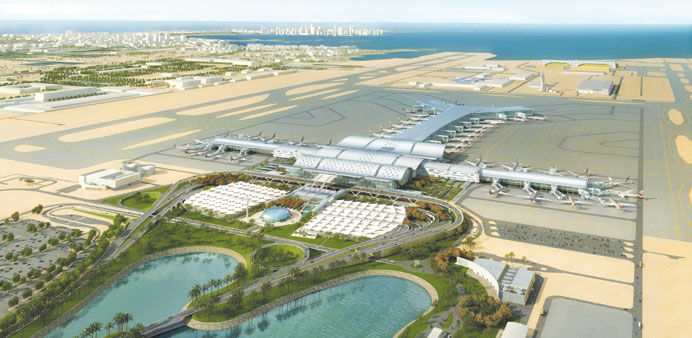
Located within the sprawling Dubai World Central commercial complex in the Jebel Ali area of the emirate, Al Maktoum will initially have a meager capacity of around 7mn passengers a year – falling well short of the near 50mn currently using sister facility Dubai International just 65km away.
Despite the recent opening of a new terminal dedicated to the Airbus A380 super jumbos and ongoing infrastructure improvements, Dubai International has long-term constraints. It estimates reaching full capacity by 2018 when over 100mn passengers are expected to fly to and from the airport each year.
Beyond then, Dubai will need another home.
In order to meet projected increases in passenger traffic that will boost tourism and economic activity, increased airport capacity is seen as a necessity. So the seeds have been sown for a brand new facility.
Al Maktoum will work alongside Dubai International to attract passenger and cargo flights before becoming Dubai’s primary airport as it enters the next decade. Currently only a handful of airlines have committed to using Al Maktoum.
Eventually having five runways and forecast to handle a staggering 160mn passengers a year within the next 10 years, Al Maktoum has ambitions to be the world’s biggest and busiest airport once fully operational. It also has aspirations to be the world’s first aerotropolis, leveraging on the emirate’s position as a leading global trade, business and aviation hub.
Construction of a brand new airport so close to a facility that is by far the biggest in the Gulf, certainly raised a few eyebrows when the Al Maktoum project was first announced at the turn of the century.
How can the region support another mega airport hub? There are already large airport infrastructure projects underway in Abu Dhabi, just 80km south of Al Maktoum, and in Doha across the Arabian Gulf.
Well analysts have been busy with their forecasts.
In a recent outlook report, US aircraft manufacturer Boeing predicted that the Middle East will require 2,340 aircraft worth $390bn by 2029 – more than double the amount currently operating – to cope with passenger growth projections.
Rivals Airbus said global air travel will more than double from 2.9bn to over 6.7bn during the same period. It believes Asia Pacific will overtake Europe and North America to generate the largest amount of passenger traffic as economies open up, affluence rises and there is more disposable spend.
According to some analysts, passenger numbers in the Middle East will more than double to over 450mn during the next 20 years.
The Middle East is a much smaller market on its own by the very nature of relatively lesser populations in each country. But the region’s central geographic location positions it perfectly to capitalise on air traffic flows to different parts of the world and between different parts of the world.
According to aviation industry body the International Air Transport Association, Middle East carriers had the strongest year-on-year growth of any global region with passenger traffic up almost 12%. The region’s airlines have pumped in seat capacity as part of their robust expansion strategies to prise market share from competitors elsewhere in the world.
In order to meet the projected demands, airports need to cope and have the necessary infrastructure in place. The Middle East’s burgeoning airlines want a large slice of the global action, hence the huge airport improvements which are underway, mainly in and around the Gulf.
Backed by long-term visionary strategies of their respective governments and national airlines, airport developments are pivotal for sustained economic growth in the vibrant Gulf nations.
In the case of Dubai, Emirates plays a key role; for Abu Dhabi, it’s Etihad; and Qatar, home-grown Qatar Airways.
With each of the three national airlines building their global networks to all corners of the world at phenomenal pace in a relatively short timeframe since the birth of Emirates 28 years ago, they need bigger homes to keep in sync with the dramatic expansion.
Their respective airports are key to the success not only for the airlines, but to the local economy. More flights mean more passengers, more tourists, more business and more expenditure.
In the past, airports across the Gulf were developed like building blocks. In other words, extensions to existing infrastructure. Doha International Airport is a good example where the main terminal was extended on all sides before capacity constraints forced the development of new terminals for premium travellers, for arriving passengers and for airlines other than Qatar Airways.
What we have seen in recent years is a more focused approach towards building new stand-alone facilities. Whether it is a new terminal or new airport, planners have been hard at work to design well into the future – 20, 30, 40 years or more.
Airports are seen as a symbol of a country’s wealth and vision which is why billions of dollars are being injected into airport infrastructure across the region.
From the smaller nation of the Sultanate of Oman which is reviving its airports in the capital Muscat and Salalah to the bigger kingdom of Saudi Arabia where major overhauls are underway at Riyadh’s King Khaled International Airport and King Abdulaziz International Airport in Jeddah.
According to industry body Airports Council International, the Middle East continues to allocate large investments for developing new and existing airports to the tune of almost US$120bn. Of this, a majority $90bn is being spent on alleviating the strain on airports in the GCC, currently already running at over 90% capacity. The largest chunk of this investment is in the super hubs of the UAE and Qatar.
Huge capital expenditure is taking place in Abu Dhabi with the creation of a new terminal at Abu Dhabi International Airport which will boost annual passenger capacity three-fold from 13mn to 40mn by 2017.
Doha’s aviation industry will soon move to a new home when Hamad International Airport opens for business with an initial projected capacity of over 28mn, rising to beyond 50mn ahead of the 2022 FIFA World Cup by which time it would have gone through another phase of airport expansion that will include a new airport logistics city hub.
Dubai International is clearly the busiest airport in the Gulf, followed by Jeddah at over 20mn passengers a year and Doha International nearing 20mn, with Riyadh at 15mn and Abu Dhabi slightly less in fifth place.
Al Maktoum marked the beginning of another illustrious moment in the Gulf’s rapidly-developing aviation sector that has become a talking point within the echelons of the airline industry.
The Gulf and the sheer nature of its business model of connecting passengers from east to west and north to south is nothing new on the global scene. Regions around the world have developed such business practices but with a bigger domestic or cross border catchment area.
For the Gulf’s aviation sector, where the immediate catchment area is small by comparison as highlighted earlier, the region’s airlines have carved out a global business that has been watched admirably.
The simple philosophy of service and hospitality of the highest standards have helped win the region its good share of plaudits. Emerging from a clean slate with no baggage and no legacy, this is a young aviation industry firmly on the global stage.
However, there are always going to be foes. The opposition movement has been fierce, particularly in Europe, vocal about the mass Gulf expansion being anti-competitive. They argue the Gulf’s national airlines and airports are financially backed by governments that give them undue competitive edge.
But let’s not forget Europe’s legacy airlines and airports were built by governments before many went into private ownership. Crippling economies in Europe and inability to act fast in a rapidly changing marketplace have affected the European way of doing business.
Airports face torturous delays in infrastructure improvements due to lengthy debates on whether they should or shouldn’t be expanded. The future of a healthy economy lies very much on competitiveness and to get on with business to safeguard jobs and livelihoods.
For discerning passengers, they want convenient flights to convenient airports with convenient, hassle-free connections. Great facilities on the ground are a huge bonus.
In the Gulf, retail therapy through 24/7 airside and increasingly landside shopping malls go a long way to win customer satisfaction and repeat business. Airports are offering a multitude of retail brands to suit different tastes and pockets under one roof day and night; airports are pampering travellers with ultra luxury relaxation lounges to ease the misery of long transits; and airports are eyeing new recreational facilities such as squash, swimming and mini cinemas to keep passengers busy and entertained.
Of all the talk centring on the Gulf, there is a dark horse at the crossroads of east and west that has given competitors a run for their money and one certainly to eye: Istanbul Ataturk International Airport.
This sleeping giant has a current annual capacity of 45mn passengers and ranked 20th busiest airport in the world. Its national carrier Turkish Airlines serves over 230 destinations worldwide – 100 more than the Gulf’s biggest carrier Emirates.
Turkey has ambitious plans of its own to build the world’s largest airport, occupying a 77mn square metre plot along the Black Sea coast of Istanbul’s European side. The project is underway and envisaged to handle over 150mn passengers a year on completion, almost on par with Al Maktoum International in Dubai.
By comparison, Hartsfield Jackson International Airport in the US is the world’s busiest airport handling over 95mn passengers a year with flights spread across five runways. London Heathrow stands at 70mn and ranked third in the global list, while Dubai sits at number 10.
The battle of the airport hubs is certainly here to stay and the aviation world’s axis is clearly shifting eastwards away from Europe and North America, helped by the deployment of bigger and longer range aircraft that are cutting out historic stops to get to a final destination.
If the close proximity of London, Paris and Amsterdam; Singapore, Kuala Lumpur and Bangkok; New York and Washington can see their hubs compete successfully with one another, there is no reason to question the viability of the Gulf’s emerging super hubs.
The boss of Airports Council International recently stated: “With all the forecast of traffic growth over the next 20 years, airports must now build the capacity needed without further delay to plans for expansion and modernisation. Governments and private investors must not be shy to commit to infrastructure investment that is so crucially linked to economic development.”
The Gulf has taken note and is well ahead in the race to create world leading airport super hubs.

♦ Updesh Kapur is a PR & communications professional, writer and aviation and travel specialist. He may be contacted on [email protected]