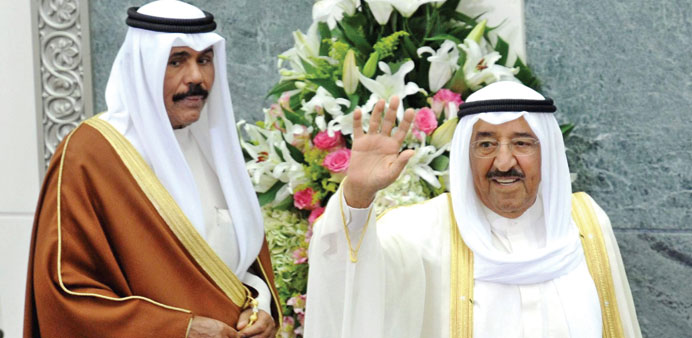
Kuwaiti Emir Sheikh Sabah al-Ahmed al-Sabah waves to members of parliament as Crown Prince Sheikh Nawaf looks on during the inauguration of the parliament session in Kuwait City yesterday.
Reuters/Kuwait
Kuwait must make tackling a shortage of government-funded housing its top priority, officials said at the opening of parliament yesterday.
Accustomed to a welfare state which is generous by international comparisons, Kuwaitis say they may have to wait for up to 20 years on the housing list.
“The housing issue is the top priority in this session,” parliament speaker Marzouq al-Ghanim said at the opening of the National Assembly yesterday. The cabinet needs to put forward improved solutions within a timetable, he said. “We have enough finances to solve this problem.”
Providing more government-subsidised housing, however, would put further pressure on already stretched public finances, with government spending forecast to exceed oil revenues soon.
Kuwait’s prime minister, Sheikh Jaber Mubarak al-Sabah, warned on Monday that the welfare system is unsustainable and said the major oil producer must slow consumption of its natural resources.
As part of an extensive national welfare programme, Kuwaiti men can apply for government housing after marriage, receiving loans that are paid off slowly.
But the waiting list for government-subsidised housing grew to more than 100,000 in 2013 and is expected to grow by thousands each year in a country where more than half of the 1.2mn nationals are under 25.
Kuwait has suffered from a lack of infrastructure development due to political infighting, entrenched bureaucracy and bad planning, analysts say.
Kuwaiti citizens might have disposable income but are lacking in basic necessities, they say.
“You can buy a Bentley but you cannot buy a house,” joked Eid al-Shihri, an organiser of a campaign called “Waiting for a House” which was set up by a group of young Kuwaitis to press the government to build more homes.
The group, which has increased its activities in recent months, has around 12,000 followers on its Twitter account @na6er_bait. A recent government poll found that housing was the most pressing topic for voters.
As well as the prime minister, a number of other officials have voiced concern that Kuwait is spending money too fast.
“I think the announcement is not at the right time,” MP Adel al-Kharafi said, referring to the premier’s remarks which appeared in local media on Monday.
“Even if the idea is accepted, even with that support, people are still weak,” he said, citing a lack of public sector jobs, poor health services and education, alongside housing.
Former boxer Ahmed al-Ezmi said he had been waiting 17 years for a house. His nine-member family, which includes his son’s family, are crammed into a three-bedroom rented apartment costing 300 dinars a month, he said.
His son is also on the waiting list, he said at a weekly “Waiting for a House” meeting outside the government housing authority late on Monday.
It is the middle class which is suffering, said 30-year-old entrepreneur Bashar al-Ostad, who runs a hotel booking website.
“I consider myself one of the fortunate Kuwaitis and still I cannot afford to buy a house,” he said at the meeting, where around 30 men sat on carpets and sipped coffee.
Sheikh Sabah in call for reforms
AFP/Kuwait
Kuwait’s Emir Sheikh Sabah al-Ahmed al-Sabah called yesterday for comprehensive reforms in the Gulf state, saying it was time to change old concepts.
“It is time to launch a new decisive phase and a major qualitative move aimed at achieving comprehensive reforms and complete development” programmes, the ruler said at the opening of the parliament that was elected in July amid a bitter political crisis.
The emir’s announcement comes a day after the government said it planned to review subsidy policies and charges on public services and commodities.
“It has become necessary to rectify old concepts ... It’s time to adopt a new work methodology,” the emir said.
Also speaking at the session, Prime Minister Sheikh Jaber Mubarak al-Sabah said that “comprehensive reforms have become an urgent national necessity.”
The country generates around 94% of its income from oil, most of which is spent on wages, subsidies, defence and security.
In a four-year programme presented to parliament on Monday, the government warned that if no reforms are undertaken, the country will start posting real budget deficits in 2021 and this could accumulate to hit a staggering $1.46tn by 2035.