


AFP/Madrid
Spain summoned the US ambassador yesterday to denounce newly reported mass US eavesdropping on its citizens’ telephone calls as “inappropriate and unacceptable”, as outrage spread over the worldwide espionage programme.
The Spanish government demanded details as it called in US Ambassador James Costos to explain the latest allegations in a growing scandal over US snooping on the telephone and online communications of ordinary citizens and world leaders including German Chancellor Angela Merkel.
The news emerged just as a European Parliament delegation began a three-day mission to Washington to probe the impact of the surveillance on EU citizens’ “fundamental rights” and to discuss a threat to suspend an EU-US agreement on the transfer of banking data.
A senior Spanish foreign ministry official met with the US envoy hours after the El Mundo daily published a classified document purportedly showing that the US security services tracked 60.5mn Spanish telephone calls in a single month.
The US National Security Agency (NSA) recorded the origin and destination of the calls and their duration but not the content, said El Mundo, which printed a classified graph showing 30 days of call tracing up to January 8 this year.
The graph illustrated the daily volume of calls monitored in the period, peaking at 3.5mn on December 11.
Though not shown on the graph, the newspaper said that such systematic trawling of huge volumes of digital information – or metadata – would include intercepting personal details through Web browsers, e-mails and social networks such as Facebook and Twitter.
The article was jointly authored by US blogger Glenn Greenwald, who said that he had access to previously secret documents obtained by former US intelligence contractor Edward Snowden.
The Spanish foreign ministry said it had underscored with the US ambassador its concern over the reported snooping.
“Spain conveyed to the United States the importance of preserving the climate of trust that governs bilateral relations and of knowing the scale of practices that, if true, are inappropriate and unacceptable between countries that are partners and friends,” it said in a statement.
Spain’s state secretary for the European Union, Inigo Mendez de Vigo, “urged the US authorities to provide all necessary information about the supposed tapping in Spain”, it said.
During a visit to Poland, Spanish Foreign Minister Jose Manuel Garcia Margallo, told journalists that if the reported espionage was confirmed “it could mean a break in the climate of trust that has traditionally reigned in relations between the two countries”.
The US ambassador said in a separate statement that some of the security programmes played a “critical role” in protecting Americans and were also instrumental in protecting allied interests.
He promised to work to address Spain’s concerns.
El Mundo urged Spanish prosecutors to charge the NSA with spying, saying that such tracing of telephone calls without the proper judicial authority amounted to a criminal offence.
In Washington, US lawmakers sought to soothe injured European feelings as they held talks with the parliamentary mission from Brussels.
“We hope for an open dialogue today,” US House of Representatives intelligence committee chairman Mike Rogers told reporters as he entered the meeting. “We’re going to find some common ground here today.”
The Wall Street Journal said yesterday that the NSA had tapped the phones of some 35 world leaders including close ally Merkel, who last week branded the snooping as unacceptable between friends.
President Barack Obama learned of the espionage programme only after an internal mid-year review, and the White House then ordered an end to the spying on some leaders, including Merkel, the Wall Street Journal said.
NSA spokeswoman Vanee Vines flatly denied reports in Germany that NSA chief General Keith Alexander had briefed Obama on the operation against Merkel in 2010 but that the president let the spying continue.
German media had reported at the weekend that eavesdropping on Merkel’s phone may have started in 2002, when she was Germany’s main opposition leader and three years before she became chancellor.
Alexander “did not discuss with President Obama in 2010 an alleged foreign intelligence operation involving German Chancellor Merkel, nor has he ever discussed alleged operations involving Chancellor Merkel”, Vines said on Sunday. “News reports claiming otherwise are not true.”
Spanish Prime Minister Mariano Rajoy said after a summit with fellow EU leaders in Brussels on Friday that he had no evidence that Spain had been spied on.
At the summit, the 28 EU leaders approved a statement which said they valued the relationship with the United States but that it had to be based on trust and confidence, especially in intelligence matters.
France and Germany are to lead efforts to reach a new understanding with Washington by the end of this year.
German parliament to hold special session on US spying claims
The German parliament will hold a special session next month to assess the impact of mass US surveillance including the alleged tapping of Chancellor Angela Merkel phone, deputies said yesterday.
The heads of the parliamentary groups of Merkel’s conservative Christian Democrats (CDU) and the Social Democrats, the two parties in talks on forming the next German government, agreed to call the debate on November 18, a CDU spokesman said.
Until now leftist opposition deputies had led calls for a special parliamentary hearing on the suspicion that surfaced last week that US spies had been monitoring Merkel’s communications.
Merkel confronted US President Barack Obama last Wednesday with evidence uncovered in classified documents provided by former US intelligence contractor Edward Snowden.
Several deputies have called for Snowden, who has sought asylum at a secret location in Russia, to be summoned to give evidence in a probe of the US National Security Agency (NSA)’s activities in Germany.
Federal prosecutors also said last week that they had opened a preliminary investigation into whether German laws were broken during US surveillance operations.
A justice ministry spokesman told a regular government news conference that there was no legal obstacle to inviting Snowden to testify “provided that he is in a position where he is now to have an address to receive an invitation”.
Merkel’s spokesman Steffen Seibert fielded reporters’ questions for over an hour on the affair, which has deeply strained relations with Washington, saying that Berlin hoped to quickly get to the bottom of the scandal first revealed by German news magazine *Der Spiegel.
“We are checking whether this information can be substantiated,” he said. “If so, this would be grave and a breach of confidence” between Germany and the United States.
He noted that a summoning of the US ambassador to Berlin last Thursday was a “rare” event “and it is an expression of the deep concern that these allegations of course triggered here and the urgency for this matter to be cleared up”.
He noted that the close alliance between Washington and Berlin had endured for several decades.
“It has done us Germans a great service and continues to occupy a central place in our foreign policy,” he said. “And it is ... precisely for this reason that we must do what we can to restore confidence where it may have been jeopardised or lost. We are optimistic that we can do this, in co-operation with the Americans.”
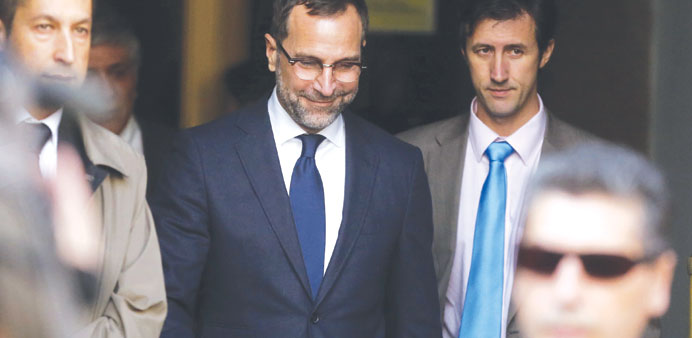
Costos (centre) leaves the Spanish foreign ministry.