


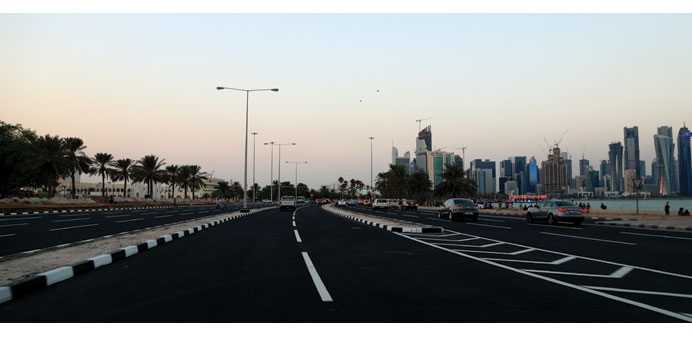
Doha is approximately 2800km from the equator, and even here there is already a noticeable difference in the length of day between summer and winter.
By Steff Gaulter
Have you noticed how quickly it gets dark in Doha? One minute it’s brilliant daylight and the next it’s pitch black. If you visit a location a little further away from the equator, there is often quite a surprising difference.
I was certainly caught out last winter when I visited England. I went for a walk with my friend in Windsor Park. The sun was quite low in the sky, so I suggested turning back before it got dark. We turned round, wandered back, drove home, had a cup of tea and it still wasn’t completely dark.
The reason for the difference in speed is the path that the sun takes across the sky. As you are probably aware, the sun doesn’t hover across the equator for the entire year. It travels northwards in the northern hemisphere’s summer and retreats southwards again for the winter.
As the sun sinks southwards for the winter, it moves further away from the northern parts of the globe. It still rises in the east and sets in the west, but in the middle of the day, it shines at more of an angle. This means that the sun doesn’t get particularly high in the sky.
In London I can tell you from experience that the maximum height it reached was the height which ensured that it shone directly into my eyes when I was driving. This low sun takes the same amount of time to set as the sun that reaches high in the sky above Qatar, which explains why the sun appears to sink faster in Doha.
As the sun changes position, the number of hours it shines on a particular location also changes. We all know that earth rotates and that’s why we have day and night; during the daytime we’re on the side of the earth that faces the sun, and at night we’re around the other side, facing away from it. However the earth rotates in a strange way.
If the earth rotated with the North Pole directly at the top of the globe and the South Pole at the bottom, we would all have about twelve hours of daylight and 12 hours of darkness, but it doesn’t. It’s tilted at a slight angle, which means the North Pole is continuously pointing towards the sun in its summer, but is completely in the shade in the winter. This tilting of the earth also affects the length of daylight elsewhere in the world.
Near the equator, the midday sun is almost directly overhead at all times of the year. That means it climbs high in the sky all year round and there are close to 12 hours of sunlight and 12 hours of darkness every single day.
Doha is approximately 2800km (1740 miles) from the equator, and even here there is already a noticeable difference in the length of day between summer and winter. The shortest day is 10 hours 33 minutes and the longest day is 13 hours 43 minutes.
This gives Doha a change in day length of 3 hours 10 minutes between June and December, and the further away from the equator you travel, the greater this difference becomes. If you fly to the Canadian city of Calgary, the length of day changes by nearly nine whole hours. Of course the greatest change in day length occurs at the poles where there are 24 hours of daylight in summer and 24 hours of darkness in winter.
I have yet to visit the Arctic Circle, but have been as far north as Reykjavik in Iceland. It’s surreal to have quite so much sunshine. Going to bed when it was still broad daylight outside felt wrong, but if you only slept when it was dark, that could be as little as three hours in June.
Whilst summer may well be fun in Reykjavik, winter is a very different kettle of fish altogether. In many cities in the northern latitudes people will travel both to and from work in pitch darkness which can significantly affect people’s mood. It has been found that lack of sunlight can cause people to sleep too much, suffer a lack energy and feel seriously depressed.
The condition, known as Seasonal Affective Disorder (SAD), is more common that you might think. It’s believed to affect nearly 10% of those people living in the northeast US State of New Hampshire.
One town in Norway has decided to take action in an attempt to alleviate the mood of the population. Rjukan is not only a long way north, on a similar latitude to Oslo, but it also has the added problem that it’s positioned at the bottom of a steep valley.
In the winter when the sun is low in the sky, direct sunlight never quite reaches the town and Rjukan remains in the shade. To combat this, a series of giant mirrors have been placed at the top of one of the hills to reflect sunlight into the valley below.
The sunshine is designed to shine onto the town square. Sensors are set to adjust automatically the angle of the mirrors in order to provide the maximum sunlight possible at any given time of day. It may make a significant difference to the people in the village; instead of hibernating through the winter, locals will have a place to go and congregate whilst soaking up some vitamin D.
A lack of sunshine is thankfully not something we have to worry about here in Qatar, but I’ve always thought it was a shame that it got dark so early when the cooler weather is upon us.
Clearly we should just be grateful that we’re not further from the equator or at the bottom of a deep valley.
(The author is Senior Weather Presenter at Al Jazeera English channel. She can be contacted on [email protected] or on Twitter at @WeatherSteff)