


 |
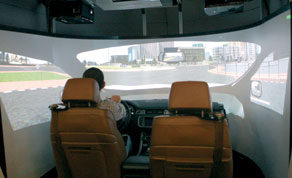
| An interior view of the immersive driver training simulator |
Williams Advanced Engineering in Qatar unveiled yesterday the Middle East’s most advanced road safety simulator at the Intelligent Transport System and Road Safety Forum.
Featuring a state-of-the-art software package, ‘3D Doha’ that accurately maps the roads of Doha and simulates realistic driving scenarios, the simulator is a major attraction at the event.
The simulator has been developed and built over three years at the Williams Technology Centre in Qatar Science and Technology Park, using the skills of local Qatari engineers and graduates.
Damien Scott, general manager of the Williams Technology Centre in Qatar, described the innovation as an important milestone for Williams’ Qatar-based applied research programme that is taking simulator technologies from the race track to help improve safety and environmental performance on the road.
“The immersive driver training simulator is the result of the partnership with Mowasalat to help pioneer the use of immersive simulators in its taxi driver training operations.
“I look forward to seeing the positive results of deploying this technology with Mowasalat and how it can be applied more broadly to help improve safety on the roads in Qatar and internationally.”
Paul Copping from the UK’s Transport Research Laboratory, which is working alongside Williams Advanced Engineering in QSTP, observed that advanced engineering and transport science have immense economic potential for Qatar.
“This simulator developed for Mowasalat is an excellent example of a solution to a real social need which is being derived from cutting edge technology,” he stated.
The new simulator is based on the cutting-edge simulator technology used by the Williams F1 Team to train its racing drivers.
Mowasalat’s business development and strategy director Nasser al-Khanji told the forum that the simulator will help the public transport provider a lot in training its drivers, especially with its Doha map.
“Before training, the simulator can be used to assess the drivers’ skills,” he observed.
The simulator features a highly immersive visual system with a 180 degree field of view, coupled with the most modern projection technology to provide a uniquely realistic driving experience to the trainees.
The 3D virtual environment has been developed with high accuracy and photo realism, based on actual still images and incorporating all road features, signs and architecture to enhance realism and relevance to local environment.
The simulator has a real, full automotive cockpit interior with driver and passenger seats, integrates all driver controls (such as steering wheel, pedals, instrument gauges), and adjustments.
The simulator can also be used to train ambulance or police drivers who need to drive fast in populated urban environments, urban planning, road network design, traffic flow simulations and for fuel efficiency driver training.
The two-day forum organised by IQPC has brought together a number of experts in ITS and road safety. Qatar’s Public Works Authority (Ashghal) president Nasser Ali al-Mawlawi, and Imad Nassereddine (adviser for roads, operations and maintenance, Asset Affairs, Ashghal) shed light on the proposed Intelligent Transport System master plan.