


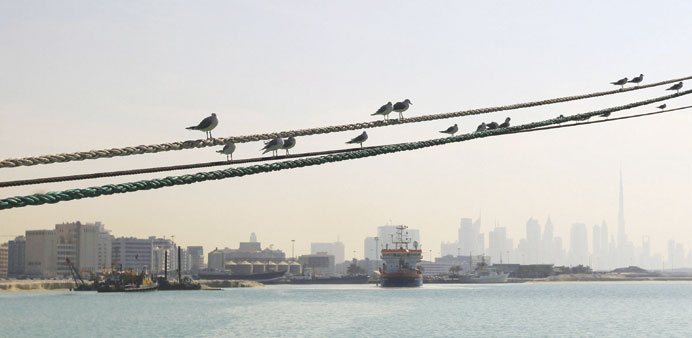
The Burj Khalifa (right) is seen from the Dubai port Mina Rashid. Consumer prices in Dubai rose 1.9% from a year ago in September, the fastest pace since December 2009, government data showed yesterday.
Reuters
Dubai
|
|
Figures released yesterday suggested inflation in the UAE will creep higher in coming months, fuelled by a strong revival in Dubai’s property sector, but a return of double-digit inflation rates still looks unlikely.
Consumer prices in Dubai rose 1.9% from a year ago in September, the fastest pace since December 2009, government data showed. Inflation was up from 1.7% in August.
In neighbouring Abu Dhabi, the biggest economy in the UAE, inflation accelerated to 1.8% in September, the highest level since April 2012, from 1.4% in August.
In Dubai’s case, higher inflation was driven by a jump in housing and utility costs, which account for almost 44% of consumer expenses in the emirate.
Those costs rose 2.9% on an annual basis, the sharpest increase since January 2009 - before a crash in Dubai’s real estate market triggered corporate debt problems which drove the emirate to the brink of default later that year.
But analysts said the data did not necessarily indicate an inflation problem was building again in the UAE. Housing construction projects now underway may ultimately restrain the rise in rents, capping inflation, they said.
Some argued that inflation was merely returning to normal levels after a period of being artificially depressed by the aftermath of the real estate crash. “Inflation is rising from abnormally low levels,” said Giyas Gokkent, chief economist at National Bank of Abu Dhabi. “I see UAE annual inflation remaining in low single digits, but continuing to gradually edge up. The primary driver appears to be the recovery in rents for now.”
A surge of inflation could be awkward for the UAE because its dirham currency is pegged to the US dollar, making it hard for the UAE central bank to tighten monetary policy while US interest rates remain very low.
Dubai experienced record inflation of 10.8% in 2008, just before its property crash. Property consultants say apartment rents and prices in many parts of the emirate have surged more than 20% in the past 12 months, implying the official consumer price index may understate the inflationary pressure caused by rising rents.
“There are clearly price pressures that are not being captured by the CPI, most notably the rise in housing costs,” said Liz Martins, HSBC’s senior Middle East economist.
The International Monetary Fund warned in July that Dubai might need to intervene in its property market to avert another boom-and-bust cycle.
“Managing the pace of economic growth and its impact on inflation would be a key concern,” Martins said. Dubai’s population of 2.2mn is growing at a rapid annual rate of about 5%, according to a government estimate.
But Martins added that the rise in Dubai’s inflation so far was to a large degree natural given the strength of its trade- and tourism-based economy, which has prospered in the past two years as the scars of the property crash have faded.
“With a stronger growth environment, a looser fiscal policy and a banking sector which is beginning to extend credit once again, we would expect to see inflation pick up,” she said.
Over the past 12 months property developers in Dubai have been dusting off stalled building plans and drawing up billions of dollars worth of new ones, and the new supply this will create may slow rent increases in future.
“I do not think we will see double-digit inflation because the 2005-2008 period was a really exceptional one, in the sense that there was a massive housing shortage,” Gokkent said.
“It is not likely that there will be a shortage any time soon in the housing sector, and even if there was you have a rent hike cap,” he said, referring to government rules designed to protect tenants from sudden, rapid rent increases.
The UAE statistics office has not yet published September inflation data for the whole federation. National inflation remained steady at 1.3% between June and August.
A Reuters poll of analysts last month forecast average UAE inflation would accelerate to 1.5% in 2013 and 2.3% in 2014 from 0.7% in 2012, which was the lowest level since 1990.