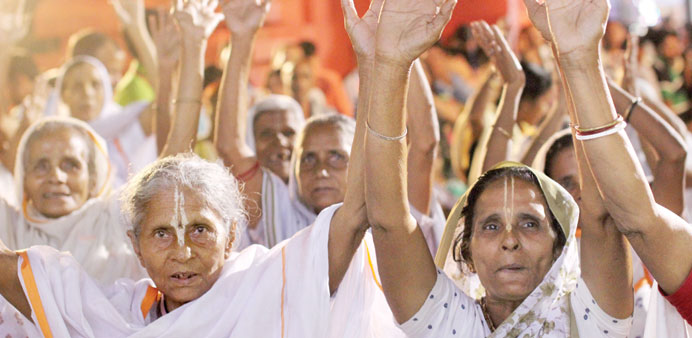
Widows from the religious city of Vrindavan dance and sing during the Durga Puja festival in Kolkata.
By Doreen Fiedler
Joyously, the widows throw their arms in the air. In their white saris, they sing and clap as they sway back and forth in a circle, part of their Durga Puja celebrations lasting several days in Kolkata, the capital city of West Bengal in India. For most of them, it’s their first partying in years, if not decades.
“It’s wonderful,” says 90-year-old Manu Ghosh. “We’re enjoying life.”
Strictly speaking, this shouldn’t be happening. But now women in India are breaking a centuries-old taboo. Tradition dictates that widows should not celebrate but instead live reclusively in the background, and that even their shadows should be kept from touching other people.
“Widows are looked on as bringing misfortune and so are shunned by society,” notes Kumar Jyoti Nath, former director of the All India Institute for Hygiene and Health. Today, he works for the aid group Sulabh, which is doing battle against this stigmatisation.
To this end, the organisation brought 50 widows, who had been living in isolation more than 1,000km away in the temple city of Vrindavan, back to their erstwhile home city.
In Kolkata they are now celebrating along with millions of other people the most important festival of the year, honouring the goddess Durga. Throughout the city, Durga is portrayed, her arms spread wide, as a mighty warrior conquering evil.
“We hope that we can trigger a social revolution so that widows may gain their rightful place in society,” says Sulabh founder Bindeshwar Pathak.
Many widows from West Bengal come to Vrindavan, where the Hindu god Krishna is held to have grown up and which is regarded as holy by many Hindus. Thousands of women live in ashrams, monastery-like centres, where they are left to fend for themselves.
Each morning the women rise at 4am to sing mantras in the temples for three hours for 5 rupees (8 US cents). Sometimes they are given alms such as rice or clothing.
When they die and there is no one to pay for burial rites, they are hacked into pieces at night by street cleaners, with the body parts stuffed into jute sacks and thrown into the Yamuna River.
Eight years ago, Kamla Agarwala, now 43, came to the Leela Punj ashram.
“It wasn’t because my husband died, but because he left me,” she said. “My brothers aren’t wealthy and nobody could care for me.” She has concealed her long dark hair beneath a purple-coloured sari.
The 20 other women with whom she shares a stuffy dormitory room, by contrast, are wearing white saris: colours and worldly joys such as sweets are often denied to widows.
In some parts of India women are regarded as “ardhangini,” meaning they have half the body of their husband. If he dies, then so does she. It was common in some communities that, during the cremation of their husbands, the widows would throw themselves onto the pyre.
During a visit to India earlier this year, the United Nations special rapporteur on violence against women, Rashida Manjoo, determined that isolated instances of this custom still occur.
In the 2005 film Water by female Indian director Deepa Mehta, the liberal hero Narayan explains the fundamental economic factors behind why widows are cast out by their families: “One less mouth to feed. Four saris saved. One bed and one corner available in the house.”
Manu Ghosh, 90, says it was her own decision to go to Vrindavan, done out of love for Lord Krishna. “After my husband’s death I told my family, ‘I’m not staying with you, I’m going to a sacred place.’”
For 40 years Ghosh has lived Vrindavan, where she says she feels the presence of her god. But now she is back in her home city of Kolkata for the first time since leaving.
“We are meeting so many people and seeing the huge, colourful statues of Durga, and all these lights,” she exclaimed. But she has not seen her family. The Sulabh group contacted the relatives of the 50 widows. Only one family responded. — DPA