


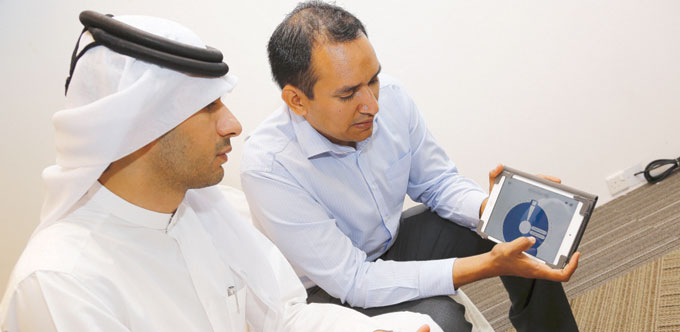
Qatar Foundation International (QFI) and Qatar Computing Research Institute (QCRI) recently launched Madar al-Huruf, a mobile application that introduces native English speakers to the Arabic alphabet.
Originally launched in the US as a physical device, the wheel is being brought to the digital world through the combined efforts of QCRI, QFI and the original designer, in an effort to extend its reach globally to individuals and communities unfamiliar with Arabic. QFI is now launching the Mobile application version of Madar al-Huruf which can be downloaded from the iTunes store onto their smart mobile device by visiting https://itunes.apple.com/mx/app/madar-al-huruf/id717596929?l=en&mt=8.
The application uses an interactive and innovatively-designed Arabic language wheel created by Moneera al-Badi, a Qatari graphic designer and graduate of Virginia Commonwealth University Qatar. Meaning “wheel of letters” in Arabic, Madar al-Huruf is both a physical handheld and virtual wheel. It is user-friendly, designed to be rotatable on two sides and allows non-Arabic speakers to learn how to match English letters and sounds, such as their name, to their Arabic phonetic counterparts.
With QFI support, Moneera worked closely with US-based teachers of Arabic in Washington, DC to finalise the wheel’s design. Two Arabic teachers in Tucson, Arizona also assisted in developing the user guide and curriculum, making the wheel a truly global endeavour.
“Learning the basics of Arabic by writing your name, the name of your hometown or a friend’s name demystifies the language and increases appreciation for the culture in the process. And that is the goal of Madar al-Huruf. At Qatar Foundation International, we work with talented individuals and partners to break down linguistic and cultural barriers,” said Maggie Mitchell Salem, executive director at QFI
In bringing QFI’s physical transliteration tool to the digital environment, Dr Stephan Vogel, principal scientist in the Arabic Language Technologies team at QCRI, said: “We are excited to work on the virtual version of Madar al-Huruf with QFI and Moneera. We identified a gap in the online education domain for language learning and have been developing supportive technology for language learning including an assistive language learning tutor and an Arabic e-book reader. Madar al-Huruf serves as a great first step into a whole host of inventive language learning tools that QCRI has developed for non-native speakers of Arabic.”
Baljit Singh, a graduate of Carnegie Mellon University in Qatar, implemented the iPad and iPhone versions of Madar al-Huruf. Singh was an intern with QCRI during the summer of 2012 and worked on Arabia – a computer assisted language learning application.