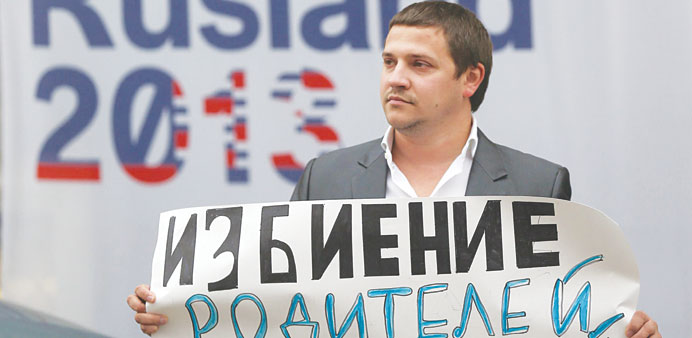
A Russian holds up a placard reading ‘Beating the parents in front of their children, it is your protection? This is crime’ yesterday in front of The Netherlands embassy in Moscow. The Dutch government had on October 9 apologised to Russia over the detention and alleged beating of a senior diplomat.
Reuters/Amsterdam/Moscow
The Netherlands was seeking answers yesterday after a Dutch diplomat was beaten up in Moscow, the latest in a series of incidents testing relations between the two countries.
Prime Minister Mark Rutte’s government summoned Russia’s ambassador in The Hague to explain Tuesday’s assault, in which the second-in-charge of the Dutch embassy in Moscow was attacked at his home by unknown intruders posing as electricians.
Last week, Dutch Foreign Minister Frans Timmermans had to apologise after a Russian diplomat was detained in the Hague.
Russia had complained that he was assaulted during the detention.
Both attacks coincide with tension over Russia’s jailing of Greenpeace activists, including two Dutch citizens.
Attackers broke into the apartment of the Dutch diplomat late on Tuesday, forced him to the ground, hit him and drew a heart containing the letters LGBT (lesbian, gay, bisexual, and transgender) on a mirror in pink lipstick, Dutch media reported.
The diplomat, named by Dutch media as Onno Elderenbosch, was slightly hurt, Timmermans said in a posting on Facebook.
Dutch officials were not releasing the name of the diplomat or details of the attack due to privacy regulations. He is listed on the embassy’s website, however.
Rutte told journalists the incident was “very serious”, and said that he wanted to know all the facts of the incident before making further comments.
Russia’s foreign ministry expressed regret over the attack and said it would track down the culprits.
The US condemned the incident.
“We condemn the attack on the minister-counselor of the Netherlands in Moscow. Such actions are unacceptable.,” US Ambassador to Moscow Michael McFaul said on Twitter.
Timmermans, a Russian speaker who was posted in Moscow in 1990s, said that he would phone his Russian counterpart Sergey Lavrov later in the day.
The Netherlands and Russia are celebrating four centuries of diplomatic ties this year with a series of high-level political visits, cultural exchanges and trade missions.
Dutch politicians urged King Willem-Alexander and Queen Maxima to cancel a visit to Russia planned for next month.
Lawmaker Sjoerd Sjoerdsma labelled 2013 a “disaster year” for Russian-Dutch relations.
A week ago, Timmermans apologised to Moscow for the detention of a Russian diplomat in The Hague, saying the envoy’s right to diplomatic immunity had been violated.
Moscow said attackers had entered the diplomat’s home, beat him with a police baton and illegally detained him for several hours over the previous weekend.
Earlier this month, the Netherlands launched legal proceedings against Russia, saying it had unlawfully detained activists on board a Dutch-registered Greenpeace ship who were protesting against oil drilling in the Arctic.
The Netherlands, the first country to legalise same-sex marriages, has also been at odds with Moscow over gay rights.
When Russian President Vladimir Putin visited Amsterdam in April, he was met by gay rights activists waving pink and orange balloons to protest against Russia’s treatment of homosexuals.
At the same time the countries have been ramping up bilateral trade in energy, construction and retail goods.
Dutch executives, including the head of global healthcare and consumer appliances group Philips, joined Rutte on a mission to Russia to drum up more business.
The Netherlands and Russia have more than 23bn euros ($31bn) in annual bilateral trade, with the Netherlands serving as a key hub for Russian oil and gas exports.
Thirty per cent of crude oil and 45% of oil products entering Rotterdam, Europe’s largest port, originate from Russia, making it by far the most important supplier.