


 |
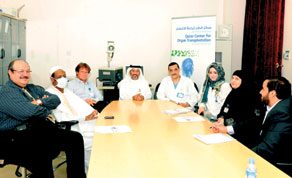
| The patient with QCOT team |
One of the most recent success stories was that of Dr Abdul Halim Ahmed Omar who chose HMC to have his kidney transplantation. Dr Omar, a Sudanese consultant nephrologist, working in Omdurman Military Teaching Hospital, had been suffering from kidney failure and was undergoing renal dialysis for the past eight months.
Dr Omar found dialysis treatment very challenging and difficult to maintain while trying to perform his normal duties as a physician in Qatar. He was familiar with the surgical team at HMC and had great confidence in their ability. He consequently sent his medical tests and reports to the transplantation team for evaluation and was delighted to be selected on medical grounds as a suitable candidate to undergo an organ transplantation operation.
Dr Omar and his brother, Al-Fateh, went to Hamad General Hospital (HGH), where tests and investigations were carried out. The comprehensive medical tests that are performed by HMC’s specialists indicated a strong compatibility between him and his potential donors (his brother and two sisters were ready to donate their kidney to him).
The meticulous transplant preparations were carried out over a month. The HMC surgical team, including Dr Yousef al-Maslamani, Dr Riyadh Fadhil, Dr Omar al-Faytouri, Dr Isam Omar and Dr Henric Anan successfully conducted the transplant on September 7, 2012.
“I thank His Highness Sheikh Hamad bin Khalifa al-Thani, the Emir of the State of Qatar, and his generosity which has led to significant investment being made in the health sector that benefits many people. Qatar has helped many people in the Arab world receive much needed medical treatment and I am proud of the high quality care provided here. I am also grateful to the clinical and administrative teams at the QCOT for their support and excellent care,” said Dr Omar, who continues to pursue his follow-up appointments at the outpatient clinic.
Elaborating on the experience of donating his organ to his brother, Al-Fateh Omar, the younger brother of Dr Omar, said: “Even though I live so far away from my brother, in Kurdofan province which is 600km west of Khartoum in Sudan, I immediately expressed my willingness to donate my kidney when I knew about his health condition. I was relieved when they told me that the tests showed tissue compatibility between my brother and me. We thank Allah that the transplant was a success and both of us are doing well. Currently I am continuing with my normal daily routine and regularly go for follow-up medical check-ups. We greatly appreciate the support given to us by the Qatar Red Crescent Society (QRCS) who have helped us in so many ways.
“This was a more complicated surgery but because of the extensive tests and laboratory investigations needed we were confident that the operation would be successful,” explained Dr Yousef al-Maslamani, surgeon and kidney transplant consultant, medical chief of staff at HGH and director of Qatar Centre for Organ Transplantation. He added that an increase in the number of kidney transplant interventions is expected to be performed this year. “We are currently preparing 10 pairs of organ recipients and donors for transplants”.
Dr Riyadh Fadhil, kidney transplant consultant, urologist and deputy director of Qatar Centre for Organ Transplantation, underlined that the centre has witnessed an increase in kidney transplant patients from Sudan, Morocco, Lebanon, Iraq, India and other countries. This confirms the growing reputation of the transplantation services and confidence in the team and the care it provides to patients.
Dr Fadhil added that he is proud of the team’s achievement and believes the reputation that has been established is a testimony of the humanitarian role played by the centre internationally, regardless of the patient’s sex, nationality or religion.
Dr Henrik Gjertsen, senior consultant within the organ transplantation team, performed the kidney removal using a leading-edge endoscopic surgery technique. “This type of surgery has many benefits for the patient – the surgery has less blood loss and in many cases there is no need for blood transfusions during the operation. This technique also results in less post-operative swelling, shorter operative time (surgery takes usually under an hour), and decreases hospital stay by several days – all of which is better for the patient.”
Dr Henrik said that kidney failure patients no longer need to seek kidney transplantation abroad. “Qatar now has high quality transplant services in our centre, which is staffed by highly qualified, internationally experienced surgeons and clinicians, who are supported by the best laboratories and facilities. The services we have here are on par with what I have seen in the Karoliska hospital in Stockholm, Sweden, where I worked previously for more than ten years.”
Dr Mohamed Nagi al-Masri, consultant of anaesthesia at HGH provided specialised pain control support during the operation. The patient’s heart condition had to be taken into account and Dr al-Masri opted to use local anaesthesia, instead of sedatives to control pain, which was better for the patient.