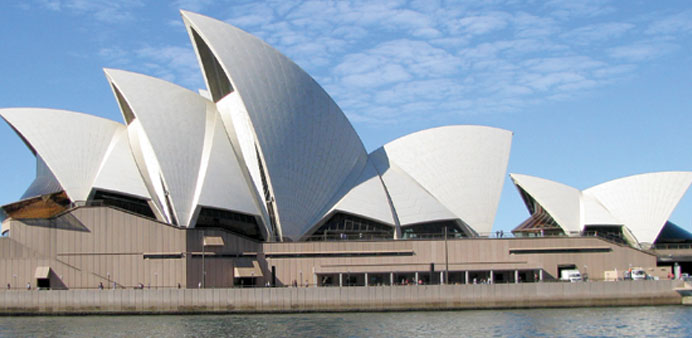
It took 14 years to piece together the Sydney Opera House, a job that came in 14 times over budget and 10 years behind schedule. Photograph: Sid Astbury
By Sid Astbury
It took professional modeller Jamie Berard three years and 2,989 Lego pieces to come up with a kit version of the Sydney Opera House. “It’s an amazing geometric puzzle. There’s nothing that just goes linearly in a box,” he said. “We actually stopped the project at one point because it just proved to be too difficult.”
It was the same 50 years ago for the builders who worked with Jorn Utzon, the Danish architect whose controversial design was chosen above 232 others.
(Except, of course, that trial and error with plastic bricks is easier than experimenting with reinforced concrete.)
It took 14 years to piece together the Opera House, a job that came in 14 times over budget and 10 years behind schedule.
Utzon fell out with his employers and was sacked before the puzzle was finished. He never returned to Australia to see it resplendent on the harbour.
Utzon was not there — his name was not even mentioned — when Britain’s Queen Elizabeth II opened the Opera House on October 20, 1973.
The Dane had to wait for recognition until 2003, five years before he died, when he won the Pritzker Prize, architecture’s highest award, for what had become one of the world’s most-loved, most-photographed, most-visited buildings.
At the prize-giving, he described his masterpiece as a “symbol for not only a city but a whole country and a continent.”
Berard reckoned that if he could literally piece together the sails that form the roof of the Opera House, the rest would come easily. “That was basically the proof of concept,” he said. “If I could get that right, I felt like the rest of it we could figure out.”
In the real thing, 2,194 roofing sections are held together by 350km of steel wire. In engineering terms, it is not pretty — but it works. What the roof covers is a different matter. Sets, stages and even performers have to arrive and depart by the lifts rather than from the flanks of the building.
“Everything is so sandwiched in,” Peter Sellars, a visiting opera director, moaned. “There’s not an extra inch anywhere.”
The brass section in the orchestra pit of the opera theatre is screened off from the rest of the ensemble so other players are not deafened. In the main concert hall, Perspex “doughnuts” hang from the ceiling — an ugly retrofit to try and make the acoustics work better.
But for most of the 9mn people who come to see the Opera House each year, the outside is all that matters.
Brazilian visitor Fellipe Mathias de Silva, in Sydney for three months to learn English, paid homage to its uniqueness as he gazed in wonder at Utzon’s curvaceous structure. “It’s very different from other buildings,” he said. “If you come to Australia, the first place you need to know is the Harbour Bridge and the Opera House. It’s different. It’s not square. Most buildings are squares.”
Fellow Brazilian Paulo Andre Cavalcante, an economist, said the Opera House was not Australia’s greatest icon — that was the kangaroo — but the building was certainly nice to look at.
Australian author David Malouf, who lived through the 14 years of construction and Utzon’s dramatic exit, wrote in more lyrical terms in praise of the World Heritage-listed building, saying the harbour city had recomposed itself around its crowning glory “as if it had been waiting for just this miraculous object to appear and claim its place.”
Opera House? It is a bit of a misnomer.
There are rock concerts under the sails. In the 1970s it hosted the world boxing championships. Business conventions are a regular feature.
The Opera House reflects Australia’s determined egalitarianism. It has catered to sports fans by showing World Cup matches on a giant screen. It was also host of the final of Australian Idol, one of the nation’s most watched entertainment broadcasts.
What goes on inside does not seem to distract from the majesty of the building itself.
“It’s uplifting,” said Brian Fardon, who has worked as an usher at the Opera House since it opened 40 years ago. “It just lifts you up. It really does. For once, they did it right.”
Fardon, 74, said he would still spend his days at the Opera House even if he were not paid to do so.
“I gave up full time work in 1999 when I retired,” he said. “But I still kept this going because it’s fabulous, I love it.” – DPA