


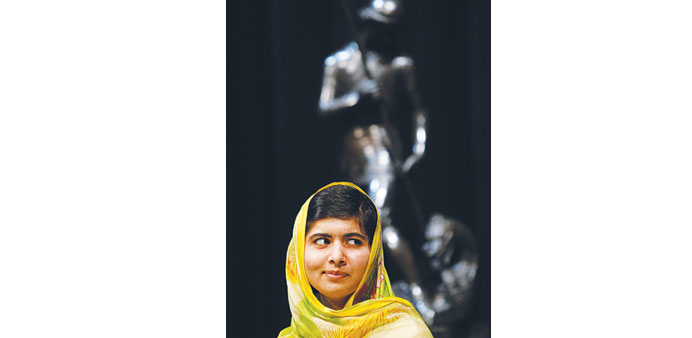
A picture taken on July 26, 2013 shows Pakistani student Malala Yousafzai receiving the XXV International Prize of Catalonia award from Artur Mas, president of the Catalan regional government, at the Generalitat Palace in Barcelona.
Internews/Peshawar
Though Malala Yousafzai failed to win the prestigious Nobel Peace Prize, she has already set up an enviable record by winning 17 international awards.
The 16-year-old education campaigner has been the youngest recipient of so many awards. Her awards were won in a one-year period after being injured in an attack by a Taliban gunman in Mingora in Swat on October 9, 2012.
The experts, mostly from Norway where the Nobel Peace Prize is awarded, large sections of the media and the betting agencies had listed Malala as the favourite for the award.
However, Malala was more realistic than all of them as she had argued before the announcement that she didn’t deserve the Nobel Peace Prize yet. On another recent occasion, she had remarked that receiving the Nobel Peace Prize would be an honour and more than she deserved.
By winning the European Parliament’s coveted Sakharov human rights prize a few days before the announcement of the Nobel Peace Prize, Malala had apparently surged ahead of other top contenders for the latter award.
She had beaten the US intelligence leaker Edward Snowden for the Sakharov award. Malala was the favourite for this award as she enjoyed the support of the three main political groups in EU parliament.
However, the five-member Nobel Committee selected the Organisation for the Prohibition of Chemical Weapons (OPCW) while awarding the Nobel Peace Prize. It seemed the committee chose the winner by reasoning instead of emotion.
It was the second consecutive year that an organization instead of an individual was honoured. In 2012, the Nobel Peace Prize was given to the European Union.
Earlier, Malala had won her 16th award named after the Russian investigative journalist who was shot dead seven years ago. It is called the RAW in WAR Anna Politkovskaya Award.
RAW in WAR promotes women who have defended human rights. Last year’s winner was Marie Colvin, the journalist with British newspaper The Sunday Times, who was killed covering the Syrian conflict.
The previous 15 awards that Malala won are as follows: (1) Harvard Foundation Humanitarian Award - 2013 Peter J Gomez Humanitarian Award Harvard University humanitarian of the year, (2)Clinton Global Initiative Global Citizen Award, (3)Amnesty International Ambassador of Conscience Award, (4) Tipperary International Peace Award, (5) Observer Ethical Awards - International Campaigner of the Year, (6) Kids Rights - Children’s Peace Prize, (7) Pakistan’s National Peace Prize, (8) Simone de Beavoir Prize, (9) Premi Internacional Catalunya, (10) Opec Fund for International Development Annual Award for Development, (11) Atlantic Council Freedom Award, (12) Unicef Spain Mobilise Award, (13) Oklahoma City National Memorial and Museum Reflections of Hope Award, (14) Rome Prize for Peace and Humanitarian Action, (15) Mother Teresa Memorial Award for Social Justice.
Malala says she’s no Western puppet
Malala Yousafzai hit back at claims that she has become a figure of the West, insisting she was proud to be a Pakistani.
The 16-year-old, who was shot by the Taliban for championing girls’ right to an education, claimed she retained the support of people in her homeland, and reiterated her desire to enter Pakistani politics.
The activist was shot in the head on her school bus on October 9 last year for speaking out against the Taliban.
She was flown for specialist care in Britain, where she has continued her education, while she has been feted and honoured in the West.
On Thursday, she won the European Union’s prestigious Sakharov human rights prize, while US President Barack Obama welcomed her to the White House on Friday.
Asked in a BBC television interview broadcast yesterday about some people in Pakistan thinking she was a “figure of the West” and “a Westerner now”, she said: “My father says that education is neither Eastern or Western. Education is education: it’s the right of everyone.
“The thing is that the people of Pakistan have supported me. They don’t think of me as Western. I am a daughter of Pakistan and I am proud that I am a Pakistani.
“On the day when I was shot, and on the next day, people raised the banners of ‘I am Malala’. They did not say ‘I am Taliban’.
“They support me and they are encouraging me to move forward and to continue my campaign for girls’ education.”
She highlighted the problem of education in the midst of the Syrian conflict.
“We want to help every child in every country that we can,” she said.
“We will start from Pakistan and Afghanistan and Syria now, especially because they are suffering the most and they are on the top that need our help.
“Later on in my life I want to do politics and I want to become a leader and to bring the change in Pakistan.
“I want to be a politician in Pakistan because I don’t want to be a politician in a country which is already developed.”