


Just like learning is a continuous process so, too, are methods of teaching. Nothing really is cast in stone as long as these help the teacher impart and the students develop cognitive skills.
One teaching method may differ from another in content, approach and style, but what is instructive is to keep an open mind and embrace all that is effective, and encourages the learner to harness the skill(s) he or she derives from learning and be able to employ it to his or her advantage in life.
October 5 is marked as the International Teacher’s Day. The Next Generation School celebrated the occasion by paying tribute to teachers through a seminar on “Quality Education” held on the school campus.
A number of teachers, mentors and prominent community members attended the session where six research papers were presented by leading educationists, who suggested bringing uniformity in the standards across the board.
As ever, a rich discourse followed with different speakers presenting different ideas and approaches, but all with a purpose to imbibe learning as a tool, which goes beyond the classroom.
Some excerpts from the underpinnings:
* Mrs Shagufta Bakali, CEO, The Next Generation School
Learners who are healthy and well nourished are ready to participate and learn; they are supported in learning by their teachers and parents. So environment that is safe and protective provides adequate resource and facility. It is with this process through which trained teachers use child-centred teaching approaches in well managed classrooms and schools. Teachers are role models; teaching is quintessentially, a profession that teaches all professions. This is a life process. Yesterday, we paid tribute; today, this generation expresses itself.
This educational seminar has been a unique experience, but for The Next Generation School everything is about being different and this spirit and difference will continue.
* Mrs Marry Dedinsky, Professor and Director of Journalism program, Northwestern University in Qatar.
Professor Marry Dedinsky has been teaching journalism for two decades — and in Doha since 2010. Extolling the profession, she said:
Teachers must thoroughly and completely be in control of what is to be taught and how it is to be taught and it requires a lot of work by the teachers even before they are in the classroom to teach.
When the teacher delivers the lecture, students can answer the quiz that is being taught to them in the class but it is very difficult for them to understand its application or how they can connect the academic concept to their daily lives.”
The immediate feedback of the instructor is very important as well as the practice of the subject matter. In the class, we are not to test the memory of the student but to test their knowledge, learning and understanding.
College education is very different from school education. You can see that people with college background are masters of their own lives because they have a different way of learning and getting educated. I would emphasise on the Socratic method of teaching. The student should be an active participant. Skills need to be developed for people to become powerful and to have dimensions to high quality education.
My suggestion to the teachers is, if you have the privilege of teaching a class, use the class to make students work. This way, they will not only seek the information that may be useful to them but also acquire skills they can use for a life time.
Teach the skills of the subject beyond the content of the subject. Student should learn how to do something, how to prove something and this is the experience of their lives.
* Mrs Noryn Ali, Masters Business Communication, MIS-IT Class teacher Year VI
In today’s rapidly changing world, teaching techniques are also changing. There are many popular trends that are used in making teaching effective and interesting. When we talk about the emerging trends, we can see varieties of methods such as online learning techniques, game-based learning, video conferencing, experiential learning or learning by doing, in class library, research-based learning and many more but there are hindrances in bringing all these concepts to life. When we talk about the difficulties, we face untrained parents, non-willing teachers, time constraint and non-supportive management. But it’s easy to remove the obstacles. We need to coach the parents to become part of the regular training sessions and get familiar with the new learning systems.
A dedicated team is required to explore, devise and provide reference resources to the teachers; instructors learn through tutorials about the delivery methods and should be equipped with the latest training and teaching kits.
Teaching gets even more interesting when students grasp every concept which is being delivered. For this, many techniques are practical and effective. Some may not be acceptable to parents and the management of an educational institute, because of a typical mindset about a traditional classroom. Thus it is important that the triangle of the management, parents and teachers work together.
It is a common observation that some students grasp far better than others and it is entirely likely that the performance of almost half the class is average. The ability is not in question; rather, it is the level of parental involvement, (how much) exposure the teachers have and how effective their methodologies are.
Since it’s a matter of great importance and every student must be treated equally, it is advised that such techniques of teaching be adopted which let the teachers spend more time with those students individually, who are not as resourceful as some of their class members.
* Mr Muqeem Khan, Professor Northwestern University in Qatar
I have always believed that channelled imagination is the key to success. Young minds are full of energy and their thoughts pure. They have a different perspective and sometimes they see what we adults don’t.
The easiest way to teach is from the heart; similarly, the easiest way to learn is from the heart. If a student is connected to something emotionally and psychologically, he or she will put in all the physical and mental effort.
You as a teacher just have to sit back, relax and watch how they develop. In my class, I always emphasise on bringing out the emotional side of my students where they can relate their dreams to the concepts that are being taught in the class. And build upon what they believe is the way to go.
* Riyaz Ahmed Bakali, Founder, Director The Next Generation School
I will emphasise on the conceptual importance of strategic direction. Strategic direction is required and leads towards the development of a comprehensive strategic model for an educational institution.
It defines the strategic model which leads towards coherent and successful conceptual development required for an academic strategy and cascading then from institutions, organisations, teams and individual team members.
Strategic planning in education leads to a quality education model, with its practical application of derived standards in the institute.
The need of the day is to understand the context of the mission which represents its reason for existence and that the mission of the institution should always drive decisions.
I would suggest the following points for educational institutes to follow.
Get the mission and vision right.
Adopt quality to develop standards.
Have a process based approach.
The need of the day is ownership styles of educational institutes.
Most important is the openness towards change.
Education is no more a business, think education strategy more than business strategy.
The event was chaired by Dr Shaukat Chandna who delighted the audience with his wit and new approach towards bringing change in the field of education.
Rashid Nizam, the Community Welfare Attaché at the Pakistan Embassy, graced the occasion as the chief guest.
Certificates were awarded to the participants and mementos handed to the speakers.
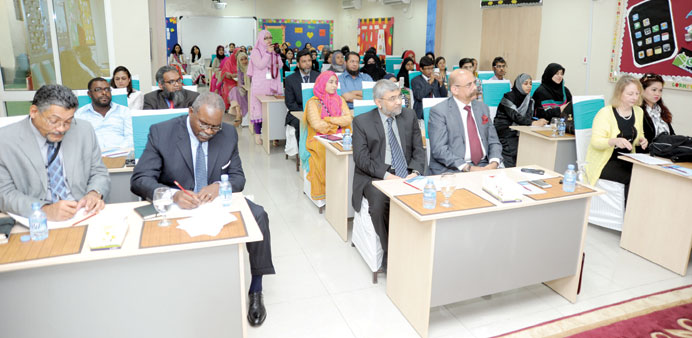
Participants all ears at The Next Generation School’s ‘Quality Education’ seminar.