


By Gautaman Bhaskaran
Strangely, India appears immune to recognising genius. At least not until that genius is acknowledged outside the country. Of course, everybody knows that Satyajit Ray was ignored at home — in Bengal — till the Cannes Film Festival honoured him with an award, albeit a minor one. But that was enough to wake up his own countrymen. Even decades later, it was Hollywood’s Oscar for Lifetime Achievement which was given to him on his deathbed in 1992 that pushed the Government of India to bestow the Bharat Ratna on the master.
Similarly, Indian mathematical genius Srinivasa Ramanujam, who was born in Erode, studied in Kumbakonam and lived in what was then Madras (all in southern India), was ignored, even shunned by the nation’s literati, and forced to grow and develop in isolation. Till the West looked at him.
There is an interesting paragraph on him in Wiki. He “was an Indian mathematician and autodidact who, with almost no formal training in pure mathematics, made extraordinary contributions to mathematical analysis, number theory, infinite series, and continued fractions. Living in India with no access to the larger mathematical community, which was centred in Europe at the time, Ramanujam developed his own mathematical research in isolation. As a result, he rediscovered known theorems in addition to producing new work. Ramanujam was considered to be a natural genius by English mathematician G H Hardy, in the same league as mathematicians Euler and Gauss”.
Hardy, unlike the learned Indians of the time, understood Ramanujam’s brilliance and invited him to Cambridge. The two worked together, but malnutrition and illness killed Ramanujam in 1920 when he was just 32. During his short life, he independently compiled 3900 results, mostly identities and equations, and almost all of them have been proved correct.
However, for generations of Indians, Ramanujam has remained a virtual stranger, and it is in this context that Gnana Rajasekaran’s under-production biopic on the mathematical wizard assumes immense importance. The film being shot in Tamil and English, has Abhinay (son of the renowned Tamil actors, Gemini Ganesh and Savithri) playing the protagonist.
During a shoot in an old bungalow in the busy Nungambakkam area of Chennai — a scene where we see a tuberculosis-struck young Ramanujam resting by his bed and working on his mathematical discoveries — Rajasekaran, the Indian Administrative Service (IAS) officer-turned-moviemaker, tells me that he has been specialising in and fascinated by biopics. He already has to his credit two; one on Tamil poet Bharati, and the other on Tamil social reformer, rationalist and father of the Dravidian movement Periyar or E V Ramasamy. One would suppose that the film on Ramanujam would have a far greater appeal at home and outside, given the new impetus that is now being given to the life and work of the prodigy.
Ramanujam had been on Rajasekaran’s mind for a long time, and the movie finally happened after an amazingly varied journey. Basically a writer, Rajasekaran dabbled in Marathi theatre during his four-year stint with the Ministry of Home Affairs in Mumbai, a job that frequently took him to New Delhi, where he watched great plays staged by the National School of Drama. His father’s death and his last wish to see his son as an IAS officer impelled Rajasekaran to pursue a career in administration.
But luck seemed to hold his hand. While earlier at the Ministry, he was given an assignment in the photo department, where he dabbled with cameras and lenses (his earlier and brief stint at the film institute in Chennai coming in handy), his first IAS posting was in Kerala, a State where cinema and culture are held in high esteem. Recognising his interest, he was asked to head the Kerala Film Development Corporation.
It was during his Kerala days that Rajasekaran made his first movie called Mogamul (1994), a plot that was syrupy and soapy, but radical for those times. It dealt with a young boy falling in love with an older woman. Bharati and Periyar followed in 2000 and 2007 respectively, and with Ramanujam, the director appears to have completed his trilogy of great Tamils.
Rajasekaran’s film begins in 1887, the year Ramanujam was born, and ends with his death in 1920, and takes us through his early days at Kumbakonam and later, at Cambridge. The movie unit had a 15-day schedule at Cambridge, where the strictest of conditions were imposed. A professor was assigned to make sure that the crew and cast did not dirty the place (something common among Indian cinema guys); they were not even allowed to touch the walls!
Earlier, the film was shot at the house in Kumbakonam where Ramanujam spent his boyhood. The building is being preserved as a memorial by the Sastra University. The camera then panned to among other places the Town School and the Government College in the same city where Ramanujam studied, and then to the Chennai Port Trust, where he worked as a clerk.
Rajasekaran says that his aim in making Ramanujam was to underline the callousness with which we treat our prodigies and geniuses. The mathematician was a classic case. Nobody, or just about, understood the man’s aptitude and ability. “One of the biggest problems in India is the way talent is suppressed by society, often through marriage. You get the man married and burden him with domesticity, as Ramanujam was”, Rajasekaran quips. He hopes that his movie would help the country realise how wrong it is to ignore greatness.
For every Ramanujam, there may have been many others who could have died unsung. As Bertrand Russell once wrote, for every genius who might have triumphed over adversity, there could have been others who succumbed in youth. Rajasekaran’s Ramanujam will be a study in struggle, the struggle of a man whose infinite numbers made little sense to fellow Indians. They only saw in him oddity and eccentricity. But these precisely were the traits of a mastermind, few understood, till Ramanujam sailed the seas to faraway shores where accolades and awards awaited him.
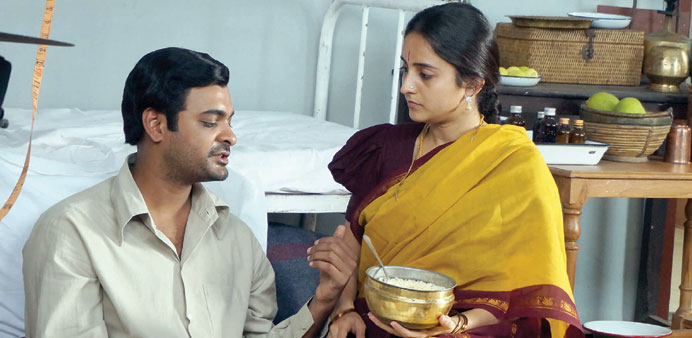
Abhinay as Ramanujam in a scene from the movie with the same title.
* Gautaman Bhaskaran has been writing on Indian and world cinema, and may be e-mailed at [email protected]