


By Dr Zaira K S
Worldwide, glaucoma affects about 6 billion people and is the leading cause of irreversible blindness. In fact, as many as 6 million individuals are blind in both eyes from this disease. As many as half of the individuals with glaucoma, however, may not know that they have the disease. The reason they are unaware is that glaucoma initially causes no symptoms, and the loss of vision on the side (periphery) is hardly noticeable.
What is glaucoma?
Glaucoma is a disease of the major nerve of vision, called the optic nerve. The optic nerve receives light-generated nerve impulses from the retina and transmits these to the brain, where we recognise those electrical signals as vision. Glaucoma is characterised by a particular pattern of progressive damage to the optic nerve that generally begins with a subtle loss of side vision (peripheral vision). If glaucoma is not diagnosed and treated, it can progress to loss of central vision and blindness.
Glaucoma is usually, but not always, associated with elevated pressure in the eye (intraocular pressure). Generally, it is this elevated eye pressure that leads to damage of the eye (optic) nerve. In some cases, glaucoma may occur in the presence of normal eye pressure. This form of glaucoma is believed to be caused by poor regulation of blood flow to the optic nerve.
What causes glaucoma?
Elevated pressure in the eye is the main factor leading to glaucomatous damage to the eye (optic) nerve. The optic nerve, which is located in back of the eye, is the main visual nerve for the eye. This nerve transmits the images we see back to the brain for interpretation. The eye is firm and round, like a basketball. Its tone and shape are maintained by a pressure within the eye (the intraocular pressure), which normally ranges between 11 mm and 21mm (millimetres) of mercury. When the pressure is too low, the eye becomes softer, while an elevated pressure causes the eye to become harder. The optic nerve is the most susceptible part of the eye to high pressure because the delicate fibers in this nerve are easily damaged.
How is glaucoma diagnosed?
An eye doctor (ophthalmologist) can usually detect those individuals who are at risk for glaucoma (because of, for example, a narrow drainage angle or increased intraocular pressure) before nerve damage occurs. The doctor also can diagnose patients who already have glaucoma by observing their nerve damage or visual field loss.
The following tests, all of which are painless, may be part of this evaluation:
Tonometry determines the pressure in the eye.
Pachymetry is a relatively new test being used for the diagnosis and treatment of glaucoma. Pachymetry determines the thickness of the cornea.
Gonioscopy is to examine the drainage angle and drainage area of the eye. In this procedure, the doctor can determine whether the angle is open or narrow and find any other abnormalities within the angle area.
Ophthalmoscopy: This procedure is done to examine the optic nerve (seen as the optic disc) at the back of the eye. Damage to the optic nerve, called cupping of the disc, can be detected in this way.
Visual Field testing actually maps the visual fields to detect any early (or late) signs of glaucomatous damage to the optic nerve. This process produces a computerised map of the visual field, outlining the areas where the eye can or cannot see.
Other, more sophisticated tests may also be employed. All of these tests need to be repeated at intervals to assess the progress of the disease and the effect of the treatment.
How often should someone be checked (screened) for glaucoma?
The following are the American Academy of Ophthalmology’s recommended intervals for eye exams:
Age 20-29: Individuals of African descent or with a family history of glaucoma should have an eye examination every three to five years. Others should have an eye exam at least once during this period.
Age 30-39: Individuals of African descent or with a family history of glaucoma should have an eye examination every two to four years. Others should have an eye exam at least twice during this period.
Age 40-64: Individuals should have an eye examination every two to four years.
Age 65 or older: Individuals should have an eye examination every one to two years.
These routine screening eye examinations are mandatory since glaucoma usually causes no symptoms (asymptomatic) in its early stages. Once damage to the optic nerve has occurred, it cannot be reversed. Thus, in order to preserve vision, glaucoma must be diagnosed early and followed regularly. Patients with glaucoma need to be aware that it is a lifelong disease. Compliance with scheduled visits to the eye doctor and with prescribed medication regimens offers the best chance for maintaining vision.
What is the treatment for glaucoma?
Although nerve damage and visual loss from glaucoma cannot usually be reversed, glaucoma is a disease that can generally be controlled. That is, treatment can make the intraocular pressure normal and, therefore, prevent or retard further nerve damage and visual loss. Treatment may involve the use of eye drops, pills (rarely), laser, or surgery.
What are glaucoma risk factors?
Glaucoma is often called ‘the sneak thief of sight’. This is because, as already mentioned, in most cases, the intraocular pressure can build up and destroy sight without causing obvious symptoms. Thus, awareness and early detection of glaucoma are extremely important because this disease can be successfully treated when diagnosed early. While everyone is at risk for glaucoma, certain people are at a much higher risk and need to be checked more frequently by their eye doctor.
The major risk factors for glaucoma include the following:
* Age over 45 years
* Family history of glaucoma
* Black racial ancestry
* Diabetes
* History of elevated intraocular pressure
* Near sightedness (high degree of myopia), which is the inability to see distant objects clearly
* History of injury to the eye
* Use of cortisone (steroids), either in the eye or systemically (orally or injected)
* Farsightedness (hyperopia), which is seeing distant objects better than close ones (Farsighted people may have narrow drainage angles, which predispose them to acute [sudden] attacks of angle-closure glaucoma).
What are the different types of glaucoma?
There are many different types of glaucoma. Most, however, can be classified as either open-angle glaucomas, which are usually conditions of long duration (chronic), or angle-closure (closed angle) glaucomas, which include conditions occurring both suddenly (acute) and over a long period of time (chronic). The glaucomas usually affect both eyes, but the disease can progress more rapidly in one eye than in the other. Involvement of just one eye occurs only when the glaucoma is brought on by factors such as a prior injury, inflammation, or the use of steroids only in that eye.
Can glaucoma be prevented?
Primary open-angle glaucoma cannot be prevented, given our current state of knowledge. However the optic-nerve damage and visual loss resulting from glaucoma can be prevented by earlier diagnosis, effective treatment, and compliance with treatment.
Secondary types of glaucoma can often be prevented by avoidance of trauma to the eye and prompt treatment of eye inflammation and other diseases of the eye or body that may cause secondary forms of glaucoma.
Most cases of visual loss from angle-closure glaucomas can be prevented by the appropriate use of laser iridotomy in eyes at risk for the development of acute or chronic angle-closure glaucoma.
For questions and clarifications please contact: [email protected]
* Aster Medical Centre, a division of DM Healthcare, a leading health conglomerate in the Middle East and India has collaborated with Optica, a leading optical retailer in the Middle East, to organise a one day long eye camp at Aster Medical Centres, located at C-Ring road and Musherib on October 10 from 8:30am to noon and again from 3:30pm to 8:30pm. For registration and enquiries, please contact on 33151015.
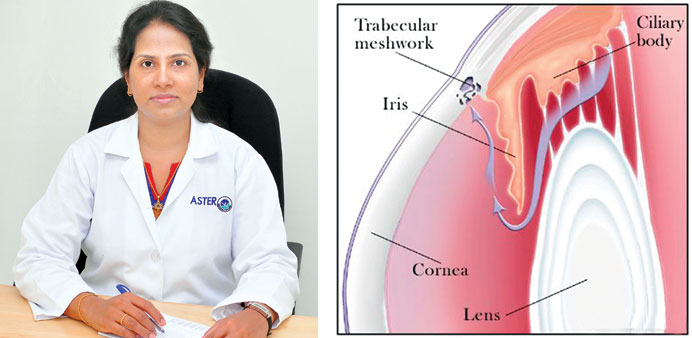
Dr Zaira K S, MBBS, DO Ophthalmology, Aster Medical Centre, C-Ring road