


 |
|
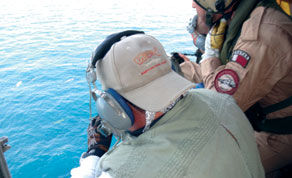
The surveyors at work near Al Shaheen area |
The air force rescue helicopters proved to be ideal for counting whale sharks, and more than 50 individuals were seen close to the offshore platforms of the Al Shaheen oilfield. “Aerial surveys are important in order to get a population count of whale shark and other species that live far from the coast. We are very grateful for the support provided by the Air Force” says Mohamed al-Jaidah, from the Ministry of Environment and leader of the Qatar Whale Shark Research project.
The Al Shaheen oilfield is operated by Maersk Oil on behalf of Qatar Petroleum. Recently the Ministry of Environment signed a memorandum of understanding with the Maersk Oil Research and Technology Centre committing the partners to promote research into marine biodiversity in Qatar waters. “It was a great experience to observe the whale sharks from the air. It was much easier to count them than from a boat and we could cover a larger area. We hope that this trip is something we can build on for future surveys”, says Mohamed al-Jaidah.
Mass gatherings of whale sharks are only seen in very few places in the world and the project is in the process of identifying the importance of the Al Shaheen area for the world’s biggest fish.
This week’s aerial survey, the first of its kind in Qatar, comes towards the end of a busy research season for the Qatar Whale Shark Research project. The project team, that includes David Robinson form Heriot-Watt University, has made frequent offshore visits in the May-September period that the whale sharks visit Qatari waters, deploying acoustic transmitters on individual whale sharks and acoustic receivers that can detect whale sharks that have acoustic transmitters attached to them.
In addition, satellite tags were attached to individual sharks in order to track movements within the Gulf and beyond and researchers performed photo ID and spot pattern identification.
The researchers have also taken samples of fish spawn, thought to be the whale sharks’ primary food source. This is the first year of a five-year research programme.
A documentary film highlighting some of this year’s research activities – including some spectacular underwater footage of whale sharks in Qatar — will be released in November.