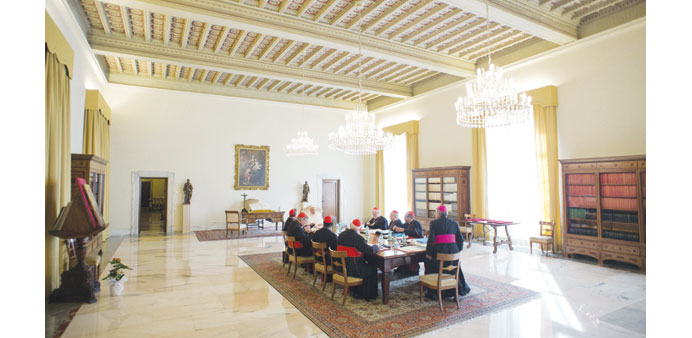
Pope Francis attends a meeting with cardinals yesterday at the Vatican. The cardinals began closed-door meetings with the Pope to help him reform the Vatican’s troubled administration, known as the Curia, and map out possible changes in the worldwide church.
AFP/DPA/Vatican City
Pope Francis outlined plans for reform of the Catholic Church to make it less “Vatican-centric” yesterday as he met top cardinals tasked with helping him overhaul the 2,000-year-old institution.
In his strongest censure of the intrigue-filled Vatican world yet, the Argentine Pontiff condemned “leprosy” in the Vatican and called for a less hierarchical church structured “horizontally”.
“Leaders of the church have often been Narcissuses, gratified and sickeningly excited by their courtiers. The court is the leprosy of the papacy,” Francis said in an interview with Italian left-wing daily La Repubblica.
The comments came as the Pope, who has become known for his humble style, met a group of eight cardinals that he has called to advise him on reforming the Vatican administration and bettering communication with local churches.
Francis has already taken steps to tackle one of the Vatican’s most high-profile problems: the scandal-plagued bank.
In June he set up a pontifical commission to analyse the bank and propose ways to reform it, and yesterday it published its accounts for the first time in a new drive for transparency.
A report in the Corriere della Sera daily said the bank was shutting 900 accounts as part of an internal audit, including ones deemed suspicious belonging to diplomats from the embassies to the Holy See of Indonesia, Iran, Iraq, and Syria.
The unique advisory board of cardinals meeting yesterday – an innovation in church government – is holding closed door talks for three days and is expected to address a range of problems.
These could include further financial reform, the role of women in the church and whether to soften institutional lines on issues such as the position of divorced Catholics and homosexuality.
It will also look at how to strengthen ties between the Vatican and local parishes, and place more focus on priests and their communities.
Vatican spokesman Father Federico Lombardi ruled out any quick decisions, indicating that more sessions would be held in the future.
“The Pope has said it, it is a lengthy work,” Lombardi said.
The cardinals were due to meet until tomorrow in the library of the papal apartment where Francis has refused to live, preferring a more humble Vatican guesthouse.
The Pontiff was expected to take part in the proceedings most of the time.
The Holy See “is too Vatican-centric”, the Pontiff said in the interview.
“It looks after the interests of the Vatican, which are for the most part, earthly interests. This Vatican-centric vision neglects the world that surrounds it,” he said. “I do not share this vision and will do everything to change it.”
“The church is – or must become once more – a community of the people of God, and the presbyter priests, vicars and bishops who cure souls are at the service of God’s people,” he added.
“We must restore hope to young people, help the old, be open to the future, spread love. Be poor among the poor. We need to include the excluded and preach peace,” the Pontiff told the La Repubblica newspaper.
Popes do not usually give interviews, but Francis has broken with tradition.
Two weeks ago he spoke openly about divorce, abortion and homosexuality in a wide-ranging conversation published by a group of Jesuit magazines.
Speaking to La Repubblica’s founder Eugenio Scalfari – who last month published a letter from the Pope in which he was told that God’s mercy applied to non-believers like him – Francis said he wanted to revive the reform-oriented spirit of the Second Vatican Council.
“The Council Fathers knew that being open to modern culture meant religious ecumenism and dialogue with non-believers. But afterwards very little was done in that direction. I have the humility and ambition to want to do something,” the Pope said.
The eight cardinals in the group come from Australia, Chile, the Democratic Republic of the Congo, Germany, Honduras, India, Italy, and the US.
“This is the start of a church structured just not vertically but horizontally as well,” Francis said.
The cardinals “are not courtiers but wise men who share my same feelings”, he added.
The 76-year-old said his focus lay on helping the church engage better with the modern world – while also returning to its humble roots.
“We have to open up to the future,” he said, recalling how the 1962-1965 Second Vatican Council, which carried out large-scale reforms to update the church.
Those who drew up the reforms “knew that opening up to modern culture meant Christian unity and dialogue with non-believers”.
“Little was done to follow up on it. I have the humility and ambition to want to do it,” Francis added.
The Pontiff recalled his namesake, St Francis of Assisi, who “longed for a poor church that looked after others, accepted monetary help and used it to help others with no thought of itself”.
“Eight hundred years have passed and times have changed, but the ideal of a missionary and poor church is still more than valid,” he said.
The first pope from Latin America also revealed that he had briefly thought about turning down the papal nomination after being elected by his fellow cardinals at a historic conclave in the Sistine Chapel in March.
“Before accepting, I asked if I could retire for a few minutes ... I felt great anxiety,” he said. “I closed my eyes and all thoughts disappeared. Even the one about refusing to accept the nomination. At some point a great light filled me. It lasted a moment but for me it seemed a very long time.”
Francis was elected in March, after the Catholic Church had been rocked by the resignation of his predecessor, Benedict XVI, and following a string of financial and sexual abuse scandals, as well as allegations of Vatican in-fighting.