


By Noimot Olayiwola/Staff Reporter
More than 50 patients have straightened their teeth at the Hamad Medical Corporation’s Dentistry Department, using the modern transparent approach called Invisalign – a custom-made series of aligners.
In a month, the Dentisty Department treats various dental issues among more than 2,000 patients, comprising mostly females including those aged between 50-60 years, Dentistry Department chairman and senior consultant professor Dr Henno Rainer-Reginald Miethke said at a press conference yesterday.
According to him, almost 90% of children being seen at the department now receive braces.
Meanwhile, more patients in Qatar are said to be opting for the aligner approach, which was invented in the US some 20 years ago and was introduced to Europe in 2001.
“Invisalign is the most developed, established, convenient and technologically advanced concept, which is a clear alternative to physical braces,” he said.
Over 1.4mn patients are reported to have been treated with Invisalign worldwide.
“We have introduced Invisalign to our patients since 2009 but we were not able to fix as many due to the cumbersome arrangement of getting the aligners across from the manufacturer in California because the system is heavily Internet based,” professor Miethke said.
He explained that since the concept is custom-based, it involves back and forth movement of patient’s data between Qatar and California.
“Once a patient indicates their interest in the aligners, we will send the impression of their teeth to California via the Internet and the data will go through the computer aided design/virtual set up. The data then begin to travel between here and San Jose until the braces are right and the patient is happy with it,” he said while explaining further that: “The approved data will then be sent for computer aided manufacturing/stereolithography/aligner fabrication thus forming a model and a plastic foil is created.”
According to the official, the process of creating the model has now improved with the opening of a branch of the manufacturing company in this region.
Professor Miethke explained that the aligner trays are made of smooth, comfortable and virtually invisible plastic that patient wear over their teeth and based on the exact movements their dentist or orthodontist plans out for them.
“The aligners gradually and gently shift the teeth into place, moving the tooth and closing any gap in between by between 0.10-0.33mm depending on the gap,” he said.
“There are no metal brackets to attach and no wires to tighten. You just pop in a new set of aligners approximately every two weeks, until the treatment is complete, usually lasting between three months to two-and-a-half years, depending on how complicated the case is,” he said.
Aside a little irritation to the gums, lips and teeth and feeling of discomfort for one to three days, the method seems to have no much complications, especially when compared to the traditional braces, he said.
He also noted that the aligners do not interfere with teeth brushing.
However, he stated that the braces could also be available in the private dental centre but at a slightly higher price compared to what the department is charging without mentioning any cost.
Professor Miethke maintained that the acceptance level among patient is increasing but added that some doctors are still reluctant to its use.
“Because doctors need a certain degree of information technology knowledge or a liking for the subject, some tend to view the procedure as a bit difficult. However, all doctors that must fix the braces should be certified in the procedure,” he noted.
Present at the press conference was Orthodontist-consultant Dr Abdumueen Ali Ahmad al-Qahtani.
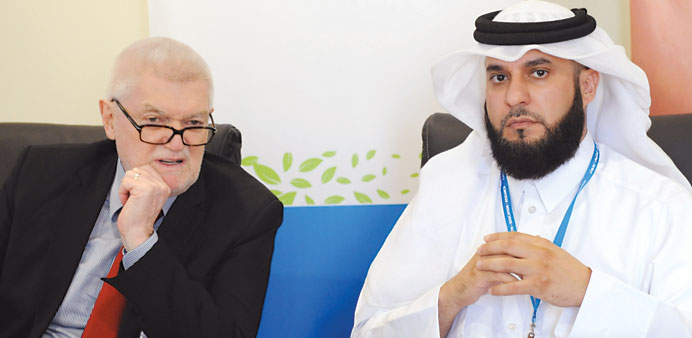
Professor Miethke and Dr al-Qahtani are seen during the press conference yesterday.