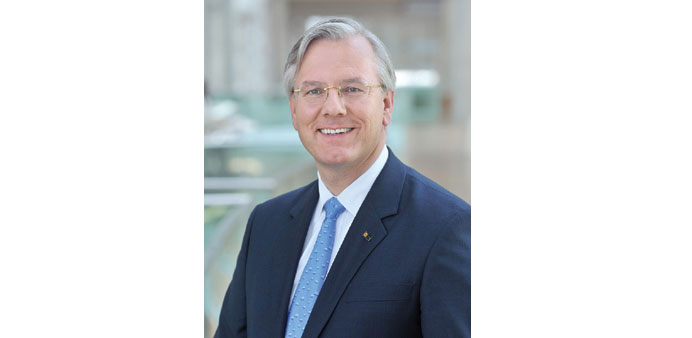
Dr Christoph Franz: “We are investing in the premium segment”. PICTURE: Jürgen Mai
By C P Ravindran/Seeheim, Germany
German flag carrier Lufthansa plans to invest 1mn euros (QR4.90mn) each day for the next 1,000 days to upgrade its products as part of a major expansion drive, its CEO Christoph Franz has announced.
Addressing a group of international journalists invited to attend a workshop on the Lufthansa group’s business plans and projections at the airline’s Aviation Academy at Seeheim near Frankfurt, Franz said that network carriers in Europe had to adopt new business strategies to meet challenges.
“Generally we can see an overcapacity with higher competition from low-cost airlines and fast-growing carriers from the Middle East,” Franz said.
“On top of that we find in our home market, Europe, a very aviation-critical framework, higher taxes and fees in Germany and the UK. Night flight bans and emission trading, the list gets quite long.”
He said that network carriers in Europe would have to reduce unit cost, cut off loss-making routes and increase revenues and yields.
“And we have to look abroad - new growth will happen outside of Europe with the Bric (Brazil, Russia, India and China) states taking a leading role. New traffic flows are new market opportunities.”
Pointing out that the ever-rising fuel price was a constant concern, Franz said: “The more optimistic the economic environment gets, the faster the oil price climbs - last year we had 24.8bn euros in traffic revenue and the fuel bill of 7.4bn euros was more than 30% of it.”
The International Air Transport Association (IATA), in its latest outlook for 2013, forecast a 1.8% profit margin out of a total $711bn in revenues globally for all airlines.
“That’s a small margin and it’s only a small increase compared with the (IATA) forecast before,” Franz noted. “In other industries investors and companies would leave the business with these small margins.”
Lufthansa, which is in the middle of a major restructuring programme, is investing in modern jets to cut its fuel bill and catch up with fast-growing Middle Eastern airlines, particularly in the hotly-contested routes between Europe and Asia.
It has already announced plans to buy 59 wide-body airliners in a deal with a book value of 14bn euros ($18.7bn) that will be split between America’s Boeing and Europe’s Airbus.
The order for 34 Boeing 777-9X and 25 Airbus A350-900 has been called the biggest in European aviation history.
Lufthansa’s supervisory board approved the order at a recent meeting in Frankfurt.
The twin-engine Boeing 777 and Airbus A350 offer significant fuel savings on long routes compared with their heavier, four-engine forerunners, the 747 and A340, which Lufthansa plans to phase out of its fleet.
Lufthansa expects the new aircraft, the first of which will be delivered in 2016, will enable it to make a “quantum leap in efficiency”.
Franz said that the latest order for 59 jets came on top of 236 planes for 22bn euros already on order, from the A380 to the Airbus A320neo.
“We are investing in the premium segment; Lufthansa is now the only Western airline with a five-star rating for its First Class. And, with more than 1,000 available seats per day, we are in the 5-Star class, the airline offering the biggest choice of First-Class seats, worldwide,” Franz said.
“Nearly 200,000 passengers have flown in our new fully-flat Business Class and they love it, the quality standards in the new Business Class are superb and we are further investing in order to speed up the installation of the new Business Class product in our fleet.
“Our Economy Class which now features personal in-seat screens across the fleet will get a further boost with the introduction of a premium economy in 2014.”
Franz said that Lufthansa was open to the idea of forming alliances with any of the Gulf airlines.
“We have investigated this question several times ... The Lufthansa group, we have done our own homework and we developed business plans, potential forms of joint ventures, etc, with the different Gulf carriers,” Franz said.
“So far we’ve come to the conclusion that it is not beneficial for us. But in our industry never say never. So if things and the environment are changing, maybe we come to new solutions.”
Lufthansa has two joint ventures, one covering the North American route with United Airlines and Air Canada, and another on the Europe-Japan stretch with All Nippon Airways. It is in talks to enhance its collaboration with Air China.
Franz, who is leaving Lufthansa next May to join Swiss drugmaker Roche as chairman of its board, said he believed the airline would continue its efforts to cut costs even after its restructuring programme, called SCORE, officially ends in December 2014.
The SCORE programme, which was launched in 2012, represents one of the most far-reaching restructuring processes in the history of Lufthansa. By 2015, the group aims to use the programme to boost its operating profit to 2.3bn euros.
“Our industry is not only sensitive to crises, it’s also a high-cost sector…Few changes can be made here. So we will need to change ourselves, if we want to survive into the future,” Franz had told Lufthansa’s annual general meeting earlier this year. “We want to shape the industry before it shapes us.”