


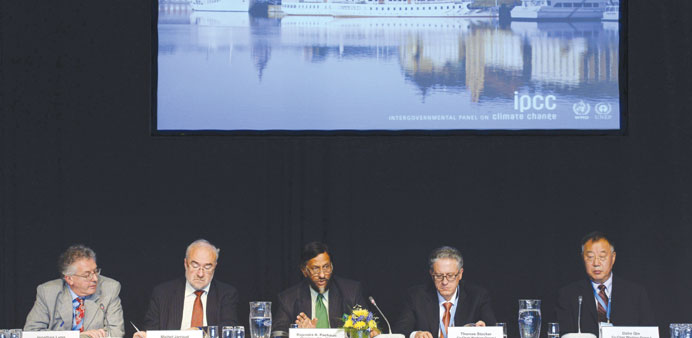
Moderator Jonathan Lynn, World Meteorological Organisation secretary-general Michel Jarraud, Intergovernmental Panel on Climate Change (IPCC) chairman Rajendra K Pacahauri, co-chair working group 1 Thomas Stocker and co-chair working group 1 Dahe Qin presenting the first volume of its Fifth Assessment Report, the first overview since 2007 of scientific evidence for climate change, in Stockholm yesterday.
AFP/Stockholm
The UN’s climate panel said yesterday it was more certain than ever that humans were the cause of global warming and predicted temperatures would rise another 0.3 to 4.8 degrees Celsius (0.5-8.6 degrees Fahrenheit) this century.
Heatwaves, floods, droughts and rising seas are among the threats that will intensify through warming, the Intergovernmental Panel on Climate Change (IPCC) said in a report released in Stockholm.
Environmental activists, scientists and leading politicians said the long-awaited review of climate science proved fossil-fuel burning must be urgently curbed.
In a government-approved summary, the Nobel-winning group said it was “extremely likely” - a term meaning it was 95% convinced - that humans caused most of the warming observed over the past 60 years.
In its last report in 2007, the panel had put this at 90%.
UN climate chief Christiana Figueres said the report was “an alarm-clock moment for the world”.
“To steer humanity out of the high danger zone, governments must step up immediate climate action and craft an agreement in 2015” against greenhouse gases, she said.
US Secretary of State John Kerry also urged strong action, labelling the report “yet another wakeup call”.
“Those who deny the science or choose excuses over action are playing with fire,” he said.
The volume is the first of a trilogy summarising the status of global warming and its impacts.
The IPCC has delivered four previous assessments in its 25-year history.
Each edition has sounded an ever-louder drumbeat to warn that temperatures are rising and the risk to the climate system is accentuating.
The projections for this century are based on computer models of trends in heat-trapping greenhouse gas emissions, especially from coal, oil and gas which provide the backbone of energy supply today.
The most optimistic of four warming scenarios sees an average temperature rise of 1.0 C (1.8 F) by 2100 over 2000 levels, ranging from 0.3 to 1.7 C (0.5-3.1 F). This is the only scenario that can safely meet the UN’s target of 2 C (3.6 F), which also factors in warming from the start of the Industrial Revolution to 2000.
By comparison, the highest IPCC scenario has an average warming this century of 3.7 C (6.7 F), ranging from 2.6 C (4.7 F) to a 4.8 C (8.6 F) - a maximum many experts deem catastrophic.
“Global surface temperature change for the 21st century is projected to be likely to exceed 1.5 C relative to 1850-1900 in all but the lowest scenario considered,” said Thomas Stocker, co-chairman of the working group that authored the report.
Heatwaves this century “very likely” will be more frequently and longer, he said, with added risk of floods and droughts in a warmer world.
Depending on how much carbon gas enters the atmosphere, sea levels will rise by between 26 and 82 centimetres by 2100, the report added.
Climate sceptics have pointed to a slowdown in warming over the last 10 to 15 years as proof that scientists’ models are flawed - or that global warming is a green scare