


Agencies/United Nations
US President Barack Obama yesterday cautiously embraced overtures from Iran’s new president as the foundation for a possible nuclear deal, but a meeting between the two leaders failed to materialise, underscoring entrenched distrust that will be hard to overcome.
In a speech to the UN General Assembly, Obama said he was determined to test President Hassan Rohani’s recent diplomatic gestures and challenged him to take concrete steps toward resolving Iran’s long-running nuclear dispute with the West.
But in a sign of the difficulties the two countries face in trying to seize a historic opening, US and Iranian officials were unable to orchestrate a much-anticipated handshake between the leaders on the UN sidelines in New York.
Even a brief encounter would have been symbolically important given that it would be the first direct contact between US and Iranian heads of government since before the 1979 Islamic revolution that ousted the US-backed shah.
“There will be no meeting,” a senior US official said. “We indicated that the two leaders could have had a discussion on the margins if the opportunity presented itself. The Iranians got back to us. It was clear that it was too complicated for them to do that at this time given their own dynamic back home.”
Rohani’s recent gestures, including agreement to renew long-stalled talks with world powers on Iran’s nuclear programme, have raised hopes for a thaw in relations between Washington and Tehran after a long period of estrangement.
But even as Obama welcomed signs of a “more moderate course” by Iran, Israeli Prime Minister Benjamin Netanyahu said the world should not be fooled by Rohani’s “soothing words.” The Israeli leader said Iran was trying to mask its continued quest for a nuclear bomb, something Tehran denies it is seeking.
“Conciliatory words will have to be matched by actions that are transparent and verifiable,” Obama told the annual gathering of world leaders in New York.
Differences over Iran’s nuclear programme and scepticism about Rohani’s intentions, especially from US lawmakers and close US ally Israel, have cast doubt on the prospect for any immediate breakthrough between Washington and Tehran.
Seeking to keep expectations under control, Obama said suspicions between the two countries were too great to believe their troubled history can be overcome overnight.
“The roadblocks may prove to be too great but I firmly believe the diplomatic path must be tested,” Obama said.
Obama suggested that Rohani’s overtures could provide the basis for an elusive deal to curb Iran’s nuclear ambitions and said he had instructed Secretary of State John Kerry to press a diplomatic effort along with other world powers.
But Obama stopped short of offering any concessions such as a softening of sanctions that have crippled Iran’s economy.
There had been feverish speculation that Obama and Rohani might greet each other in passing at a UN-hosted luncheon but the Iranian president skipped it. The reason was because alcohol was served with the meal, according to Press TV, Iran’s English-language broadcaster.
lNetanyahu ordered the country’s UN delegation to boycott Rohani’s speech yesterday, a spokesman tweeted.
Netanyahu “has instructed the Israeli delegation to act as they did last year and not be present during the Iranian president’s remarks”, Ofir Gendelman wrote on the social media website Twitter.
“When Iran’s leaders stop denying the Holocaust of the Jewish people, and stop calling for the destruction of the Jewish state and recognise Israel’s right to exist, the Israeli delegation will attend their addresses at the General Assembly,” Gendelman wrote.
Netanyahu, who will speak on October 1 at the week-long annual debate, is expected to tell the Assembly that Iran’s attempt to reconcile with the West was a “honey trap” to cover up its uranium enrichment for a nuclear bomb.
In his speech at the assembly last year, Netanyahu, who has not ruled out military strikes to stop suspected Iranian development of nuclear weapons capability, drew a red line on a white board featuring a cartoon bomb to illustrate the point at which Iran becomes nuclear armed.
An Israeli official told local radio on condition of anonymity that Netanyahu would urge world leaders not to fall into the trap of Iran’s diplomatic offensive.
“The current Iranian charm offensive aims at reaching a deal with the international community that will preserve Iran’s ability to rapidly build a nuclear weapon at a time of its choosing - the so-called breakout option,” states an internal Israeli document, a copy of which was provided to The Washington Post.
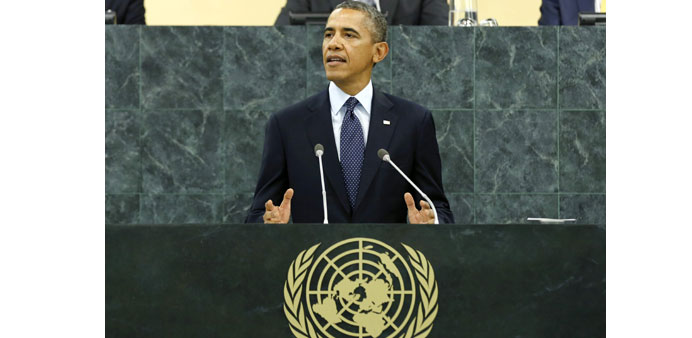
Obama speaks at the 68th UN General Assembly yesterday.