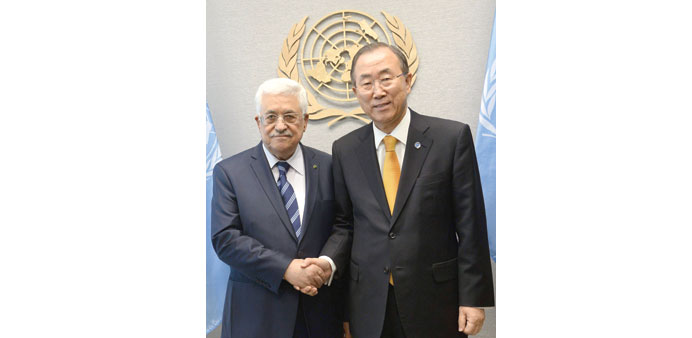
Palestinian President Mahmoud Abbas meets UN Secretary General Ban Ki-moon during the 68th UN General Assembly yesterday.
AFP/United Nations
US President Barack Obama yesterday urged the global community to overcome old prejudices and take the risks needed to help reach a peace deal between Israel and the Palestinians.
“The time is now ripe for the entire international community to get behind the pursuit of peace. Already, Israeli and Palestinian leaders have demonstrated a willingness to take significant political risks,” he told the UN General Assembly.
Two years after Palestinian President Mahmoud Abbas made a powerful plea to the annual UN summit to grant his people statehood, Obama said the US remained “determined to resolve a conflict that goes back even further than our differences with Iran: the conflict between Palestinians and Israelis”.
The Middle East peace process was relaunched in July after almost three years of stalemate.
US Secretary of State John Kerry spent months doggedly shuttling back and forth to persuade the two sides to return to the negotiating table.
With the guidance of newly appointed US special envoy Martin Indyk, Israeli and Palestinian negotiators have been meeting in secret to hammer out some of the thorniest issues standing in the way of a deal to create two states, living side-by-side.
In September 2011, Abbas handed over a formal request for Palestinian statehood to UN chief Ban Ki-moon, and triggered wild applause as he addressed the UN General Assembly, vowing the Palestinians were ready to return to peace talks if Israeli settlement activities cease.
But the dramatic move was immediately rejected by Israel and the US.
Obama praised Abbas for having now put aside efforts “to short-cut the pursuit of peace and come to the negotiating table”.
He also hailed Prime Minister Benjamin Netanyahu’s release of Palestinian prisoners and said the “current talks are focused on final status issues of borders and security, refugees and Jerusalem.”
“Now the rest of us must also be willing to take risks,” Obama insisted.
“Friends of Israel, including the US, must recognise that Israel’s security as a Jewish and democratic state depends upon the realisation of a Palestinian state,” Obama said in his address.
“Arab states - and those who have supported the Palestinians - must recognise that stability will only be served through a two-state solution with a secure Israel.”
“All of us must recognise that peace will be a powerful tool to defeat extremists, and embolden those who are prepared to build a better future,” he said.
“So let us emerge from the familiar corners of blame and prejudice, and support Israeli and Palestinian leaders who are prepared to walk the difficult road to peace.”
Abbas, who will address the UN tomorrow, met yesterday with UN chief Ban Ki-moon and they discussed “the role that the international community could play in support of the Middle East peace process in order to make tangible political progress towards the realisation of the two-state solution”, Ban’s office said in a statement.
They also discussed “the vital need for the international community to unite to bolster the fiscal standing of the Palestinian Authority”, the statement added.
Kerry’s team, in conjunction with the Middle East Quartet, is working on an economic plan to attract some $4bn in private investment to help shore up the Palestinian economy by investing in sectors such as technology, housing construction and tourism.
Qatar condemns Israeli violations of Palestinians’ rights
Qatar has condemned Israel’s ongoing violations of the Palestinian people’s rights and the continued attacks, excessive use of force and indiscriminate shelling of civilian areas, leading to many casualties, mostly women and children.
In a speech at the 24th regular session of the Human Rights Council at the UN Office in Geneva, the second secretary of Qatar’s permanent delegation Al-Mohannad al-Hammadi called upon the international community to exert all pressure on Israel, compelling it to abide by international law and stop all violations and barbaric military operations against Palestinian civilians, and to ensure accountability for all those responsible.
Qatar also strongly condemned the continuation of the unjust blockade imposed on the Gaza Strip and the placing of obstacles to movement that prevented Palestinians from accessing basic needs of food, fuel and building materials, as well as services such as health and education.
Al-Hammadi said Qatar would provide all it could to relieve the suffering of the trapped people in Gaza and continue to support relief, development and reconstruction projects there.
He said Qatar considered the continuation of the Israeli illegal settlement activities in the West Bank and East Jerusalem, forced evictions, house demolitions, building of the separation wall, increasing attacks by Israeli settlers on the lives and properties of the Palestinian people, and violating the sanctity of Al Aqsa mosque as serious breaches of international law.
Israel must understand that the issue of settlements represented a major obstacle to negotiation efforts being made in order to reach a just and comprehensive peace, al-Hammadi said.
Qatar condemned the torture and murder of Palestinian prisoners and detainees, calling on the international community to intervene to stop Israel’s criminal practices against them.