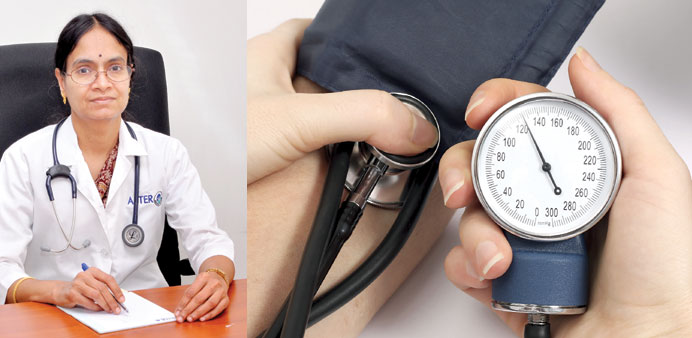
By Dr Maanvizhi
Hypertension or high blood pressure
Hypertension or persistently raised arterial blood pressure is one of the major risk factors for heart failure, myocardial infarction (heart attack), stroke and chronic kidney disease.
A series of trials have proved that antihypertensive therapy can reduce the risk of stroke by atleast 30% and risk of coronary heart disease by at least 20%. Management of hypertension requires a holistic approach involving multi-factorial interventions targeting not only blood pressure, but all modifiable cardiovascular risk factors.
How high should be my BP to term it as hypertension?
If the systolic (top) reading is sustained above or equal to 140mm of Hg or the diastolic (bottom) reading is sustained above or equal to 90mm of Hg or both, it is called hypertension.
Can we diagnose hypertension with just one reading above 140/90?
A minimum of at least 3 readings are taken with the person quiet and seated, with the arm supported, using an appropriate size BP cuff, with adequate rest between the readings. Ideally, BP is measured in both the arms. If the clinic BP remains 140/90 or greater, repeat BP checks are done over the next several weeks with advice on lifestyle modifications.
How is hypertension diagnosed? And what are the stages of hypertension?
Hypertension is usually diagnosed by blood pressure monitoring in the clinic. The average ambulatory daytime blood pressure measurement is more reliable. Individuals can also monitor their blood pressure using standard home BP monitoring equipment.
* Optimal blood pressure in an adult: <120/80mm of Hg
* Normal blood pressure: <130/85mm of Hg
* High normal blood pressure: >130/85mm of Hg.
Stages of hypertension:
Stage 1 – more than or equal to 140/90
Stage 2 – more than or equal to 160/100
Stage 3 – more than or equal to 180 /110
Isolated systolic hypertension — wherein systolic more than or equal to 160mm /diastolic <90mm of Hg.
Can we use home BP monitoring equipment to diagnose hypertension?
If the clinic BP readings are high, one can also monitor using standard equipment at home.
The person has to rest for at least five minutes, with the BP cuff over the arm placed at the level of heart and twice daily measurements are to be recorded for a minimum of seven days and the average of these readings can be taken to confirm the diagnosis.
What is ‘white coat ‘ hypertension?
This term is used in some individuals who show persistently high BP readings while monitoring in the clinic, but who show fairly normal BP readings while monitoring at home. Even in this group of patients, there is a slight higher risk of cardiovascular disease as compared to normotensive individuals.
Can hypertension be present without any symptoms and should it still be treated?
Yes. Hypertension can be detected incidentally when you consult your doctor for any other health issues. Most patients are without many symptoms. Some patients present with symptoms of end organ damage like angina, renal impairment, peripheral vascular disease etc. Hence, it is advisable to check a person’s blood pressure periodically.
Even if asymptomatic, hypertension needs to be treated to reduce the risk of complications to target organs like heart, brain, blood vessels and kidneys.
What are the goals of management of hypertension?
To identify people who require anti-hypertensive treatment.
To reduce the risk of cardiovascular morbidity and mortality by lowering the blood pressure.
To indentify other risk factors, to detect any complications that are already present and manage them as appropriate.
What are the causes of hypertension?
Primary or essential hypertension has no identifiable cause and accounts for 95% of patients detected with hypertension.
Secondary hypertension where there is a known underlying cause occurs in about 5% of patients.
The commonly detected causes being renal diseases like glomerulonephritis, renal artery stenosis, polycystic kidney disease, diabetic nephropathy, endocrine diseases like pheochromocytoma, cushing’s syndrome, thyroid disorders, vascular conditions like coarctation of aorta, pregnancy (pregnancy induced hypertension or PIH), drugs and toxins like alcohol, oral contraceptive pills, liquorice present in herbal medicines, drugs like ephedrine, pseudo ephedrine present in many of the over-the-counter cold and cough preparations, non-steroidal anti-inflammatory drugs, corticosteroids etc.
Misuse of alcohol is the most common individual secondary cause for hypertension. Complete abstinence from alcohol lowers the blood pressure within three to four weeks.
What are the contributing factors for hypertension?
Important environmental factors include high salt intake, heavy consumption of alcohol, lack of physical activity, and obesity. Some 40 to 60 % is explained by genetic factors. There is little evidence that stress causes hypertension. Transient elevation of BP can occur due to exercise, anxiety and unfamiliar surroundings.
How common is hypertension?
The proportion of people with hypertension increases with age. About 30% of people between 45 to 54 years of age and 50% of people aged 65 to 74 years and 70% of people over 75 years have a BP that is at least 140/90mm of Hg.
Hypertension is more common in people of African — Caribbean descent than Caucasian people.
What are the initial tests to be done in a patient diagnosed with hypertension?
A base line ECG is done to assess cardiovascular status. Blood glucose, serum cholesterol levels and kidney function tests like urea, creatinine, electrolytes and urine analysis to check for the presence of protein, glucose and blood has to be done. A special urine test called albumin creatinine ratio is done to detect early stages of renal complications.
Examination of the fundus of the eye to check for changes to the blood vessels in the retina of the eye, which in turn, reflects the severity of hypertension, is also carried out.
Cardiovascular disease risk is assessed for individual patients based on their age, gender, body mass index, smoking status, cholesterol levels, presence of associated diseases like diabetes, chronic kidney disease, rheumatoid arthritis, SLE, family history of coronary heart disease or stroke etc.
Men belonging to South Asian ancestry (such as from Pakistan, India, Bangladesh, Sri Lanka) have a slightly higher cardiovascular risk.
What are the life style changes which will help to control blood pressure?
DASH Diet (Dietary Approach to Stop Hypertension) recommends a diet low in total fat, saturated fats and cholesterol, five portions of fruits and vegetables per day (one medium size apple can be taken as one portion), at least two portions of fish per week including one portion of oily fish like mackerel, herring, salmon and reducing the salt intake (not more than 6g of sodium chloride). This can be achieved by choosing steamed fish or grilled lean meat, skinless chicken, using low fat dairy products etc and by avoiding deep fried food items, processed food and red meat, sausages etc.
Reduced consumption of coffee and other caffeine rich products, limiting alcohol consumption to 21 units/week for men and 14 units/week for women (rough guide 1 unit = 8g alcohol/small glass of wine) and encouraging physical activity such as 30 minutes of moderate intensity exercise per day on at least 5 days a week can all help to lower the blood pressure.
Advice on smoking cessation has to be provided to smokers with hypertension, since the cardiovascular risk takes longer time to reduce even after quitting smoking.
Weight reduction in obese (BMI > 30 kg/m2) and overweight (BMI > 25 kg/m2) individuals is also recommended.
What are the types of medications given to a patient with hypertension?
There are several classes of antihypertensive drugs such as ACE inhibitors, angiotensin receptor blockers, beta blockers, calcium channel blockers and diuretics which are prescribed to reduce one’s blood pressure.
Your physician will decide on choosing the appropriate class of drug according to your age, sex, associated comorbidities like diabetes, heart disease, presence of proteinuria and several other factors.
Apart from medications to reduce blood pressure, antiplatelet drugs like aspirin, cholesterol lowering drugs called statins are also prescribed based on the cardiovascular risk assessment in selective patients.
What is the optimal target blood pressure during antihypertensive treatment?
The target varies depending on other associated conditions. If the patient has associated diabetes, the BP has to be maintained < 140/80. In non-diabetics, the BP target is < 140/85. The mean daytime ambulatory BP measurements and home measurements should be a little lower < 130/75 in diabetics and < 130/80 in non diabetics.
How frequently should I review with my doctor when I am taking these medications?
The initial review after starting the antihypertensive treatment is within a month’s time. If BP is controlled, then the patient can be reviewed once-in-three month interval. If BP is not controlled, the patient needs more frequent reviews in order to adjust the dosage of medication or to add an additional medication. Most patients may need more than one drug.
Annual follow up of the hypertensive patients is done to ensure compliance with treatment and to check for adequate blood pressure control, to look for signs of target organ damage, if any, to assess and treat other modifiable risk factors for coronary heart disease or stroke and to reinforce lifestyle changes.
Can we take antihypertensive medications prescribed to other family members without consulting a doctor?
It is dangerous to take medicines prescribed to another person since it may cause serious side effects.
Any special precautions to be taken if a hypertensive woman becomes pregnant?
Pregnancy in a woman with already existing hypertension should be handled by a specialist very carefully.
Some medications like ACE inhibitors and angiotensin receptor blockers are contraindicated during pregnancy and has to be changed to a suitable alternative ideally before conception or as soon as pregnancy is confirmed.
Can I stop taking my blood pressure medications once my BP returns to normal?
Majority of patients are tempted to do this. In general, one needs to continue maintenance dosage of antihypertensive and other medications as prescribed by one’s physician lifelong if high risk of cardiovascular disease or target organ damage.
In some patients with persistent normal blood pressure readings, the physician will consider reduction in dosage of the antihypertensives or withdraw the medication gradually with careful follow up of the patient’s blood pressure.
To summarise
Systemic blood pressure rises with age and the incidence of cardiovascular diseases such as coronary heart disease and stroke is closely related to the average blood pressure at all ages. Hence let us all become more health aware and join hands together to fight against hypertension. Even a small reduction in blood pressure will cause significant reduction in the risk of cardiovascular diseases.
* Dr. Maanvizhi Kandiah
MBBS, PGD MCH
General Scope Physician
Aster Medical Centre,
C Ring Road
(For questions and
clarifications on the article please
contact: [email protected])