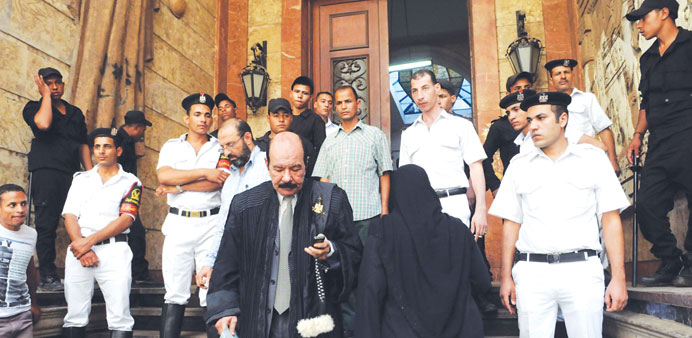
A lawyer leaves the courthouse in Cairo yesterday as soldiers keep watch during the court session on the fate of the Muslim Brotherhood.
Agencies/Cairo
An Egyptian court yesterday banned deposed president Mohamed Mursi’s Muslim Brotherhood and ordered its funds seized, a crippling strike in the campaign to crush the Islamist movement.
The case was brought by a lawyer from the leftist Tagammu party on the grounds of protecting Egyptians from violence.
It was not stated if he was acting at the instigation of the army-backed government, which has launched one of the fiercest crackdowns against the group in decades.
“The court bans the activities of the Muslim Brotherhood organisation and its non-governmental organisation and all the activities that it participates in and any organisation derived from it,” presiding judge Mohamed al-Sayed said in a ruling.
He also ordered the government to seize the Brotherhood’s funds and administer its frozen assets.
The ruling did not specifically mention the Brotherhood’s political wing, the Freedom and Justice Party.
But the state news agency quoted Freedom and Justice Party spokesman Hamza Zawbaa as saying the party rejected the ruling and would appeal.
“What is happening to the Brotherhood translates to a return of the police state after having removed it through the January 25 revolution,” he said, describing the revolt that toppled autocrat Hosni Mubarak in 2011.
The Brotherhood slammed the ban, saying it was part of a sustained campaign against the movement.
“The Muslim Brotherhood is part and parcel of Egyptian society. Corrupt and politically motivated judicial decisions cannot change that,” it said on its official Twitter account.
It said it was an organisation that “will always be present on the ground even after it is dissolved, and will continue serving the Egyptian people”.
The “junta is trying to silence anyone who opposes them. Dissolution verdict is politically motivated and part of a continuous crackdown,” it said.
“Muslim Brotherhood remained and will remain, no matter how fascist regimes try to eliminate them. Dissolution will not affect the organisation,” it added.
The movement has seen hundreds of its members killed and thousands arrested since the army overthrew Mursi in July. The ruling may force the Brotherhood to go underground, especially as public support for it has dropped.
The court’s decision raises the possibility that some Brotherhood members will lose faith in peaceful resistance and take up arms against the government.
“How the Brotherhood responds to this verdict depends on the individual decisions of rank-and-file members, because the broader structure has largely ceased to function,” said Eric Trager, an expert on the Muslim Brotherhood at the Washington Institute for Near East Policy.
Mohamed Ali, a Brotherhood official, said: “The ruling will not prevent us from continuing our peaceful resistance to the coup”.
The Brotherhood emerged from the shadows to win parliamentary and presidential elections after Mubarak was overthrown.
But many Egyptians became disillusioned with Mursi after he gave himself sweeping powers and mismanaged the economy, taking to the streets in protest and prompting the army move.
Following Mursi’s overthrow, the Brotherhood organised rallies demanding his reinstatement, bringing on the fiercest campaign against it by security forces in decades.
The government accuses the Brotherhood of inciting violence and terrorism and has put forward its own plan for new elections. Egypt’s state and private media now portray the Brotherhood as a terrorist group and an enemy of the state.
Security forces killed hundreds of its supporters in raids on their Cairo protest camps in August and rounded up thousands more, including many leaders, among them Mursi.
The Brotherhood has been forced to hold smaller protests to avoid antagonising security forces. Brotherhood lawyers, who have been trying to get members out of jail, say they too fear arrest.
Brotherhood veterans said it is increasingly difficult to persuade young members, who are likely to be infuriated by the court decision, to resist using force against the state.
Human rights activist Gamal Eid questioned the wisdom of the court’s decision, saying it could backfire.
“With an eye to the future, you will see the ruling is wrong. It will make them work in the darkness,” he said on social media. “It will make the Brotherhood continue practicing violence and hate speeches.”
The Brotherhood has proven resilient throughout its 85-year history.
Egypt’s army rulers formally dissolved the Brotherhood in 1954 and it has survived repression under various strongmen, relying on its funds and social charity networks to become the country’s biggest political party.
“The ruling will not prevent us from continuing our peaceful resistance to the coup,” said Mohamed Ali, a Brotherhood official.
“A ban represents a blunt approach in which there is no space for the Brotherhood in political and social life,” said Michael Hanna, an Egypt specialist with the New York-based Century Foundation think tank.
Senior Brotherhood members had said the movement was willing to concede its core demand for Mursi’s reinstatement, but wanted guarantees its imprisoned members would be released and its leaders would be allowed to operate freely.
But the interim government feels little incentive to make a deal with the Brotherhood that would alter its road map for a new constitution and then elections by mid-2014, analysts say.
The government says it is for the courts to decide whether to release the Brotherhood members currently in custody, who face charges including incitement to murder.
Attacks by militants have been rising since the army overthrew Mursi. Most of the violence has taken place in the Sinai Peninsula near the border with Israel and the Hamas-run Gaza Strip.
Al Qaeda-inspired militants based in the Sinai have attacked security forces in the area almost daily. The army has responded with air and ground attacks.