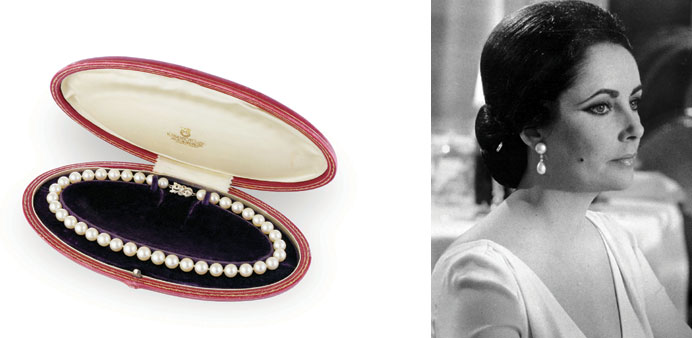
1954 Cultured Akoya pearls, white gold, diamond formerly belonging to Marilyn Monroe. Photo courtesy Mikimoto America, USA RIGHT: Elizabeth Taylor in Ash Wednesday (1973): Paramount Pictures/ Photofest.
By Denise Marray
“All art is autobiographical; the pearl is the oyster’s autobiography.” So said the Italian film director, Federico Fellini. Right now, there are hundreds of ‘pearl autobiographies’ on show at the Victoria and Albert Museum (V &A), London. This truly stunning exhibition, organised in partnership with the Qatar Museums Authority (QMA), has been co-curated by independent jewellery historian and curator Beatriz Chadour Sampson and Hubert Bari, Director of a future Pearl and Jewellery Museum at QMA. ‘Pearls’ is part of the events programme for Qatar-UK 2013 Year of Culture.
The jewellery and works of art in the exhibition are drawn from the V&A and QMA’s collections, alongside objects from British collections including Tate Britain, the British Museum and the Royal Collections and established jewellery houses such as Mikimoto, Tiffany & Co., Bulgari, Cartier, Chaumet, Rene Lalique and YOKO London.
Each of the beautiful pieces on show has its own special allure and history. What is clear is that pearls have, for centuries, been cherished by many cultures and their appeal seems universal.
It’s hard to single out a few pieces from such a rich collection because each is exceptional, but here is just a taster.
There is the stunning Dagmar necklace in gold, silver, enamel, diamonds and pearls, lent by Her Majesty Queen Elizabeth II. Also on show is a beautiful Norman Hartnell evening gown worn by Her Majesty on a state visit to Paris in 1957. The pearl embroidery with mother of pearl and diplomatic choice of motifs including the Fleur-de-lis, the French Royal emblem, was intended to compliment the host nation.
The Mary Queen of Scots necklace (1572) has a poignant story attached to it. It is said to have been given by the young Queen as a love token to Thomas Howard, 4th Duke of Norfolk, on the occasion of their engagement. This event eventually led to his execution on suspicion of treason. This piece in gold, enamel and Scottish freshwater pearls has been lent to the exhibition by His Grace, the Duke of Norfolk, Arundel Castle.
It’s hard not to feel a shudder of fear when gazing at the single Pearl Drop earring worn by Charles I at his execution in 1649. This haunting piece in gold, enamel and pearl comes from a private collection.
Of course, pearls are associated with glamour, and great Hollywood beauties such as Elizabeth Taylor and Marilyn Monroe have pieces of their personal jewellery on show.
The Akoya necklace given to Monroe by her husband Joe DiMaggio during their honeymoon in Japan in 1954 is truly beautiful; an Associated Press picture of the actress wearing the piece is remarkable for revealing her natural, fresh faced beauty and her preference for under-stated jewellery quite distinct from her glitzy screen goddess image.
Elizabeth Taylor is, of course, celebrated for her passion for jewellery. On display is a pair of Bulgari natural pearl earrings with platinum and diamonds given to her by her friend and attorney, Aaron Fisher.
An exquisite Chinese imperial robe gives an insight into the value placed on pearls by this ancient culture. In imperial China pearls were only permitted to be worn by the immediate imperial family, the emperor, empress or empress Dowager.
Catherine the Great (1729-1796), understood the political significance of upholding Russian traditions such as wearing the Kokoschnik (headdress) embroidered with pearls.
Muhammed Ali Khan, Nawab of Arcot (1749-95) is shown in a portrait festooned with pearl necklaces and armlets and with pearls embroidered on his coat, belt and turban.
A fabulous necklace with seven graduated strands of natural gulf pearls with a platinum clasp is just one of the outstanding pieces on show from the QMA collection.
Present at the preview was Michael Hakimian, Chief Executive of YOKO, London. In the 1700s his ancestors were crown treasurers to Emperor Nadir Shah of Persia. They were charged with caring for the magnificent jewels which the Shah brought back after his invasion of India. Hakimian is absolutely passionate about pearls and travels the world to find the finest examples, especially those of exceptional and unusual colour, used to form the centre pieces of YOKO creations.
His designs are much sought after and he has a loyal following in the Middle East. “In particular, we find Qatar to be the prime country where our jewellery is appreciated,” he commented. YOKO makes custom made pieces for many clients in Qatar, particularly for weddings or special occasions. On average, prices range from US$100,000 to $300,000 but a unique masterpiece could go as high as a million dollars.
Finding great pearls is no easy task, he explained. “It has always been very difficult to find superb quality, because by nature, out of every ten thousand pearls maybe just one is good enough to be called superb. Nature is in charge. You cannot tell an oyster what you want or how big or how beautiful you want the pearl to be!”
Emma Clarke of Mikimoto, said that headpieces for weddings in pearls and diamonds are especially in demand from Middle East customers. A custom made piece can take up to a year to make and where price is concerned, she said, “The sky is the limit.”
A show stopping piece is Mikimoto’s ‘scarf’ of 5,000 cultured pearls from the Akoya oyster, each pearl perfectly matched in size and lustre and set off with diamonds. This wouldn’t keep out the cold but it would certainly stop the traffic!
Film material shot during the last pearling expeditions off the coast of Qatar in the early 1970s shows the process of harvesting natural pearls. It reflects the hard reality of the work. Because fresh water was so precious on the pearling boats it could not be used to wash salt off the skin — so the divers spent months covered with salt.
Martin Roth, Director, Victoria and Albert Museum, explained that the V&A and Qatar Museums Authority have a “long and outstanding co-operation” and exchanges in terms of conservation and objects.
Miguel Bianco Carrasco, Director of Strategic Cultural Relations — Office of HE — Chairperson, said: “The Qatar Museums Authority is thrilled to collaborate with the V&A on this truly remarkable exhibition. Creating lasting partnerships between institutions that encourage dialogue and cultural understanding is one of the fundamental objectives of the Qatar-UK 2013 Year of Culture. This exhibition is a great example of this, bringing together two great Qatari and UK organisations.”
* The exhibition which is sponsored by Qatar Shell runs from 21 September 2013 – 19 January 2014