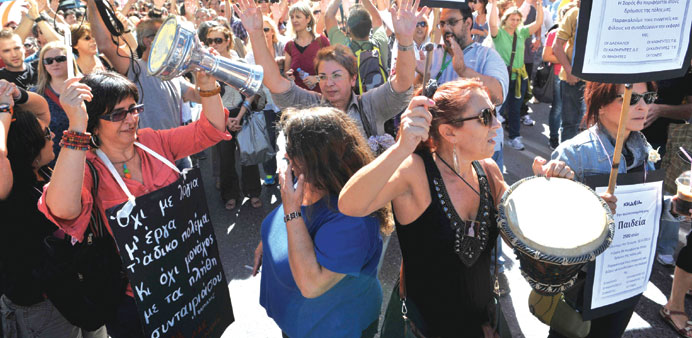
Teachers shout slogans yesterday in Thessaloniki during a 48-hour strike by civil servants.
AFP/Athens
Thousands of civil servants demonstrated in Greece yesterday in the week’s second major protest against planned job cuts, as social tensions rose over a leftist musician’s murder by a suspected neo-Nazi.
A police source said some 20,000 people marched in Athens, Thessaloniki and other cities as a two-day strike called by the civil servants’ union ADEDY shut down public services and disrupted the operation of hospitals and schools.
Fearing additional layoffs in the recession-hit country, unions reject a job redeployment scheme demanded by Greece’s EU-IMF creditors in return for access to bailout loans.
Protesters held aloft banners reading, “No to layoffs” and “No to the dissolution of public services”.
“They will abolish permanence (in public sector jobs) and sell whatever they can from the public property, be it schools, hospitals, social insurance funds,” said Christos Vagenas, a 39-year-old civil servant.
“Essentially, everything will be given to the private sector,” he said.
The protests were held in a tense climate following the killing hours earlier of a left-wing musician allegedly by a member of neo-Nazi party Golden Dawn.
Pavlos Fyssas, a 34-year-old hip hop singer, was stabbed to death yesterday morning in the western Athens district of Keratsini outside a cafeteria, in an apparent ambush.
Speaking to reporters, the victim’s father said Fyssas had been “hunted down” by a group of assailants and dealt a “professional” stab blow.
Government spokesman Simos Kedikoglou blamed the incident squarely on Golden Dawn, condemning the group’s “raw violence” and calling on other parties to “raise a barrier to the vicious circle of tension and violence”.
Greece’s venerated President Karolos Papoulias, a former resistance fighter against Nazi Germany, also noted that Greeks “had a duty not to leave open roads to fascism, not even a crack.”
Police said a 45-year-old alleged member of the Golden Dawn neo-Nazi group arrested at the scene of the killing had confessed to stabbing Fyssas, who wrote music under the nickname Kilah P.
“The suspect confessed his act and also admits that he has a specific political affiliation,” police spokesman Christos Parthenis told a news conference.
Parthenis added that “offices and homes” apparently belonging to Golden Dawn were being searched by police in connection to the murder.
“This is shocking and intolerable by any standards, and more so in a European country,” said the leader of the Socialists and Social Democrats group in the European parliament, Hannes Swoboda.
Swoboda expressed his concern in view of Greece’s six-month stint in the rotating European Union presidency, which starts January 2014.
“If the Greek government... fails to put a stop to the hate-filled behaviour of Golden Dawn... it will be an unacceptable presidency and not likely to bring any progress, either for Europe or for Greece,” he said.
Golden Dawn immediately denied any connection, but the incident - a few days after a group of Communists were beaten by suspected neo-Nazis - was likely to inflame tensions in Greece where anger is simmering over four years of austerity cuts.
In yesterday’s demonstrations, anti-government slogans were mixed with anti-fascist chants.
“Block the fascists in every quarter,” shouted a group of some 2,000 Communist protesters in Athens.
Yesterday’s protests followed strikes earlier in the week. On Monday, at least 17,000 teachers and civil servants took to the streets to protest against plans for massive public sector redeployments and layoffs. On Tuesday, hospital workers and lawyers joined the demonstrations.
Overall, Greece has pledged to axe 4,000 state jobs and redeploy 25,000 public sector workers by the end of the year, in return for its much-needed rescue loans.
Civil servants have to accept new posts or spend eight months on reduced salaries as alternative posts are found, with the risk of losing their jobs altogether.
Hard hit by the economic crisis, Greece is experiencing a sixth year of continuous recession and has a staggering 27% unemployment rate.
Conservative Prime Minister Antonis Samaras, who heads a fragile coalition with the socialists, this week said the Greek economy is likely to need another six years to return to pre-crisis levels.
Samaras’s party is struggling in the polls, with the anti-austerity leftist party Syriza vying with the conservatives for first place.
Despite its implication in violent incidents, Golden Dawn ranks third in opinion polls, capitalising on the country’s recession plight and widespread anger towards mainstream parties for failing to tackle decades of corruption.
National elections are not scheduled to be held in Greece for another three years, but there is strong speculation regarding an early ballot in 2014.