


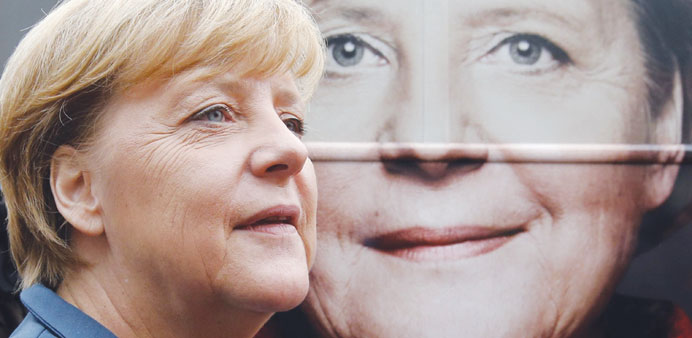
German Chancellor Angela Merkel standing before an election poster depicting her in Berlin. Even if the current Christian Democratic Union (CDU)-Free Democrat Party (FDP) coalition forms the next government, Chancellor Merkel could make longer-term and more courageous decisions without having to worry about the immediate electoral impact. She would be able to pursue a two- or three-year programme, instead of her current four-week strategy.
|
Nearly a century ago, in 1919, John Maynard Keynes analysed the economic consequences of the peace following Germany’s defeat in World War I. To be sure, the consequences of Germany’s general election on September 22 will not be nearly as momentous. But the outcome will not be as inconsequential as most analysts currently claim. |
For starters, even if the current Christian Democratic Union (CDU)-Free Democrat Party (FDP) coalition forms the next government, Chancellor Angela Merkel could make longer-term and more courageous decisions without having to worry about the immediate electoral impact. She would be able to pursue a two- or three-year programme, instead of her current four-week strategy.
Merkel’s post-election agenda might still be very cautious, emphasising medium-term fiscal consolidation for Germany and the eurozone as a whole at the expense of boosting employment and growth.
But a re-elected Merkel would no doubt be willing to proceed, at least by small steps, on the creation of a European banking union, including a resolution mechanism that draws on eurozone-wide resources.
Moreover, even if Merkel leads the same political coalition, she would more strongly support eurozone schemes to encourage lending to small and medium-size enterprises, and European Union education programmes, such as Erasmus. She would also be willing to work on institutional reforms aimed at closer co-ordination of EU member states’ economic policies.
Finally, even within the CDU-FDP camp, there is growing recognition that Germany’s enormous current-account surplus – above 6% of GDP and the world’s largest in absolute terms, at about $250bn – means that Germans receive almost no return on about 25% of their savings.
Somewhat faster demand growth in Germany and a lower external surplus would help not only Germany’s trade partners, but also German savers.
Of course, the CDU-FDP coalition may not be returned to power. The other post-election scenarios are a grand coalition between the CDU and the Social Democratic Party (SDP); a red-green coalition between the SDP and the Greens (if both do better than predicted and the liberal FDP falls below the 5% electoral threshold), possibly with tacit support from the left-wing Die Linke; or a CDU-Green coalition.
In all three cases, the government would be more oriented toward European and eurozone integration than a renewed CDU-FDP administration would be. True, the German Constitutional Court has ruled out open-ended financial commitments over which the German parliament has no control, so Germany can go only so far in support of greater economic integration without greater political integration.
But a government that includes the SDP or the Greens would contain at least one party that is ready for more significant steps toward a quasi-federal eurozone featuring elements of fiscal union (though limited for the sake of constitutional compliance).
Both parties are less complacent than the current government about the eurozone’s stability and Europe’s growth prospects. And both believe that there are too many low-paid marginal jobs in Germany to justify glowing reports about the quality of employment; that income growth is too slow and accrues disproportionately to the wealthiest; and that somewhat greater eurozone solidarity is in Germany’s own long-term interest.
The German election will not produce a political earthquake and will not suddenly open the door to a federal Europe on the model of the US, with large implicit fiscal transfers and highly centralised defence and foreign policies.
But, at a minimum, the outcome is likely to speed up implementation of eurozone decisions that have already been made, leading to somewhat more expansionary economic policies in both Germany and the eurozone.
A government that includes the SDP or the Greens – both of which have egalitarianism and internationalism in their DNA – would almost certainly go further and embrace substantial reform, renewal, and strengthening of eurozone institutions as a medium-term target. Such a government would back a eurozone strategy, led by Germany and France, that focuses on growth and employment, which would infuse some constructive enthusiasm into the 2014 European Parliament election.
A German government coalition that includes the SDP or the Greens (now a central player in German politics) could thus accelerate the reform and integration that the eurozone needs.
That would enable Europe, now with the full support of Germany, to recover more rapidly from its economic malaise and to take on the global leadership role that has eluded it for so long.- Project Syndicate
♦ Kemal Dervis, former minister of economic affairs of Turkey and former administrator for the UN Development Programme (UNDP), is vice president of the Brookings Institution.