


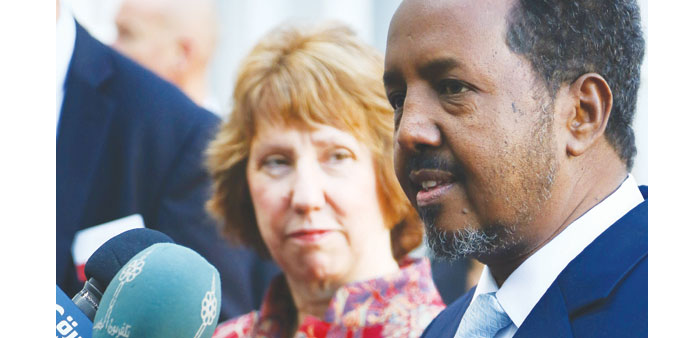
President of Somalia Hassan Sheikh Mohamud speaks to media with European High Representative for Foreign Affairs, Britain’s Catherine Ashton.
Agencies/Brussels
International donors pledged nearly €2bn yesterday as part of a “New Deal” to help Somalia recover from more than 20 years of civil war and destruction.
“We have commitments for 1.8bn euros,” European Commission President Jose Manuel Barroso said.
“It is a historic day for Somalia,” said Somali President Hassan Sheikh Mohamud, adding “1.8bn euros is a huge amount” as his country goes through “a remarkable transformation” to normality.
Barroso earlier announced the European Union would give €650mn on top of 1.2bn it had already provided to pay for security and development.
This showed that the EU would “remain engaged” with Somalia, noting that much still needed to be done as security and human rights problems continued.
Among other contributors, Britain gave €60mn for health and economic development, citing the need to prevent Somalia “falling back into the arms of terrorism, famine and insecurity”.
Germany offered €90mn, Sweden 170mn and Denmark was to provide $124mn, including a previously announced $71mn.
EU foreign affairs head Catherine Ashton said Somali President Mohamud faced one of “the most difficult challenges in the world”, describing the New Deal Compact as “more than a pledge of money.
“You take home with you a message ... that we stand with you what we know is going to be an extremely challenging (future),” Ashton said.
For Mohamud, there were four key priorities among many—security, legal reform, public finances and economic recovery.
“The New Deal must deliver on the ground soon,” he told delegates. After years of suffering, “expectations from our people are understandably high. We must not let them down”.
Somalia’s Islamist Shebaab rebels dismissed the conference.
“The billions promised will most likely be unpaid, the paltry sum given to the apostates,” it said, using its term for the Somali government, “will be lost in corruption”.
“It’s a bit like Belgian Waffles: sweet on the outside but really has not much substance to it. They are just hollow promises of Kufr”, or infidels, it said.
The New Deal Compact commits the government and its international partners to a series of political, security and development goals, including a two- to three-year plan to kick-start the economy.
Among the targets are plans to get 1mn children into school in a country that has one of the world’s lowest enrolment rates with just four out of 10 children in class.
Between 2008 and 2013, the European Union provided €1.2bn in aid - €521mn for development and 697mn for security.
Most security funding has gone to the African Union Mission in Somalia (AMISOM), comprising some 17,000 troops and launched in 2007 with UN Security Council approval.
It props up the government in Mogadishu and has fought alongside its army, seizing a string of towns from Shebaab rebels, but several recent deadly rebel attacks have dented confidence.
At least 18 people were killed in Mogadishu on September 7 when two blasts rocked a popular restaurant, an attack quickly claimed by the Shebaab.
In August, medical aid agency Doctors Without Borders (MSF) closed operations in Somalia after 22 years of working in the Horn of Africa troublespot.
Plans by Barclays Bank to shut down remittances to Somalia - a lifeline for millions of Somalis dependent on money from abroad - could undermine any progress made Monday at an international donors’ conference, warned one regional group.
Barclays announced this year that, by September 30, it would close the bank accounts of British-based money service businesses sending remittances to people in Somalia and the region, due to concerns over crime, money laundering and the financing of terrorism.
But cutting off this financial lifeline would “interfere with the livelihoods of people who are getting very small remittances from people in the diaspora,” warned Mahboub Maalim, the head of the region’s Intergovernmental Authority on Development (IGAD).
Cutting off this source of money would “bring back piracy,” Maalim said, adding that it would also lead groups such as the Shebaab militia to revert to underground channels of payment.
Removing Somalia’s only viable financial system would “strangle at birth” the objectives of a landmark deal to rebuild Somalia after years of civil war, IGAD wrote in a statement issued during the conference.
In its statement, IGAD urged Barclays to give the Somali remittance services another 12 months to find alternative solutions that would “enable banks to remain in the sector and keep legitimate and regulated remittances flowing.”
The statement, signed by the foreign ministers of Somalia, Ethiopia, Djibouti, Sudan and Uganda, as well as by the Kenyan Foreign Ministry, also called on Britain and organisations such as the World Bank to help devise a solution.
“More than 40% of the population of Somalia would lose an estimated $1.2bn a year in remittance income, and nearly $500mn from the UK alone, if the lifeline were cut,” IGAD wrote.