


By Bonnie James/Deputy News Editor
Traffic congestion, which returned to Doha roads last Tuesday when schools re-opened after summer holidays, went from bad to worse yesterday leaving motorists fuming and fretting, especially during peak hours.
“I started 30 minutes early to beat the rush, but ended up spending even more time than usual stuck and crawling in bumper-to-bumper traffic,” a resident told Gulf Times. A cross-section of motorists also shared similar experiences.
Whether it was Al Shamal Road, Salwa Road, Corniche, Rayyan Road, C, D or E Ring roads or any other road in the core areas of Doha, the scenario was the same. A number of minor accidents aggravated the situation.
Though traffic policemen were present at almost all the busy roundabouts and signals, it seemed they were overwhelmed by the sheer number of vehicles on the roads. Given the statistics from 2012, as many as 5,138 new vehicles were registered in Qatar every month on average.
This number would have increased now, considering the augmented pace of developmental activities in the country. The total number of registered vehicles in Qatar stood at 876,039 in 2012 compared to 814,373 in 2011.
“Getting on to Al Shamal Road from Qatar Decoration area of Salwa Road, a distance of less than 2km, took about 20 minutes, most of which was spent stuck in traffic,” another motorist said.
Al Shamal Road, a vital link of the Qatar Expressway Programme and a major arterial thoroughfare, was clogged all the way from The Mall Roundabout and well past the Gharrafa bridge, a stretch of about 14km.
“The average speed on the busiest portion of Al Shamal Road, which has a maximum limit of 100km/h was only 50km/h, as all the lanes were packed,” he recalled.
Distances which used to take 10 minutes now require at least 40, as pointed out by another resident. “The short drive from Ain Khaled to Muaither has become a very tiring experience,” observed a parent who drives his daughter to school.
The stretch between Muaither and the Industrial Area interchange is always congested during peak hours. Ongoing road works has worsened the situation.
“Accidents are very common on this road, as the road narrows to a single lane at one point and many motorists do not have the patience to slow down before converging from multiple lanes,” he said.
One of the reasons for increased traffic yesterday was the beginning of the new academic year 2013 -2014 at Qatar University (QU). About 17,000 students are enrolled in various programmes conducted by the university, local Arabic daily Arrayah reported yesterday.
A majority of the students, especially men, drive to QU, while most of the women are dropped off and picked up by family members or house drivers. Further, QU has hundreds of teaching and administrative staff.
Traffic was heavy all around the QU area, as it is always during working days. The university is expanding its car parking facilities in order to cater to the increased number of students.
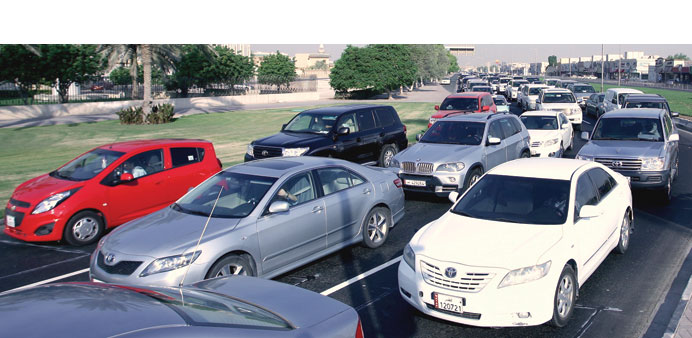
Long lines of vehicles heading towards TV Roundabout from Markhiya roundabout yesterday morning. PICTURES: Nasar T K