


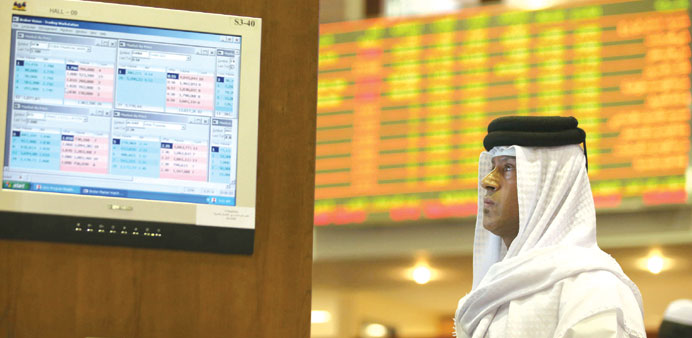
An Emirati investor follows the stock market developments at the DFM (file). The DFM’s advance this year, the biggest among gauges in the world’s 50 largest equity markets, has been helped by MSCI’s June decision to raise the UAE to emerging-market status and an improving economy.
Bloomberg/Dubai
Dubai’s biggest brokerage plans to almost double staff over the next year, counting on growing demand for the emirate’s equities, as trading in the world’s most-volatile stock market climbs to a three-year high.
Mena Corp Financial Services, which traded the most shares in Dubai since April among 48 brokerages tracked by the exchange, will boost the number of employees to 50 from 27, managing director Nabil al-Rantisi said by phone on Tuesday. The 100-day moving average of stocks traded in the emirate surged to 696mn dirhams ($189mn) on Thursday, the highest level since February 2010, data compiled by Bloomberg show.
The DFM General Index tumbled 13% in two weeks from a five-year high reached August 25 on mounting concern the US would carry out a strike on Syria and hurt Dubai’s economy, which is dependent on revenue from tourism and trade. The gauge jumped 9.2% in three days to Thursday, bringing this year’s gain to 56%, as US President Barack Obama said he would pursue a proposal by Russia to have Syria surrender its chemical arms. The swings made Dubai’s index the most volatile in the world in the past month, data compiled by Bloomberg show.
“People still believe that Dubai is a safe haven,” Rantisi, 36, said by phone. “We are still in hiring mode. The market looks good in the medium to long-term.”
The DFM’s advance this year, the biggest among gauges in the world’s 50 largest equity markets, has been helped by MSCI’s June decision to raise the UAE to emerging-market status and an improving economy. Gross domestic product will grow 4.6%, on average, between 2012 and 2015, more than twice as fast as the previous four years, government forecasts show.
The reclassification of benchmark indexes in the UAE, a federation of seven emirates including Dubai, stoked bets foreign investors would channel more money into the local exchange.
“There has been an increase in western institutional interest,” Julian Bruce, the head of institutional trading at EFG-Hermes Brokerage UAE LLC, said by e-mail on Tuesday. “Renewed confidence has not only brought new buyers into the market,” it has pulled in investors who were on the sidelines, he said.
Before Dubai’s index tumbled in August, stocks were trading at the highest estimated price-to-earnings ratio since 2008. The level rose to almost 15 on August 28, exceeding a multiple of 11.4 for the MSCI Emerging Markets Index.
The gauge’s 30-day volatility, a measure of price fluctuations, was at 41.6, near the highest since January 2010 and the most among 72 indexes tracked by Bloomberg. That is more than 10 points above benchmark measures in Japan and the Philippines.
“If we see a diffusing of the Syrian situation it will be welcomed by all and clearly confidence will return,” EFG- Hermes’ Bruce said. “Any further upside will be governed by events such as the third-quarter results to see if this recovery is sustainable and can be maintained.”
Some of the UAE’s 48 brokerages have reaped the benefit of higher volumes. Mena Corp reported a profit of 8.7mn dirhams in the six months through June, compared with a loss of 2.8mn dirhams a year earlier. Half-year net income at Al Ramz Securities, the second-biggest brokerage by trading value, jumped to 17.6mn dirhams from about 120,000 dirhams in the period.
This year’s average daily trading value has more than doubled from 2012 to about 530mn dirhams. That compares with a record 1.5bn dirhams in 2007, before Dubai’s housing market crashed, with home prices tumbling more than 60% from a 2008 peak during the global financial crisis.
Property prices in Dubai, home to the world’s tallest tower and artificial islands, have risen almost 40% over the past year, according to Standard Chartered estimates. The emirate’s growing population, improving economy and status as a haven amid regional political uprisings are driving the rebound, the bank said in a report on September 4.
Second-quarter profit at Emaar Properties, Dubai’s biggest publicly traded company, rose 10%, beating analysts’ estimates and helping drive a 53% surge in the stock this year.
“Equity markets move in cycles and the market went through a very tough down-cycle during the crisis,” Mohammed Ali Yasin, managing director at Abu Dhabi-based NBAD Securities, said by phone on Wednesday. Trading volume on Tuesday, which was almost four times the 12-month daily average, “confirms the confidence of investors in the viability of our equity markets,” he said.