


By Colin Covert
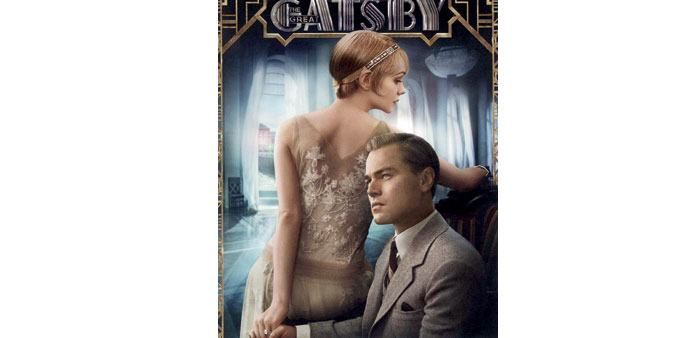
FILM: The Great Gatsby
CAST: Leonardo DiCaprio, Carey Mulligan, Tobey Maguire, Joel Edgerton, Isla Fisher
DIRECTION: Baz Luhrmann
Call it “The Grating Gatsby”.
Although the incurably exuberant Baz Luhrmann had the glitter factories and sequin mines working overtime, his glitzed-up Gatsby is dishwater dull. Because he has an eye for spectacle but is deaf to emotional detail, he has turned an exquisitely told story of doomed romance into a production with all the depth of a pop-up book.
Given his track record of exhilarating success with flashy music videos like Strictly Ballroom and Moulin Rouge!, and train-wreck failure with more narrative projects like his incoherent epic Australia, we might have expected subtle literary material to be beyond his grasp. But who would have predicted that Luhrmann, the P T Barnum of supercharged excess, would make Jazz Age decadence such a drag?
Like Gatsby’s overheated fantasy of his unattainable beloved, Luhrmann has decked out his film “with every bright feather that drifted his way”. The cheerful dissonance of watching flappers and swells rave to Jay-Z quickly fades, and the movie plods on like a sixth-period American Lit class.
Leonardo DiCaprio (a heartthrob lead for Luhrmann’s 1996 Romeo + Juliet) plays mysterious millionaire Jay Gatsby, whose all-night soirees at his palatial West Egg manse attract the cream (and dregs) of New York society. He’s the subject of wild rumours, many circulated by himself.
Chasing his blinkered vision of the American dream, he reinvents himself and racks up riches outside the law.
Tobey Maguire is our narrator, Nick Carraway, here an onscreen stand-in for F Scott Fitzgerald, writing a memoir of his encounters with Gatsby while riding out “morbid alcoholism” at a snowbound Midwestern sanitarium. Ethereal Carey Mulligan is Daisy Buchanan, Nick’s second cousin and Gatsby’s object of desire. Joel Edgerton is her possessive old-money husband, Tom, whose baleful squint and Hitler-style mustache sum up his character.
Each of them seems to be acting in a different movie. DiCaprio conveys Gatsby’s passion with a gaze that suggests advanced constipation. Mulligan operates in two modes - Doe-Eyed Stare for languid moments and Mascara Eruption for high drama.
Edgerton attacks every line of dialogue like a bull in a porcelain showroom. Maguire drifts through his performance with the vacant smile of a forgettable lad sitting for his high school portrait.
Fitzgerald’s novel is a peculiar mix of staggeringly literal symbolism (the billboard eyes of Dr T J Eckleburg, occulist, launched a million term papers) and oblique psychology. The main character is a cypher. What the players think can be inferred, though only up to a point, by the epigrammatic things they say.
The film’s solution to these difficulties is to pull out every visual gimmick, from period newsreel footage to Mach-10 zooms. Wall Street’s pre-Crash jitters are invoked by two separate point-of-view shots from the cockpits of airplanes power-diving toward the financial district’s sidewalks. Because one just wouldn’t make the point.
The ever-writhing camera captures some powerful images. After a teasing half-hour offscreen, DiCaprio makes his entrance to an orchestral burst of Gershwin and a volley of fireworks.
More often, Lurhmann’s grand gestures are unrelated to the emotional point of a given scene, like exclamation points randomly strewn throughout a sentence. Luhrmann’s notion of honouring Fitzgerald’s text is to type out key phrases on the screen and stereoscopically float the letters out over our heads.
Like Fitzgerald’s narrator, watching this gaudy mess, “I was within and without, simultaneously enchanted and repelled”. But mostly? Bored. — Star Tribune/MCT
When larceny
meets illusion
By Rick Bentley
FILM: Now You See Me
CAST: Jesse Eisenberg, Mark Ruffalo, Isla Fisher, Morgan Freeman, Woody Harrelson, Dave Franco
DIRECTION: Louis Leterrier
Now You See Me is like seeing a magician pull a rabbit out of a hat and then showing you how the trick is done, only to learn the bunny’s dead. Everything’s going reasonably well until the disappointing end.
The big trick of Now You See Me is the criminal ways of a group of illusionists — played by Jesse Eisenberg, Woody Harrelson, Isla Fisher and Dave Franco — brought together by a mysterious stranger to pull off a series of impossible crimes. Their first trick is to rob a bank in Paris without leaving the United States. The tricks get bigger and more baffling.
The authorities — particularly agents from the FBI (Mark Ruffalo) and Interpol (Melanie Laurent) — are not amused by how the thieves give all of the money to their audience. Each philanthropic crime makes the agents more determined to end the act.
Until the final scene, Now You See Me is a mildly interesting look at what happens when larceny meets illusion. Imagine David Copperfield becoming a member of the Ocean’s Eleven gang.
Director Louis Leterrier shows a deft hand when dealing with the stage presentations, but he doesn’t have equal ability staging the more emotional moments. Leterrier’s past work — such as The Incredible Hulk and Clash of the Titans — has shown the same weakness when it comes to personal drama.
It doesn’t help that his cast looks more like the legion of substitute actors rather than big stars. Eisenberg doesn’t have the stage presence to pull of the masterful magician he’s supposed to be, while Fisher and Franco are just along for the ride. Neither has the acting talent to make the roles more than just supporting players.
The fourth member of this Robin Hoodish gang, a mentalist played by Harrelson, comes the closest to being a headliner.
Michael Caine’s role as the investor for the magicians doesn’t give him much to do. But Morgan Freeman gets the most out of playing an ex-magician who’s become a sensation by debunking the work of magicians.
It could be that while the screenplay by Ed Solomon, Boaz Yakin and Edward Ricourt comes with enough misdirection to make the illusions fun to watch, the movie falls apart in the end. Even one of the biggest clues is explained one way and then appears completely different at the conclusion.
And for a film that takes great pride early in pulling back the curtain to reveal the reality of the moment, the screenwriters take impossible leaps over gaping holes in the finale without apology.
The key to any good piece of entertainment is to be as entertaining at the end as in the beginning. Now You See Me is more like “Now You Don’t” when it comes to a big finish.- The Fresno Bee/MCT
An intriguing twist
By Cary Darling
FILM: Evidence
CAST: Stephen Moyer, Radha Mitchell
DIRECTION: Olatunde Osunsanmi
Part CSI, part found-footage horror film, Evidence is a well-made thriller with its fair share of suspense and mild scares.
Stephen Moyer (True Blood) and Radha Mitchell (Olympus Has Fallen) are Reese and Burquez, Las Vegas detectives looking into a mass murder that took place at the site of a bus crash in the desert.
Reese is a forensic expert in terms of video images, and that’s just as well since all they have to go on is the video from cameras and mobile phones found at the scene.
Is the killer one of the passengers? Did one of them have enemies? Or is there some stranger wandering in the desert on a hunting spree?
Director Olatunde Osunsanmi (The Fourth Kind) keeps things moving quickly and, for the most part, refrains from getting too grisly. While the entire found-footage concept may be played out, Evidence is an intriguing twist on a predictable formula.— The Fort Worth Star-Telegram/MCT
(DVDs courtesy:
Saqr Entertainment Stores, Doha)