


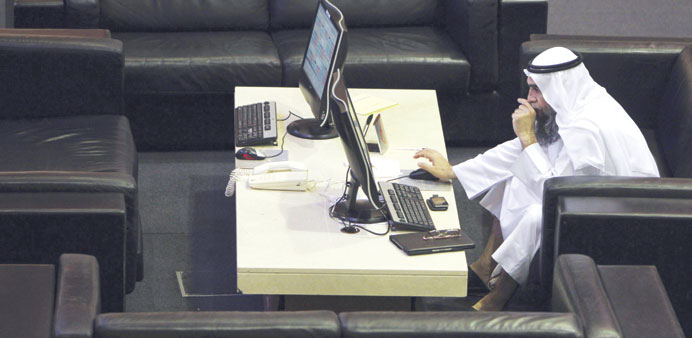
Most Gulf bourses resumed declines yesterday as US Congress prepared to debate on whether or not to approve a military strike on Syria, while Egypt rose after a full acquisition offer for Orascom Construction.
Dubai’s benchmark dropped 2% to 2,325 points, giving back Sunday’s gains to slump to a two-month low.
“This volatility shows the market didn’t bottom out and the technical outlook is still negative,” said Firas al-Zghaibi, financial markets strategist at brokerage Mena Corp. “Most likely, the index will break below 2,300. A typical target is 2,220 but because of news-flow, volatility may rise so we might see lower levels.”
Abu Dhabi’s index fell 1.4%, down for a fifth session and to slump to its lowest close since May 27.
US President Barack Obama is seeking support from Congress for punitive military action against Syria over a chemical weapons attack in a civil war that the UN says has killed at least 100,000 people.
Congress was set to be in session yesterday for the first time since August. Debate on Syria could begin in the full Senate this week, with voting as early as tomorrow; the House of Representatives could take up the issue later this week or next.
Saudi Arabia’s measure climbed 0.1%, up for a second session since Thursday’s two-month low but gains were capped as geopolitical risk weighed on sentiment.
In Egypt, the bourse bucked a regional downtrend as Orascom Construction’s Dutch-listed affiliate announced a full acquisition offer, lifting investor interest.
Shares in OCI climbed 1.7% to 255 Egyptian pounds, matching the offer, at 255 pounds per share in cash or one share of Amsterdam-listed OCI NV. Tender periods will run from October 22-28 and January 19-23.
In a previous offer, OCI NV bought over 97% of the Cairo-listed firm. A successful buyout would mark the delisting of what was once the Cairo market’s biggest blue chip, but OCI has already been taken out of the benchmark 30-stock index
Some investors are willing to bid OCI’s market price above the tender price because they want to get their hands on OCI NV shares, which are now above €30 compared to around 20 in early July.
OCI accounted for about a quarter of Cairo’s trading.
Cairo’s 30-stock benchmark climbed 1.1% to 5,245 points, but faces major technical resistance around 5,300 points, which was the support in late July and mid-August. The 100-stock index rose 1.3%.
Elsewhere, Kuwait’s index eased 0.06% to 7,233 points; Oman’s measure fell 1.1% to 6,380 points, while Bahrain’s gauge slipped 0.2% to 1,180 points.
QE drops as local retail investors square off positionsBy Santhosh V Perumal
About 60% of the stocks were in the red and four of the seven sectors saw more than 1% erosion in their indices as local retail investors hurriedly squared off their positions to drag the Qatar Exchange down yesterday.
Sustained buying support from domestic institutions and non-Qatari individual investors notwithstanding, the bourse’s 20-stock Qatar Index (based on price data) fell 1.15% to 9,151.28 points as investors largely remained cautious due to geopolitical tension on simmering Syrian crisis.
The market narrowed its year-to-date gains to 9.48%, after remaining well above 10% for most part of the sessions.
Profit-booking was pronounced - particularly in the telecom, insurance and industrials sectors - which severely underperformed the market’s key benchmarks.
However, overall trade volumes expanded, mainly due to a substantial increase at the insurance and realty counters.
Major shakers included Ooredoo, Vodafone Qatar, Qatar Insurance, United Development Company, Barwa, Industries Qatar, Qatar Electricity and Water, Gulf International Services, Nakilat, Milaha, QNB, Qatar Islamic Bank, International Islamic, Masraf Al Rayan and al khaliji.
However, Qatari Investors Group, Mazaya Qatar and Ezdan Real Estate bucked the trend.
The 20-stock Total Return Index shed 1.15% to 13,075.08 points, the All Share Index (with wider constituents) by 1% to 2,314.60 points and the Al Rayan Islamic Index by 0.69% to 2,635.89 points. All the three indices factored in dividend income as well.
Telecom stocks deflated 1.64%, followed by insurance (1.55%), real estate (1.18%), industrials (1.13%), transport (0.89%), banks and financial services (0.81%) and consumer goods (0.62%).
Total market capitalisation melted 0.86%, or more than QR4bn, to QR503.26bn. Mid cap equities fell about 2%; and large, small and micro caps about 1% respectively.
Of the 42 stocks, only 10 advanced, while 24 declined, six were unchanged and two were not traded.
Qatari individual investors turned bearish as they were net sellers to the tune of QR11.68mn compared with net buyers of QR6.75mn on Sunday.
Foreign institutions remained profit-takers with their net selling at QR21.73mn against QR20.66mn the previous day.
However, domestic institutions were increasingly bullish as their net buying rose to QR18.91mn compared to QR11.29mn on Sunday.
Non-Qatari individuals were also increasingly bullish as their net buying surged to QR14.52mn against QR2.59mn the previous day.
Total trading volume expanded 63% to 6.13mn stocks, value by 54% to QR260.21mn and transactions by 22% to 3,481.
The insurance sectors’ trading volume grew seven-fold to 0.21mn shares and value by more than five-fold to QR10.31mn on a more than five-fold rise in deals to 131.
The real estate sector’ trading volume and value almost tripled to 2.19mn equities and QR43.41mn respectively on a 55% jump in transactions to 572.
The banking sector’s trading volume surged 41% to 1.72mn shares, value by 75% to QR91.30mn and deals by 16% to 1,087.
The market witnessed a 33% expansion in consumer goods sector’s trading volume to 0.64mn shares, 26% in value to QR35.98mn and 19% in transactions to 492.
The industrials sector saw a 27% jump in trading volume to 0.65mn stocks, 24% in value to QR50.32mn and 24% in deals to 763.
The transport sector’ trading volume rose 18% to 0.45mn stocks, value by 21% to QR20.82mn and transactions by 28% to 254.
However, there was a 38% decline in telecom sector’s trading volume to 0.26mn equities, 44% in value to QR8.08mn and 38% in deals to 182.
In the debt market, there was no trading of bonds and treasury bills.