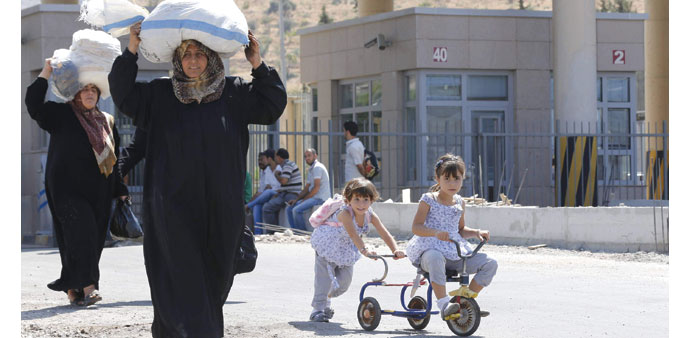
Syrians carry their belongings as they enter Turkey from the Turkish Cilvegozu border gate, located opposite the Syrian commercial crossing point Bab al-Hawa in Reyhanli, Hatay province, yesterday.
AFP/Geneva
The UN refugee agency and Syria’s overburdened neighbours Lebanon, Turkey, Jordan and Iraq yesterday urged the international community to put differences aside and find a common solution to end the “cycle of horror”.
While Washington and Moscow insist they both want a political solution to the conflict in the shape of negotiations, Syria’s ally Russia has repeatedly frustrated the US by blocking UN Security Council action against the regime of President Bashar al-Assad.
“We strongly appeal to the international community to overcome existing differences and come together to stop the fighting,” Antonio Guterres, the UN High Commissioner for Refugees, said as he read a joint statement after talks with ministers from the four countries.
“A political solution to end this cycle of horror is urgently needed. There is no humanitarian solution to the Syrian crisis. Rather there needs to be a political solution that ends the humanitarian crisis,” he said.
Guterres was flanked by Lebanon’s Minister of Social Affairs Wael Abu Faour, plus Jordan’s Foreign Minister Nasser Judeh and his Turkish and Iraqi counterparts Ahmet Davutoglu and Hoshiyar Zebari.
The four countries have received the overwhelming majority of the 2mn Syrians who have fled their homeland since the war started in March 2011, and are being stretched to the limit as they cope with the influx.
On average, some 5,000 Syrians continue to flee their country every day, according to UN data.
Counting refugees and the estimated 4.2mn people the UN says have been displaced within Syria, nearly a third of the country’s pre-war population of 20.8mn have now been uprooted.
“What Turkey, Lebanon, Jordan and Iraq are doing is an enormous service on behalf of the international community as a whole,” Guterres said, adding that the nations were “paying an extremely heavy price” for their generosity.
“The impact of such a large number of refugees on their economies, their societies, the impact of a conflict next door on their national security, is something that needs to be fully recognised by the international community,” he said.