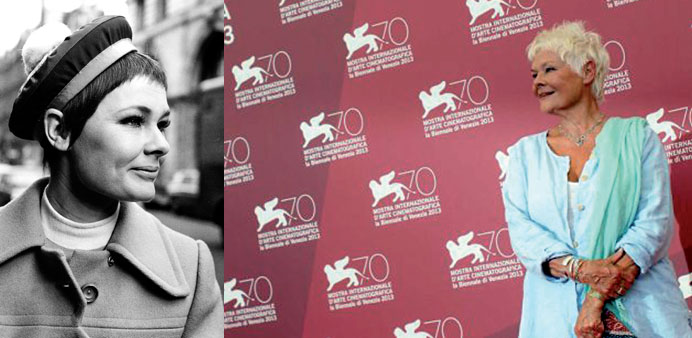
Then, and now: A young Judi Dench in a fashionable Christian Dior designed beret, left,and at Venice this week.
By Gautaman Bhaskaran
Nobody would have even dreamed in the late 1950s that British actress Judi Dench would grow so popular. I happened to see the phenomenal admiration for her the other evening at the ongoing 70th edition of the Venice Film Festival. As she walked the Red Carpet, the men, women and children who had gathered there to see her just went delirious with joy with the photographers clicking away every step she took. Mind you, she is no winsome lass in her twenties fluttering her eyebrows and posing for the camera. She is 78.
But, of course, she was 20 once, and had begun her acting career, not on screen but on stage with the Old Vic Company in London, one of the most respected groups in Britain. That was in 1957, when she was barely 23, and some of her first roles were from Shakespeare — as Ophelia in Hamlet, as Juliet in Romeo and Juliet and as Lady Macbeth in Macbeth.
Dench was gradually growing from a beautiful girl, playing endearingly romantic roles, into a serene woman with substantive parts. Much in the same way she transformed herself from a girl in love to Lady Macbeth in theatre, her first portrayals on television, too, were starry-eyed. She did not do many movies, and she was rather unknown.
It was only when she was cast as M in James Bond’s Golden Eye in 1995 that she developed a strong persona as part of Her Majesty’s Secret Service and 007’s boss. Bonds came and went from Pierce Brosnan to Daniel Craig as did the helmers from Martin Campbell to Sam Mendes, but Dench remained as M in film after film, sternly reprimanding the Man with the Licence to kill at one moment, and trying desperately to save him, as a mother would her child, minutes later.
Stephen Frears’ Philomena — part of Venice’s prestigious competition lineup — could not have found someone more apt than Dench to play the title role, of a mother forced to give up her child in an Irish convent in the 1950s. The actress plays the older Philomena, whose story the movie is all about. And what a moving piece of work it is that it had audiences crying. Or laughing sometimes.
About an Irish girl, barely 14, in the early 1950s who is abandoned in a nunnery by her family after she gets pregnant, the movie plots the suffering Philomena had to endure. Forced to do the dirtiest of jobs there, she is separated from her baby son, allowed to see him only once a week. Finally, he, Anthony, is given away in adoption to a rich American family. For the next 50 years, the disgraced girl, Philomena, lives with the beautiful memory of her son, till one day, a chance encounter with a former BBC political journalist helps her realise that she must try and find her son. She must get her secret out.
In what seems like a winning role – and of course a winning work, perhaps Frears’ career best — Dench after ridding herself of the James Bond series in Skyfall (where she dies) gives a clincher in and as Philomena, bonded to silence for half a century before Steve Coogan’s Martin Sixsmith agrees to accompany her to Washington to try and look for Anthony.
Sixsmith’s book on Philomena’s travails, published in 2009, worked not only as a catalyst for thousands of such “shamed” Irish mothers who also lost their children in a similar manner, but also as the basis for Frears’ beautiful film. The best part of it was that the pairing between Dench and Coogan leads to comic relief.
Coogan, who also co-wrote the screenplay along with Jeff Pope, said the movie needed this wit and humour. “Otherwise it would be just a tragic, depressing story. The humour was important to lighten the mood, and sugar the pill. It was also important we didn’t overdo it. I said, ‘If I mug too much, or if my face becomes too animated, tell me to turn it down,’” Coogan told a presser at the festival a couple of days ago.
And at the same meet, Frears quipped that he would want Pope Francis to see Philomena, and the director said this three times during the 30-minute conference. “I am very, very keen that the Pope should see it, if you have any influence in those quarters,” Frears told reporters. “He seems like a rather good bloke, the Pope.”
Agreeing with Frears’, Dench described the film as “a shockingly terrible story, and it rightly should be told.” The actress met the real Philomena several times before filming, and admired her enduring faith and ability to forgive, which “is what makes her extreme, and makes the story worth telling,” Dench averred.
And not just that, the movie is also a bold attempt to bring out into the open what is nothing short of a scandal. Venice seemed bolder by far to screen it and in the Festival’s top slot. In an essentially Catholic country such as Italy, the most thunderous clap of cheers came half way through the film screening when Sixsmith looks at Philomena and mutters a four letter word about Catholics.
As one reporter wrote: “Italy is both a Catholic country and a robustly anticlerical one, but the whoops from the audience weren’t a reflex action to an ecclesiastical obscenity. They expressed a passionate connection to the movie’s story, inspired by true events, of a woman looking for the son that the Church stole from her a half-century before”.
The “thieves” were Northern Irish nuns who ran some sort of a slave-labour home for unwed mothers that was akin to the institutions for “fallen girls” documented in The Magdalene Sisters, which won the Golden Lion at Venice in 2002.
In Philomena, the home is called Roscrea, where wealthy couples could buy a child for $1000 and take them away without even the mothers being allowed to say a final goodbye. Conveniently, the documents on adoption are destroyed, leaving little chance for the miserable mothers to even hope for locating their children.
Frears and the rest of his team, including Coogan and Dench, do a marvellous job of presenting a movie that is brilliantly performed and helmed with amazing restraint. Philomena, which even got journalists swinging between tears and laughter, has excellent chances not only at Venice, but also at the Oscars. Dench may well get the Golden Lion for acting there, and who knows, the Oscar next February.
Maybe, it was not, after all, a bad thing the Bond guys decided to bump her off. It appears that their loss is Frears’ gain. To begin with, that is.
** Gautaman Bhaskaran has been covering several film festivals for over 25 years, and may be e-mailed at [email protected]