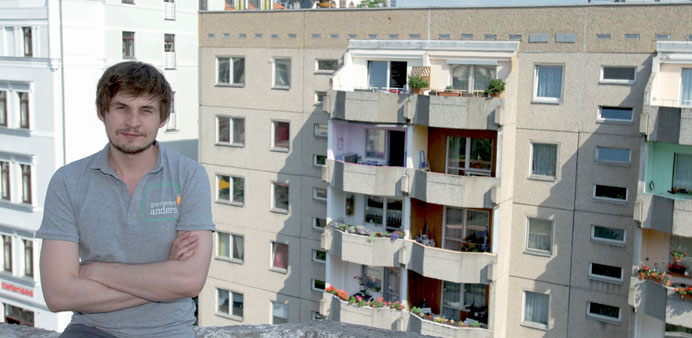
Sebastian Helmund on the balcony of his pre-fab apartment building in the centre of Leipzig. At right is a similar large-panel-system building. At left is a traditional bricks-and-mortar building of the type preferred by most Germans.
By Birgit Zimmermann
Sebastian Helmund became a fan of communist-style modular apartments in the winter of 2012.
After a long search through Leipzig’s chic areas of late-19th century buildings, he saw a flat in the centre of town owned by the municipal housing company LWB. It was a pre-fab, partially renovated, a red flag for fashionable Germans who runs a mile from anything cheap and nasty.
“I stood at the window up there and enjoyed the fantastic view. From that moment I didn’t want any other flat,” the 29-year-old founder of a design company said. Ever since he has been living satisfied and happily in the two-room flat.
In his block there are scarcely any vacancies.
East Germany is covered with low-budget apartment blocks that were assembled from concrete panels pre-fabricated in factories and delivered by truck. The German word for this style of boxy building is “Plattenbau,” which means a building put together from slabs.
Large-panel-system (LPS) construction has been used in many nations, but has a reputation in Germany as dreary and shoddy. “Actually, pre-fabricated buildings were never in my thinking,” Helmund admits. “My friends were appalled. ‘Do you really want to move into a pre-fab?’ they would ask me.” But now they are slightly envious.
Location flicked the switch for Helmund, who lives directly on a popular stretch of restaurants and taverns. And his mid-town rent is incredibly cheap compared to flashier buildings constructed from bricks, mortar and concrete poured on site.
But asked if he could imagine living in a mass-scale, pre-fabricated public housing project, as found on the periphery of almost every eastern German city, Helmund admits his answer would still be no.
He certainly wouldn’t move to Gruenau or Paunsdorf, two such Communist-era suburban high-rise housing estates on the outskirts of Leipzig.
But the wind is changing there too. Antje Kowski is manager of the Gruenau apartment blocks and she is satisfied with things.
Since last year the number of residents there has been steady for the first time since communism ended in November 1989. “This is a good sign,” she says, noting that 41,000 people now live in Gruenau, compared with 45,000 in 2009. Gruenau was built in the 1970s and 1980s as one of the largest LPS high-rise apartment building complexes in the former East Germany.
In 1989, some 85,000 people lived there -- a city in its own right on the edge of Leipzig. After the end of communism, vacant blocks and gradual demolition were the likely fate for Gruenau, just as was the case for such other modular pre-fab housing projects as Prohlis near Dresden, Silberhoehe near Halle and Marzahn near Berlin.
Hundreds of thousands of apartments were torn down at government expense. The federal government invested more than €1.2bn ($1.6bn) in urban redevelopment in eastern Germany, mainly razing such eyesores.
Now, apparently, the situation has stabilised in the residential areas, with supply and demand in balance. “The vacancy rate has dropped signficantly, naturally due primarily to the demolitions,” says Axel Viehweger, chairman of the state of Saxony’s VSWG association of apartment companies. “Those flats that were surplus have been taken off the market.”
The VSWG has 281,000 apartments, of which 55.5% are pre-fabs. The vacancy rate now stands at 8%. There were times when the rate was 20% and more. “I don’t think about whether we need pre-fabs or not,” Viehweger says. “For many people these will be the kind of residence they’ll be seeking, because it is affordable. You shouldn’t underestimate this fact.”
And, thanks to such programmes as urban redevelopment, the housing districts have got nicer, Viehweger points out. “The areas have been lightened up. During the GDR times they were denser, meaning that more buildings were erected than the architects had actually planned for.”
Now, the pre-fab districts are less crowded and greener. There’s more room for playgrounds and parking, and they are desirable because they are connected to the local public transportation networks.
For Gruenau urban redevelopment manager Sebastian Pfeiffer, there are other issues. “The big question is, how the overall city develops further,” he said. If Leipzig keeps growing the way it has the past few years, this will also have a positive effect on Gruenau.
“It would also mean that finding affordable apartments will become more difficult overall -- something that could draw attention to the comparably cheaper pre-fab housing areas.
District managers, landlords and tenants all agree on one thing: the main problem of pre-fabricated housing is one of image.
“The East German pre-fab has been stigmatised as being drab and grey,” Pfeiffer says. Viehweger sees even darker forces at play.
“The image of the pre-fab was intentionally targeted. If I were a lobbyist representing those who own unrenovated older apartments in the city centre, then I would also be saying, ‘All the pre-fabs must go.’ But doing that would be nonsense,” he said.
Campaigns to boost the pre-fabs’ image wouldn’t help much, though, says Pfeiffer. The city districts should emphasise their strengths. “We have to see to it that we can attract young people and families,” he said. – DPA